On the one hand, there’s this, from Michael Kelly in the Scotsman on Thursday:
“Fatal errors made by Alex Salmond this year have ruined his chances of a 2014 referendum victory. The year of reversal for the cause of independence – that’s how 2012 will be recorded in footnotes to the political history of the United Kingdom.
The SNP tries to convince us that the new Scotland will be the same, only better – dependent independence. That is the fatal flaw, the fundamental inconsistency that has ensured the failure of the SNP’s only real policy. Fat ladies don’t sing in tragedies, but the chorus has begun to lament the fall of the hero. It’s all over bar the shouting.”
And on the other, there’s this, from PoliticalBetting.com in mid-February 2011:
“Unless all opinion polls are utterly wrong in Scotland, Labour will be comfortably the largest party in the Scottish Parliament post-May 5th. Labour should either win outright or come fairly close. Iain Gray will probably form a new Scottish Government. His decision is likely to be whether to go it alone or to invite the remaining Scottish Lib Dems to join him.”
Aside from comedy idiots like Kelly, though, a great many more sober commentators have also been proclaiming 2012 as a terrible year of catastrophe for the Yes campaign – by which they usually explicitly or implicitly mean its chief protagonists, the SNP. Yet for all the disasters which they allege have befallen the independence movement – the great patriotic celebrations of the Jubilee and Olympics, the supposed unravelling of SNP policy on Europe, the dogged personal smearing of Alex Salmond and his cabinet – what’s actually happened to the polling figures for independence?
Read the rest of this entry →
Category
analysis, psephology, scottish politics, stats, stupidity
Now don’t panic, readers. We wouldn’t, of course, be so crass and tasteless as to celebrate the death of an individual human being. (Though it’s hard to sensibly dispute that a great dark psychological weight will be lifted from the Scottish psyche whenever Lady Thatcher finally gasps her last.) Instead, for the latest of our “Wingy” end-of-year awards we’ll be marking the passing of something that started the year full of health and vigour and promise, but has ended it as a tragic corpse, lying unnoticed by the neighbours for months until the smell became too much to ignore.

We speak, of course, of Unionist blogging.
Read the rest of this entry →
Tags: awardslight-hearted banterwingys
Category
analysis, comment, media, scottish politics
One of our very favourite No-campaign scare stories of the year was the Huffington Post’s “Vote Yes And You’ll Die Of Cancer”. But if Scotland chooses independence in 2014, will it actually affect our healthcare? After all, we’ve already noted how NHS Scotland has been independent since inception (and why we need a Yes vote in order to provide it with a stable funding base that won’t be cut out from under it via the effect of Barnett consequentials under Westminster austerity).
But it’s also worth examining how it would work in practice. What about if we travel to the rUK or in Europe? What about the cross-border co-operation that currently characterises the relationship between the UK’s two health services? Would we still be able to be treated in an English hospital if we vote for independence? Let’s find out.
Read the rest of this entry →
Tags: Scott Minto
Category
analysis, comment, scottish politics
With very few exceptions (notably the Guardian), it’s almost unheard of for senior media commentators to ever participate in below-the-line (BTL) discussion on their own articles. Less frequent still is for articles to be amended with provocative challenges expressly soliciting abusive comments from readers. (“PS This article has been up for five whole minutes, without me being denounced by Cybernats. Where are you all?”)
Yet such was the extraordinary spectacle that was served up to startled readers of the Spectator (annual subscription: £111) back in October of this year.

In an outburst so bizarre we genuinely suspect it can only have been motivated by an office bet of some sort, the magazine’s editor Fraser Nelson embarked on a critique of the SNP’s autumn conference unencumbered by such trivial inconveniences as having attended it. The piece itself was some pretty standard right-wing bombast of the sort more often peddled by Alan Cochrane on sister paper the Telegraph, notable only for a more sneering tone and the mind-boggling assertion that “Iain Duncan Smith’s welfare reform agenda could yet make British poverty history”, but Nelson’s numerous interjections in the comments below took it to a rather less mundane level.
Read the rest of this entry →
Tags: awardslight-hearted banterwingys
Category
analysis, comment, media, scottish politics
In a year characterised by a marked increase in heat, as the Holyrood opposition focused its efforts almost exclusively on personal attacks against SNP ministers in an attempt to decapitate the Yes campaign, very few things could be said to have united a wide spectrum of the political sphere, from the radical arch-left to soft nationalists and Labour traditionalists alike. But a speech in September saw almost the entire Scottish media and blogosphere react with one astonished, horrified voice.

You don’t need us to tell you which one, do you?
Read the rest of this entry →
Tags: awardsjohannmageddonlight-hearted banterwingys
Category
analysis, comment, scottish politics, uk politics
We had a brief and dispiriting Twitter exchange back in May with a prominent Scottish Green activist (if there can strictly be said to be such a thing), in the shape of the party’s former head of media James Mackenzie. The discussion was sparked by a piece in the Guardian reporting the Green quasi-leader Patrick Harvie’s dire warning to Alex Salmond against a “bland, middle-of-the-road” prospectus for independence, which he suggested would risk “alienating” the left-leaning section of the Scottish public (ie most of it) and thereby losing the referendum.
Wading in with all our trademark gentle, reasoned tact, we recited our well-worn observation that referenda are for deciding single precisely-defined issues – in this case, who gets to elect the future governments of Scotland – rather than the fine details of multiple policies, and that starting the Yes campaign off by emphasising our differences perhaps wasn’t the smartest move.
To this Mr Mackenzie accused us of having “confused policy with constitution”, and while we won’t bore you with the full he-said-we-said (you can go and track it for yourself if you really want to), the conversation culminated in this rather huffy tweet:

Now, independence and the SNP are of course not interchangeable terms. Something like a third of SNP voters don’t back the policy, and the Greens and SSP are also in favour, as are various percentages of those who vote for the three London parties. And one of the loudest calls from the non-SNP sections of the independence movement has been that those in favour should formulate a constitution for the prospective nation in advance of the referendum, which could then form the basis of what people voted on, avoiding the danger of the referendum being seen as a party-political issue.
(Which is what the Unionist side desperately wants to make it, hence their strategy of trying to personally discredit the SNP leadership in recent months.)
The whole point of independence is indeed to give us the chance to debate every aspect of Scotland’s future. But demanding to have all these fights now is wrong in principle as well as pragmatically. We’ll come to the pragmatic part in a moment, but let’s take the moral high ground and examine the principle first.
Read the rest of this entry →
Category
analysis, comment
Fewer than one in ten of our readers follow us on Twitter, which is a bit annoying as it’s a great way of passing on interesting stuff quickly without having to put together a whole post on it. (We don’t really understand people’s objections to using Twitter. Some say it’s full of daft trivia about what celebrities had for their tea and suchlike, but that’s only true if you choose to follow those people. There’s no law that says you have to follow 1000 folk, you can follow just one if you like.)
Anyway, the point is that while everyone on Twitter is talking about it, if you aren’t you might well not have come across this piece by baby-faced left-wing wunderkind Owen Jones for the Independent yet. Called “The Strange Death Of Labour Scotland” (in a nod to Gerry Hassan and Eric Shaw’s recent book of the same title), it doesn’t contain much we haven’t been saying here for the last year. But it’s always interesting to see the English left slowly starting to notice what’s going on in North Britain. Their assessment is rarely kind, and currently readers are approving of Jones’ analysis by a margin of around 15 to 1. It’s well worth a read.
Category
analysis, media, scottish politics, uk politics
Last week, unnoticed by the media, the “Better Together” website issued a rather disturbing “Activist Briefing”. It was based around what’s been a core facet of the anti-independence campaign for years – the notion that even with oil revenues, Scotland is too poor to go it alone. (Despite regular assurances to the contrary in more recent times, this is still a fundamental belief of the No camp.)
The alarming passage was this one:
“Even with a generous allocation of Scotland’s oil revenues (a geographical share) the best estimate is that in 2011-12 Scotland was running at a significant deficit. Assuming a geographical share of oil revenues – which would in no way be guaranteed – Scotland would have run at a significant deficit in each of the last ten years.”
The two troubling aspects of the quote above are pretty obvious. Firstly, the notion of Scotland receiving its clear rights under international law is described as “generous”, as if it was somehow in the gift of the UK to decide where Scotland’s maritime borders lay in the event of a Yes vote. But much more worrying is the second part, which reaffirms the assertion that such a share “would in no way be guaranteed”.
Any attempt by the rUK to annexe internationally-recognised Scottish resources after independence would be quite simply an act of war, and as such can be discounted as belonging to the realm of fantasy. But what such comments do point to is a mindset and possible strategy that’s barely any less discomforting.
Read the rest of this entry →
Category
analysis, disturbing, scottish politics, uk politics
While we’re not planning to shut Wings Over Scotland down during the festive break, obviously political stories are likely to be a bit thin on the ground with Parliament on recess and everyone plonked in front of Doctor Who full of turkey and booze. So to fill the gaps we’ll be resorting to some traditional methods – scattered in among new articles will be some end-of-year awards, best-ofs and perhaps the odd reprint of stories from earlier in the year when we had only a fraction of the readership we do now, and which most people therefore won’t have seen.
So let’s start with our favourite piece of terrier-like interrogation from the nation’s broadcast journalists, reporters and presenters. These are the people ultimately charged with holding our politicians to account on our behalf – literally so in the case of the BBC – so it’s vital they keep on top of their game with a firm grasp of the issues and an ability to cut through the waffle and obfuscation of their interview subjects and get to the heart of the matter.

So for a gem that dates way back to almost the first political programme of the year but which nobody managed to better for the entire 11-and-a-bit months that followed it, our first-ever “Wingy” goes to… Raymond Buchanan of BBC Scotland!
Read the rest of this entry →
Tags: awardslight-hearted banterwingys
Category
analysis, comment, media, scottish politics
The core claim of the No campaign, or “Better Together” as it prefers to be called, is that Scotland is economically, politically and socially stronger as a partner within the United Kingdom. This status is defined, according to the campaign’s website, by three key factors: Prosperity, Security and Interdependence.
Each deserves scrutiny, but for now let’s focus on the first one, with reference to Alistair Darling’s recent speech at the John P. Mackintosh lecture. This was the claim that Darling made on trade and business:
“Scotland is far better represented abroad as part of the UK than we could ever hope to be as a separate state. The nationalists tell you that the UK embassies and consulates do not represent Scots. Try telling that to Scots who find themselves in trouble in a far-flung part of the world and can rely on the UK embassy to help them out. To the businesses seeking trade. They open doors for our people and businesses across the globe.
Farmers, fishermen and women, businesses big and small all reap the benefits of the UK’s global reach and global influence. Losing this influence would be a massive loss. It would be impossible to replicate it on a smaller scale.”
I’ve worked in 27 countries around the world in all six inhabited continents, so I think it’s fair to call myself a global businessman. I’m operating in a medium-sized company, but in 11 years of travel I cannot bring to mind a single case where association with Britain has differentiated our business.
Read the rest of this entry →
Tags: captain darlingno relationStuart M Darling
Category
analysis, comment, stats
When we wrote a story earlier today about another piece of embarrassing evidence falling off the Scottish Labour website, we thought it was nothing more than the latest in a long line of attempts by the party to clumsily cover its tracks over policy U-turns. But when we did a little digging, we found something altogether more interesting.

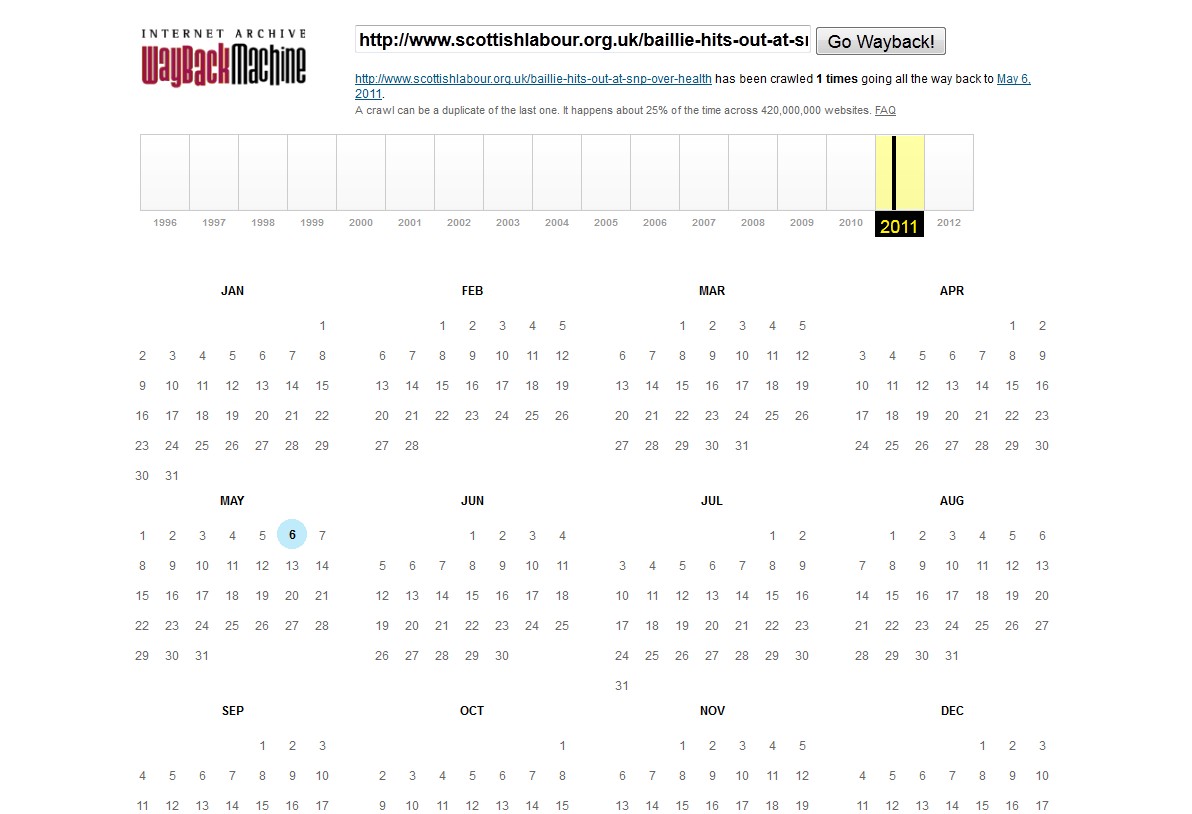
Because when we typed the page’s address into The Internet Wayback Machine for fun, we fully expected to find that the line about continuing free prescription charges had been deleted yesterday, or at least in the weeks since Johann Lamont made her infamous “something for nothing” speech.
Instead, however, TIWM listed only one previous version. While it’s not the sole factor, pages tend to show up on the archive site when they’ve been amended, and the only time the Wayback Machine had been called on to notice this particular page since its creation in November 2010 was on Friday the 6th of May 2011 – the day after the Scottish Parliament election delivered a historic landslide victory to the SNP, and an unprecedentedly humiliating defeat for Labour.
Results were still coming in on the 6th of May, but Scottish Labour had clearly already decided to eradicate mention of their promise to maintain free prescriptions. Now, it seems rather unlikely that the party convened a meeting of its executive committee, debated the policy, decided on a change and dutifully edited a page of its website while everyone was still digesting the scale of their defeat and/or catching up on some much-needed sleep after a long night of results.
(Indeed, it’s possible that the web page was changed even earlier than the 6th.)
The only reasonable conclusion it’s possible to draw, then, is that the policy was already internally a dead duck before election day. The party’s manifesto pledge (which can be found on page 41) that “with Scottish Labour, there will be no reintroduction of charges for prescriptions in Scotland” must therefore have been a deliberate and cynical lie, set to be abandoned even if the party won power.
It took almost 18 months from that day before Johann Lamont announced her “review” of policy to consider whether universal benefits like prescription charges would be retained under a future Labour government at Holyrood. The review isn’t due to publish its conclusions for almost two more years, and some prominent Labour MSPs have already suggested that free prescriptions will “probably need to stay” (despite the same member also describing them as a “right-wing policy”). But in the light of this evidence, we think it’s a reasonably safe bet what the final verdict will be.
Were readers to further conclude that it’s rather unwise – and perhaps even literally damaging to one’s health – to accept a word of anything Scottish Labour ever says at face value, we’d find it hard to disagree.
Tags: johannmageddon
Category
analysis, comment, disturbing, scottish politics
Yesterday we noted how Scottish Labour deleted evidence of an embarrassing policy U-turn from its website after it was highlighted by Alex Salmond at First Minister’s Questions. We suspected that it wouldn’t be the last example of the phenomenon, and sure enough we happened to stumble across this page earlier this morning.

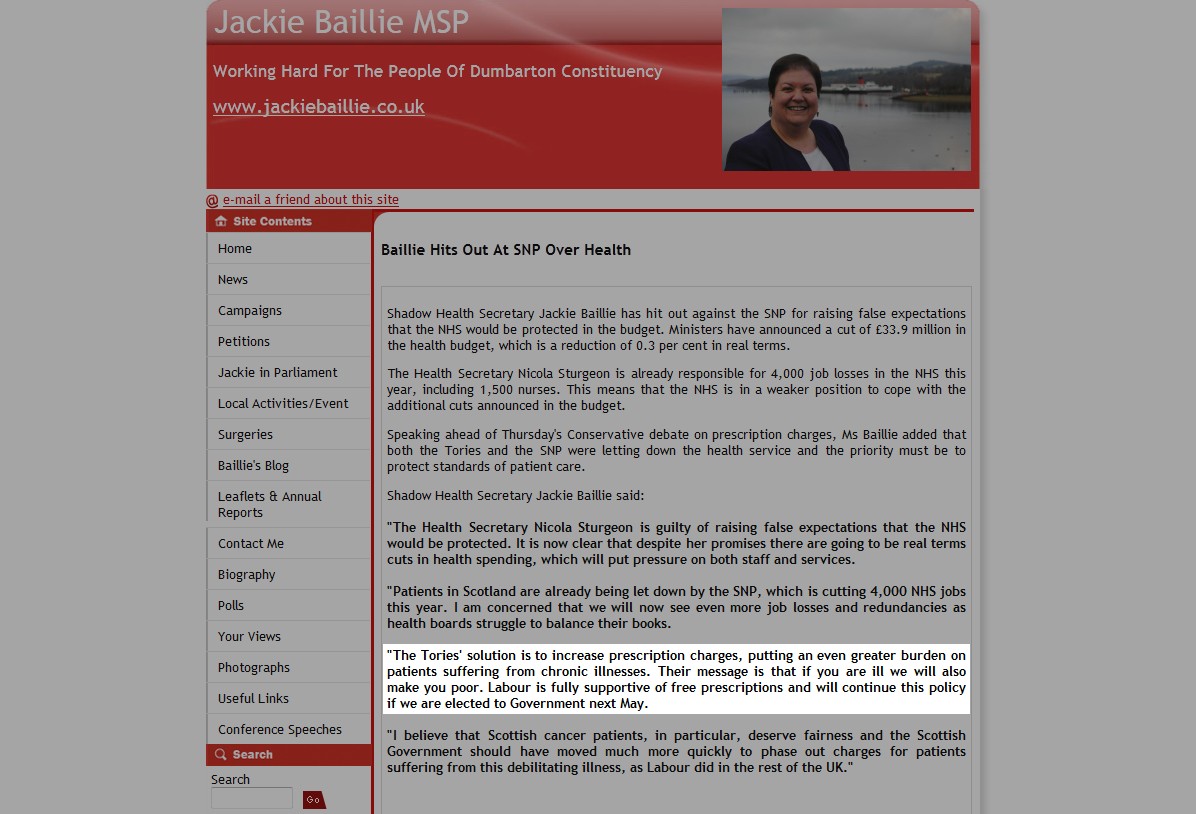
It’s a press release from before the 2011 Holyrood election, by Scottish Labour’s shadow health minister and serial fibber Jackie Baillie. But we noticed something seemed to be missing from it that we were sure we remembered. So we went and checked out the same press release on Jackie Baillie’s own website. In the quote below, the sentence in bold is a line still visible on Baillie’s homepage, but which is oddly missing from the Scottish Labour version.
“The Tories’ solution is to increase prescription charges, putting an even greater burden on patients suffering from chronic illnesses. Their message is that if you are ill we will also make you poor. Labour is fully supportive of free prescriptions and will continue this policy if we are elected to Government next May.“
The text of the two releases is otherwise identical down to the last word. Just that one solitary line has unaccountably fallen off the page in the journey between sites. We don’t mind telling you, readers, we’re completely baffled.
Tags: flat-out lies
Category
analysis, scottish politics