The Broken Rainbow
The image below is a graph illustrating how many seats each party won in last week’s supposedly “proportional” Scottish Parliament election, compared to how many they would have won if the electoral system had been actually proportional.

The SNP and Greens are now over-represented by 37% and 50% respectively, while the Unionist parties are all under-represented compared to their vote share by (left to right) 26%, 19%, 20% and 23%.
The Additional Member System has failed very badly at its job, from either perspective. “Pro-indy” parties have 73 seats (57%) rather than the 52 seats that their 40.8% vote share should have earned, while Unionist parties have 56 seats (or 43%) when they should have 69 for their 56% of the vote.
(The other 4% of the vote was scattered among 24 other parties or independents, with 1.8% going to identifiably pro-independence candidates, increasing the total “pro-indy” vote to 42.6%, fully 10 points short of current polling for independence itself.)
It is, therefore, a little bit of a stretch – to put it mildly – to present the refusal of the UK government to grant a second independence referendum on the basis of the results as an outrage against “democracy”. Indeed, if any outrage against democracy has taken place, it happened last Thursday.
The over-representation of the indy side is a combination of the unbalanced First Past The Post system that elects more than half of MSPs, and of pro-indy voters splitting their votes, mostly between the SNP and Greens, despite the SNP urging its voters to cast both votes for the SNP.
The differences between each party’s constituency and list votes are instructive.
SNP LIST VOTE
29% lower than constituency vote
LABOUR LIST VOTE
16% lower
REFORM LIST VOTE
6% higher
CONSERVATIVE LIST VOTE
0.001% lower
LIB DEM LIST VOTE
17% lower
GREEN LIST VOTE
612% higher
That’s not a typo at the end – the Green list vote really was more than six times their constituency vote, because they’re not actually a proper party like the others and only ran in half-a-dozen constituency seats.
Had each party’s list vote share matched its constituency one, the results would have come out like this, according to the Devolved Elections seat projector.

The “pro-indy” parties would have fallen one short of a majority. The other way round (constituencies adjusted to match the list vote), things would have been very different.
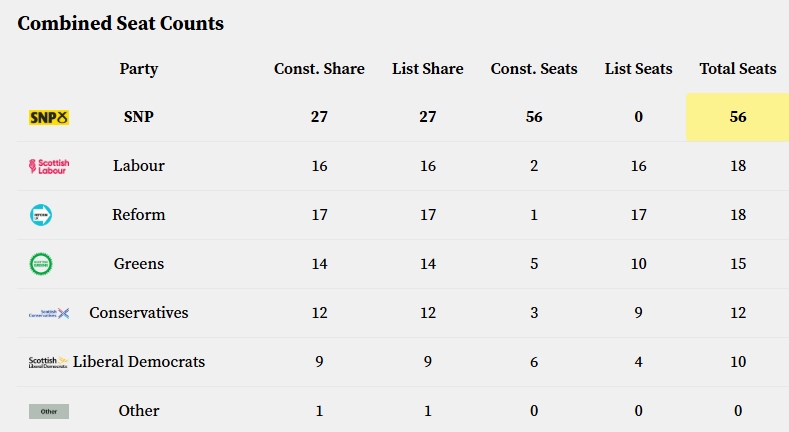
Tilting in favour of the list vote would have produced 71 seats for the “pro-indy” parties, an increase of 7 and a switch from minority to comfortable majority. Which is a stark illustration of what was already blindingly obvious to everyone even within touching distance of sanity or arithmetical competence – “both votes SNP” is a cretinous strategy if what you want is a majority of pro-indy MSPs.
The reason such a majority was achieved this year was because of the 250,000 SNP voters who didn’t also vote SNP on the list, not the 625,000 who did.
Now, that’s a purely statistical argument, not a political one, because a “pro-indy” majority of MSPs will make absolutely no difference to anything in terms of securing independence. We know that for a fact because there’s been one for every single day since the indyref, but it has achieved nothing whatsoever.
But don’t worry! The same mouth-breathing imbeciles who came up with that plainly demonstrable proven serial failure of a plan have another one for you!

Hooooooooo boy. Let’s just assess that one for a moment, shall we?
Firstly, as this site explained three and a half years ago, using a Westminster election rather than a Holyrood one as a plebiscite is monstrously stupid for a whole raft of reasons. The media coverage will treat Scotland as an afterthought because it’s only 8% of the country, and you’ll lose the heavily indy-favouring 16/17-year-olds and EU citizens who can vote in the latter but not the former.

(In fact, treating any single election as the plebiscite is dumb. It should simply be standing SNP policy that ANY time a majority of Scottish voters vote for parties whose manifesto says that a vote for them will be taken as a vote for independence, a clear and indisputable democratic mandate has been achieved. Of course it never will be, because the SNP is pathologically jealous of other indy parties’ votes.)

Using a UK election also prevents voters from separating the issues of the plebiscite and normal politics (because they only have one vote), whereas in a Holyrood vote you can say that the constituency vote is for independence and the list vote is for the actual election.
But secondly, you really do have to be an Olympic-class moron to imagine that the SNP are likely to be MORE popular in 2029 than they are now.
They’ve been in power for 19 years already, have record low approval ratings and have been haemorrhaging members and voters for the last half-decade. They won because the opposition was divided four ways, not because anybody likes them. Their vote share at this election dropped from 44% in 2021 to less than 33%. They’ve just elected loads of hopelessly inexperienced new MSPs. There’s a huge budget crisis thundering down the line towards them.

We’ve just had an election in which the SNP swore blind voting SNP would lead to a “100% guaranteed” referendum, and offered the electorate all manner of ludicrous bribes, yet over a third of independence supporters still refused to vote for the party, and 20% of indy supporters didn’t bother to vote for ANY pro-indy party.
In three years time the SNP can only conceivably be less popular than it is now, and the Greens are a pretend party who won’t be running candidates in the vast bulk of Scottish seats. The chances of achieving 50% of the Scottish vote in that election are less than zero. (They’d be doing miraculously well to get 35%.)
The infantile idea that the bogeyman of Nigel Farage as PM would be enough to boost that vote by half again is embarrassing. We were told the same about Boris Johnson, and about Liz Truss, and about Brexit, and about COVID and about Theresa May’s refusal to grant a Section 30 order, and etc etc etc. It never transpired. The dial never moved an inch.

The prospect of a Reform government in Westminster was baked into THIS election, Swinney never shut up about Reform, and it still only got the SNP constituency vote to 38%. Neither Alex Salmond nor Nicola Sturgeon achieved 50% in an election even at their respective peaks, and John Swinney ain’t no Alex Salmond nor even, God help him, a Nicola Sturgeon.

So there is NO chance, not a ghost of a crumb of an atom of a hope, that the SNP can secure 50% of the Scottish vote in the 2029 UK election. Even the indy movement’s very thickest dungwits know that in their hearts.
Why, then, they’re urging us to rush headlong to what would be an utterly catastrophic defeat is something you’d have to ask them, because we can’t unhinge our minds far enough to put ourselves in their shoes.
There is no pot of gold waiting for us in three years’ time, only the sort of pot you used to find under the bed, full of the stuff they’re talking.















EMBARRASSING ARITHMETICAL ERROR CORRECTED.
Watch yourself Kelly’s Eye will be crowing from the rooftops about the mistake, but he won’t admit he conned everyone to vote for the SNP twice and Swinney still lost.
He’s now on with forget about the Holyrood election and go for Independence in the coming Westminster election in the mean time I’m crowdfunding so please donate.
He’s a real Arseset
It made zero difference to the point anyway. But gah, too many numbers flying around at once.
The AMS makes the overall result less disproportional rather than more proportional.
It mitigates the winner tale all FPTP element of the voting design and acts as a corrective.
It is certainly not perfect – far from it and it wouldn’t be my first choice of a voting system – but if the results had been based purely on the constituency ballot the disproportionality would have been even worse than the final (joint ballot) outcome.
But that’s not the alternative. The alternative is a proportional system that actually works.
I didn’t say it was an alternative. I said it was imperfect but less imperfect than FPTP.
Otherwise you would have had 78% SNP MSPs on 38% of the popular vote.
There are options, including Single Transferable Vote used in council elections.
Interesting, Stu, that you peg the 2026 vote for the Indy parties (even nominally pro-Indy) at 42%.
Because the latest poll (IPSOS, May 4th) puts the “Yes” vote for Indy at …. 42%. With 46% voting “No.”
Oh and I forgot to add that in addition to my 8 year old grandson being taught about lesbian and homosexual relationships, the class was also told about how to wipe their bottoms.
Not too young to be told about same sex relationships nut not too old to be told about bottom wiping.
Considering how many kids go to school in nappies nowadays, and nappies for 8 year old are also more popular than ever, I think teaching kids how to wipe their bum is probably the least mental school innovation in recent years.
Link to the latest poll,campebll?
The latest I see is from the Sunday Times and os a Yes majority?
You’re factually wrong.
The Times/Norstat poll of April 30 was not the “latest” poll–the IPSOS one of May 4 (the one that I cited) was.
Your facts are as accurate as your spelling (“campebll” “os”).
O what a tangled web we weave…
Then when the planned showdown in the 2029 General Election goes nowhere, there will always be the 2031 Holyrood election as the grandstand to force Westminster out of the bunker. And so it goes on.
Ever since 2016, the SNP’s policy has basically been to kick it down the road for two years at a time. That’ll continue ad infinitum.
This policy of kicking Indy into the long grass is now showing in the opinion polls for the SNP.
There is something really smelly about the SNP, I for one believe its rotten to the cure and isn’t worth saving.
But the interesting thing is no one in Scotland could get the SNP to make any effort to even speaking about Scottish Independence for the last 11yrs and now all of a sudden Reform has come into town the SNP is speaking about Independence.
If Reform leadership screwed had their heads on right, at the next Westminster election they could say to the Scotland voters for Reform and we’ll guarantee you a referendum this is something the SNP can never do and even if the SNP win 57 MP and send them to Westminster all we’ll do is ignore them, after all we promised you a referendum and you chose to pick a party that can’t deliver a section 30 order. Reform could destroy the SNP and bury them for good.
We are actually getting to the point that no one really believes the SNP on Independence and JS fake two votes SNP has made their credibility even worse.
Who on here would vote reform if they promised a referendum in the up Westminster election I would.
Reform wouldn’t offer Independence. They certainly wouldn’t deliver on it.
They’d not let the UK cash cow just walk out the door & take all that free energy & resources with it.
@Geri
Polling evidence is clear enough.
If a Reform government offered us a referendum next week, a majority of Scots would vote No.
It’s us that wouldn’t deliver – us free, Sovereign Scots.
Deal with it.
That “free energy & resources” exists only between yer lugs.
Polling means absolutely zero. It can be manipulated, rigged, depends on how the questions are asked & who exactly is doing the counting.
Larry Johnson, ex CIA analyst, admitted they’re manipulated all the time. They’re to influence opinion. They’re not a guarantee of anything.
Under the current COLONIAL administration we probably wouldn’t win but I’m sure a campaign would fix that. The SNP wouldn’t be in charge of an independent Scotland. It’s only a political party following colonial orders. That’d change.
Independence is forever. Not just for five years.
Reform will soon have everyone marching to war. They’ll be too busy with the crypto to be offering Scottish Independence.
Fish Face is anti Scottish Independence. He’d shit himself. Their overseas Hegemony is over without losing the Scottish pay packet too.
Man, Geri, but yer gas is at a low peep. I almost feel sorry for you, knocked as flat as you obviously are.
Almost!
Your arguments “by numbers” aren’t working. Your lack of conviction shines through every line.
Take some time out, go tinker with your gas chamber plans, or mull some other extermination scheme for the normies who stand in your way.
You’ll feel a lot better.
Lucky for Scotland that the boys petitioning the UN make all of this democratic voting malarkey a pointless sideshow.
Beats me why Rev Stu chooses to ignore where it’s all happening, at the UN.
Anybody ken when the UN will hand us Indy? I need to make plans and I expect most of the other readers BTL do too.
Colonialists in this place very often mistake disruption for cleverness and noise for wit, but “the stone knows the difference”, as the Picts say.
Good Lord, Northy!
So even the Picts are now using the lying language of the coloniser – English.
Has anyone watch the mid week Scottish Prism, take a look. Already JS has backed track on what he said he would do, no surprise.
John Swinney will now sell Scotland for federalism make no mistake this is what’s going to happen. The SNP leadership will promote it to the membership and The National will sell it to Scotland, we have all be taken for a right fool if we let them, Independence and nothing less.
The problem with federalism is that Westminster would never agree to Scotland, Wales and NI having equal representation. Little states in the US have the same voting rights as the big states. After that, England could devolve itself into a federation of regions and cities. What they would try is to federalise are the English regions and cities so that they had equal voting rights with the three satellite parts – i.e. Scotland, Wales and NI which are countries not regions. Beware!
Not seeing that at all, Lorncal.
Scotland is just as much a group of regions as England is.
The Borders, the Central Belt, the Highlands & Western Isles, the Northern Isles. There’s at least 4 regions. Different histories, different languages, different religions, different political outlooks.
An England of devolved regions would work fine with a Scotland of devolved regions. It’s a peculiar blind spot suffered from by most Indy supporters that leads them to believe that Scotland is a naturally unitary political and geographic entity.
It’s not.
well- the only way to fix it would be to “true” proportional representation, as in the German Bundestag. Problem with that is, it would inflate the number of parlamentarians (as it does in Germany to the taxpayer’s expense) and create even more MSP’s who don’t really represent any constituents but sheep-vote for the party.
bottomline: yep, the skewed outcome is galling, however, the alternatives (FPTP vs. “true” proportional representation) are impractical (the latter) or worse (the former)
DRAFT ‘CONVERSION THERAPY’ BILL IN KING’S SPEECH AGAIN
The Government has repeated its pledge to bring forward a draft Bill to ban so-called conversion therapy under its plans for this parliamentary session.
In the State Opening of Parliament, King Charles III announced that a “draft Bill to ban abusive conversion practices” will be brought forward in England and Wales. This was also pledged in the July 2024 King’s Speech, but a Bill was never published.
The Government claimed that its conversion practices proposals, which as a draft Bill would receive pre-legislative scrutiny rather than going through the process of becoming law, are not “intended to interfere with people’s right to religious belief and expression”. But church leaders recently warned that such a law could “make sharing the Gospel with some people illegal”.
‘CRIMINALISE DISAGREEMENT’
Joanna Timm, Senior Public Affairs Officer at The Christian Institute, commented: “This was an opportunity for the Government to call time on these deeply divisive plans. There is abundant evidence that the LGBTQ+ activists who want a conversion therapy ban want it to criminalise people who disagree with their ideology.
“There are already robust protections in law against abuse and coercion. Legal advice is clear that expanding the current law risks criminalising things that should never be made illegal – such as a mother urging her gender-confused daughter not to have a double mastectomy, or a church leader praying with a member of their congregation who asks for prayer about sexual temptation.
“We need only look at the Australian state of Victoria’s conversion therapy ban – which activists here call the ‘gold standard’ – to see that it is about regulating everyday speech.
“Not only is it unlawful under Victoria’s ban not to affirm a person’s declared gender identity, but official state guidance on how to comply with the law tells Christians how to pray, and what they can and cannot teach. At one point, it even said a parent discouraging their child from taking puberty blockers would be guilty of unlawful conversion therapy.”
UNWORKABLE
According to ITV, the Government halted its plans last year due to concerns around religious freedom and parental guidance.
The previous Conservative Government also acknowledged the difficulties of such measures, noting in its 2024 manifesto that “legislation around conversion practices is a very complex issue, with existing criminal law already offering robust protections”.
The manifesto emphasised that more time should be taken before “reaching a final judgement on additional legislation in this area”.
In Scotland, a 2024 Government Bill on conversion therapy was dropped after a hostile response from lawyers and the public.
(The Christian Institute, 13 May 2026)
link to christian.org.uk
The UK is heading towards a Totalitarian state where this ideology will seep into every single persons private life & every sad jobsworth will do their civic duty to shop in their neighbours.
As we can see from on here alone – the saddos would have the Gestapo up & running in no time.
I don’t think there can be any reader, however slow or uneducated, who isn’t full aware of the linkages between the Gestapo and the gas chambers.
You’re on record here as being enthusiastic for gas chambers to deal with Scots whose opinions you dislike.
You’re not going to be allowed to pretend otherwise.
I have no doubt that if you thought you could dob in your neighbours for the Gestapo to round them up and herd them into the gas chambers, you’d do it in a heartbeat.
Shiteface,
That was just for you. Cause you’re special.
Don’t you be adding a crowd now. You’ll take that lonely walk on yer own.
I don’t think there can be any reader, however slow or uneducated, who wouldn’t agree that yer in desperate need for a little something that’d put you out of all our miseries.
Sven,
Of course it wouldn’t work both ways.
This is to criminalise the non believers to the Church of LGBTQWERTY++++ It’ll be an offence to talk to your own children about sex. Even in the comfort of your own home, that’ll be the States job & they’ll encourage children to dobb you in to yer nearest
HitlerYouth officer.Don’t ever pause for thought on the street if yer lost either. The thought police will ask if yer praying & call in the swat team.
We all know who is behind this crap. The Church of Satan wants to eradicate religion. There’ll be none of that moral compass & conscience malarkey. It’s full steam ahead with Jenny & don’t be bothering them with things like worship & what’s right & wrong.
I find it amazing that ppl like shitface can cheer on the trashing of religious sites, smashing religious statues, take a shit on alters, head chop Christians, persecute nuns & priests & think we should all support them cause they only mean over there, the brown ppl, & couldn’t possibly follow him home wearing another guise.
It’ll be interesting to see what Chucky does. The supposed defender of the faith. If he’ll open the door to this nonsense.
“There’ll be none of that moral compass & conscience malarkey”
Knock out comedy comment of the day. Not for the first time, it’s from Geri.
A high bar set too. I’m thinking nobody will top it afore midnight.
Unless it’s Geri treating us to a twofer.
Fearghas MacFhionnlaigh 00.31.
I wonder if that would cut both ways, Fearghas. Would, for instance, someone disagreeing with Christian or Islamic belief and saying so to a devout believer be in danger of offending.
My own feeling is that whilst I’m sure many would feel free to accuse Christians of that hackneyed oft repeated trope of “your imaginary friend” it would be a singularly courageous (or exceptionally foolish) humanist who entered into debate with a follower of Islam to argue they were mistaken and should change their way of life.
Great post, Sven.
I believe you’re getting close to the “great revelation”.
The understanding that because of the ongoing practical alliances, within western democracies, between genderwoowoo and Islam, the intended dual purpose of “Anti Conversion Therapy” is that it will be used to protect both the genderwoowoo and Islam.
If the legislation makes it onto the statute books, it will inevitably be hijacked by the facilitators of the religion of peace to shut down any criticism of their subversion of western democracies and western, Christian-based value systems.
Then we will all, too late, weep and wail about “unintended consequences”. But of course, those consequences were baked in from the start.
As I see it, the solution is a simple one. Reform need only state that on coming to power, they will repeal all such legislation on Day 1.
Perhaps Day 2, as there will be rafts of other legislation to be repealed!
Sven/HMcH: it is less the gender woo woo and Islam that has united as the ultra left and Islam. Each is using the other for its own ends and agenda. Neither would be a pretty state of affairs for Scots, or, indeed, Brits, or Europeans, or the West, in general.
The fact that Western democracies have all protected this alliance should be a matter of deep concern, but, oddly, it isn’t – not for our rulers. Ergo, it must be a state of affairs that they support – or think that they support. Why? Globalism. Removing all barriers, all borders, is the goal of the billionaires who run the show and for whom our political elites dance like puppets.
All that porous or open borders does is encourage vast movements of humanity and the lack of any intent to try and solve domestic problems where they arise, mainly in Africa. It has been suggested that China, which has a strong foothold in Africa, encourages the movement of peoples to the West, but that might just be lazy thinking.
The real problem for us, apart from the ever-increasing numbers of one demographic coming these shores, is that most are not actually prepared to integrate and assimilate, either in any cultural or religious ways. The UK, and Europe, consists of very old countries with democracy of a kind; they are not America, Canada, Australia or New Zealand which were classed as ‘young countries’ (albeit with indigenous populations who did not fare well under colonialism). Sheer brute strength overcame these indigenous populations.
What we are facing is the whole ‘woke’ gamut that is destroying us from within – post modernism – whose entrenched aim is to tear down all that existed before and rebuild. Year Zero. People who came here in the past – the Flems, the Huguenots, etc. – all kept their cultures and languages for little more than a couple of generations, and then assimilated and integrated, so that, without DNA testing, we couldn’t pick them out today.
Islam is different in that it is a political movement before anything else, and it cannot be separated into ‘state’ and ‘church’ because it is both, just as Christianity was five hundred or more years ago. The greatest outward statement of what Islam proposes here is shown every day in its female attire – the niqab, the burqa, etc. These are political statements far more than cultural ones. These were never seen before on British streets until recently.
Reform and the Tories are going to have to ally again – even become one party – if they are to have any hope of challenging the more blatant challenges from Islam and the ultra left, and all the other parties, running around like hens when the fox is in the vicinity, need to tackle the worst aspects of ‘wokerie’ if they are going to help their people. ‘Wokerie’ is not the distraction.
It is the aim that will usher in huge demographic and political changes, destroy our ability to stand up to their incursions. Independence cannot and will not fix the problem. It will take another ‘Reformation’, on the philosophical/political front this time, an alliance of the middle-class and the working-class, because the middle-class is about to feel the cold winds of reality, too, but has the middle-class the appetite for that? The working-class certainly has. Another ‘Enlightenment’, following on from the ‘New Reformation’, would become a reality, as night follows day, but both would be very different from the past.
“Ergo, it must be a state of affairs that they support – or think that they support”
They are largely content as long as it is the “great unwashed” who suffer from the results.
The answer, as the founders of the Labour Party understood, is to have grass roots politicians who rise to power on grass roots support, and who retain the integrity not to sell out.
Our ancestors could do it, so why can’t we? Our ancestors fought and overcame far greater barriers, so why can’t we?
I suspect the answer to that one is that we are not the men and women our ancestors were. Two generations of aversion to graft, and fondness for unearned handouts, have reduced us to dependency and powerlessness.
We are now fit for little more than sitting, greetin and gurnin, on our flabby erses, while more aggressive and sharp-elbowed thieves steal our birthright.
Can Reform turn this around? I don’t know, but they are the only ones making a serious case for having a try.
Thank you for highlighting this Fearghas.This needs to be publicised as much as possible.
SCOTS PRIMARY SCHOOL CHALLENGED OVER FAILURE TO PROVIDE SINGLE-SEX TOILETS
A pupil has been left in pain and distress after refusing to use her school’s gender-neutral toilet facilities, Scotland’s Court of Session has heard.
The child’s parents launched legal action against West Lothian Council over East Calder Primary School’s policy not to provide separate toilet facilities for boys and girls.
Officially opened in 2024, the £18.3 million facility includes mixed-sex toilet blocks with lockable cubicles and communal sinks.
GIRLS ‘DISADVANTAGED’
The family’s advocate, David Welsh, told judge Lady Poole that the girl “has been refusing to use the toilets in school”. He added: “Instead, she has been forcing herself to wait to use the toilet when she returns home.”
East Calder’s gender-neutral facilities were, he reported, an “intimidating, humiliating and hostile environment”. He also said that it was “reasonable for this girl to want to be able to go to the toilet without boys being there”.
Welsh added: “The school is trying to treat everybody the same, but has put one particular group, girls, at a disadvantage.”
Janys Scott KC, representing the council, claimed the facilities were legal as some cubicles carried ‘gendered stickers’. Consequently, she argued, setting up separate gendered lavatories was unnecessary. Children, she stated, had also been told they “could use the staff toilets if they didn’t want to use the toilet block”.
COURT RULING
Last year, at the Court of Session, Lady Ross KC issued an order reminding schools of their legal duties under the School Premises (General Requirements and Standards) (Scotland) Regulations 1967 to ensure that there are an equal number of facilities for both girls and boys.
The order followed the successful outcome of a judicial review by Leigh Hurley and Sean Stratford, who challenged the Scottish Borders Council’s decision to only install ‘gender-neutral’ facilities at their son’s primary school.
Gilson Grey, who represented the parents, said: “The court order makes clear that the 1967 regulations apply to all state schools in Scotland.
“There is no provision for gender-neutral toilets in the regulations. Any school not complying will be in breach of the regulations and could face a legal challenge from parents.”
(The Christian Institute, 13 May 2026)
link to christian.org.uk
“Children, she stated, had also been told they “could use the staff toilets if they didn’t want to use the toilet block”.”
——————————————————-
Interesting – does that mean that the pupils toilets are gender neutral but the staff toilets are not?
I’d print up leaflets & let every pupil & parent know they can use the staff toilets.
Let the teachers use “stickers”
Whoever authorised these toilets against Building regulations should be sued. Maybe once these eejits start having to pay back public funds they’ll think twice about pushing their stupid ideology onto ppl who don’t want it. Girls & boys require their own space.
All part and parcel of the vicious woke agenda that increasingly infects evey aspect of our lives. You get what tge wacko wokes dictate and hell mend anyone who objects.
My eight year old grandson came home from school yesterday and when asked what he was doing at school today he told us that he was being taught about gays and lesbian and how it was normal for men to have sex with men and women to have sex with women. Said he was also told how it was normal to have two men or two women as parents. Not quite sure how that will play out in a young mind. Frankly at eight years and four months of age he has more important things to learn than that. But at least he didnt get the jar of Nutella and banana
video, or at least not yet.
On mentitioning this to a friend who had been a teacher for forty years she told me that she refused to teach this to five year olds, and to which the response was we willjust get someone else then, and her card was marked. Just like nurse Sandie Peggy.
This is just another example of the vicious nasty vindictave culture of the woke brigade so much in control, where in our grandson’s case the parents have no rights.
It is post modernism and queering in action, Willie, and they have hooked themselves on to a kind of cultural Marxism, all appealing to the young and slow of thinking. Most of post modernism is based on the philosophers, such as Foucault and Derrida, that post modernism apes, who were PDFiles or oriented towards children. The whole movement is designed to upend all barriers and borders across the board.
Most people still don’t get it. They still think they are being kind and it all makes them feel virtuous. It is not accidental. We have seen the extraordinary lengths both men and women will go to, to gain access to sex with whatever and whoever. In the end, it is less a political or social movement than a sexual one with the ultimate aim being to make access to children, even very young children, legal.
Women are the first hurdle to be overcome, and the men who want unfettered access to women have led the way. It makes not a jot of difference if they are cross-dressers or AGPs or fetishists – the aim is the same. No technology can actually make people behave in ways that are not in them: it can draw out the darkest desires and lend them a cloak of legality and acceptance. Once the sexual barriers are well and truly destroyed, the rest will follow. It is fair to say that women, children, young boys, animals, gays and lesbians will all be in the firing line as being the impediments to total freedom to behave as one likes.
The aim is to make it impossible to get a job unless you sign up to all of this stuff; to make it impossible to hold any top post in any institution, in politics, in any aspect of society at all at any and every level. That is why I keep saying that independence alone will not and cannot change anything unless this is rooted out BEFORE independence.
“Children, she stated, had also been told they “could use the staff toilets if they didn’t want to use the toilet block”.
I’d put that on a leaflet & distribute it to every single girl in the school & their parents. They’d maybe change their mind when everyone suddenly starts using the staff toilets.
Let the teachers use the unisex – they have stickers.
See how they like it.
Why two different interpretations of the law? Janys Scott KC, Lady Ross KC? The building shouldn’t have strayed from building regulations so why is Janys arguing about it?
Whoever authorised for a new build to have shared toilets should be sued. Maybe once these roasters have to pay some money back to the public purse to help towards corrections they’ll think twice about pushing their stupid, depraved ideology onto everyone else. Both sexes require separate spaces.
REALITY: the latest poll (IPSOS, May 4th) puts the “Yes” vote for Indy at …. 42%. With 46% voting “No.”
The SNP has been successful at winning elections and keeping themselves in power (if also a failure at governing), all the while pushing Indy to the background. What incentive do they have to change this formula, which (so far) has kept them in office enjoying all the perks of office? What incentive do they have to push an issue supported by only 42%?
“Using a UK election also prevents voters from separating the issues of the plebiscite and normal politics (because they only have one vote), whereas in a Holyrood vote you can say that the constituency vote is for independence and the list vote is for the actual election.”
Chuckled at using “normal politics” term in the UK context.
In the supposedly equal Union that is the UK, The Kingdom of Scotland’s democratically expressed will has not got the political power to counter the ten to one democratic deficit the Kingdom of England holds.
Scotland gets what England votes for, and it has been proven that playing along with the system of attending Westminster for every parliamentary term to influence positive change for Scotland within the UK and giving legitimacy to ongoing London Rule is a pretty pointless waste of an electoral process for Scotland.
Endless chatter about how the NuSNP continue to position themselves for future elections avoids dealing with the elephant in the room issue that we will be going nowhere unless concerted efforts are put into building a credible political alternative to take over from the fully captured NuSNP.
We’ve just had yet another “Scottish” election with more English based parties standing than Scottish ones. So loads of wee cuckoos get into the bigger cuckoo’s nest created by Westminster’s Scotland Act.
All done with the bastard child voting system that is too complex for the politically dumbed down Scottish electorate to understand, and which facilitates the electing of various serial failures and grifting loonies to deliver our “normal politics” of not getting what we voted for and having a load of bullshit we didn’t vote for foisted onto us instead.
England doesn’t have its own national Elections and just hijacks the UK elections for itself so is spared the electoral fatigue the devolved nations have to endure.
Using a GE for Westminster where constitutional matters reside as a plebiscite only needs to find 56 pro-indy candidates using a much simplified “End the Union” message for the voting electorate to comprehend and get behind.
It’s baked in that the UK MSM doesn’t promote Scotland’s voice in a conventional UK election campaign, but that’s where all these supposedly big name Indy bloggers would come in as a unified group and force the issue to prominence and have the UK MSM fighting on both fronts of trying to ignore Scotland but at the same time trying to cover that Scotland was utilising the election as a legitimate democratic expression to End London Rule and return to self-governance.
The UK is content to utilise the more restrictive voting franchise for its elections, and discussion on it has been done to death with simplistic cherry-picking or disregarding of certain aspects to suit whatever agenda is trying to be punted.
“Using a GE for Westminster where constitutional matters reside as a plebiscite only needs to find 56 pro-indy candidates using a much simplified “End the Union” message for the voting electorate to comprehend and get behind”
Is it 2 years or 3 years since I first called for that?
I recall also saying that the HR election just past was the perfect forum to trial the concept. Regardless of whether or not it would work in the wee, pretendy parliament, it was a perfect crucible to get the idea lodged in the consciousness of the Scottish electorate.
A wonderful dress rehearsal for the real thing – use of the concept at the next WM GE.
Must be my faulty recollection in play, but zero, nix, nada support or follow up came from anybody.
I’m pretty sure that was Alex Salmonds plan, like, ohhhhh, at least 2017 onwards. In fact, I think that very idea is what drew the knives out for him ever returning to Holyrood & kicked off all the fake charges.
Then Angus B MacNeil at conference…
I seem to recall it even being given a name…..hmmmm
Oh -that’s right! Plan B!
Then during the leadership contest, Ash Denim also put it on the table..
So away yeh go ya wee naff. Stop plagiarising it was your idea..
HMcH
I honestly don’t recall you ever saying that or anything else positive or proactive for that matter.
I have stated the Westminster route for quite some time (referencing Thatcher) and some have engaged in debate, for or against. Don’t recall you saying anything (positive at least).
Hey ho, given the sheer quantity of drivel you swamp this site with I suppose it would challenge anyone to remember all the keich you’ve ever so kindly made public by sharing here..
Ah, one last thing;
Ya sophist catamite..
Far be it for me to attempt to convert you from your natural instincts, YL, but it’s entirely likely that any attempt by you to post sanely and persuasively on any subject whatsoever is drowned without trace by your obsessive wanging oan aboot shirt lifting.
Your most recent post demonstrating your unhealthy obsession beautifully.
You should ask a friend or family member for their opinion on what it is that exercises you so much, that you see catamites everywhere you look.
Although, be warned, you are unlikely to care for an honest answer.
Still, YL, you must try to be a brave wee sojer. The truth will set you free.
“during the leadership contest, Ash Denim also put it on the table..”
But she was two cloth-headed to make a go of it (boom boom)..
And her opponents tore her several new (fashionable) rips in the knees (boom boom)..
Sorry, Geri, I only just noticed you’ve already treated us to a twofer today. My bad for not reading your humorous efforts properly.
Do Ash Regan next (boom boom)..
HMcH
Classic non response, play the man not the ball, served up with a huge dollop of deflection topped off with lashings of projecting..
Catamite; c’mon, be all “modern man” and own it, you know you need to. It’ll stop it getting under your skin so very very predictably easily 🙂
Treichery… and televised treichery in full public view, anaw.
Under the Promissory Oaths Act 1868, the wording used at Holyrood – the hert o treichery in Scotlan – is the same as for other UK (English) public offices:
Oath of Allegiance
“I swear by Almighty God that I will be faithful and bear true allegiance to His Majesty King Charles, his heirs and successors, according to law.”
Or.
Solemn Affirmation (non?religious alternative)
“I do solemnly, sincerely and truly declare and affirm that I will be faithful and bear true allegiance to His Majesty King Charles, his heirs and successors, according to law.”
MSPs may choose either form. They must also sign a written version after speaking it aloud.
In truth the oath isn’t really about monarchs; it’s a way of saying: “I recognise the legal authority under which this parliament exists.”
And of, course, the legal authority that sits above Holyrood’s parliament in colonised Scotland is England in the form of Westminster’s parliament.
Christ Almighty, ivery wan o Scotland’s MSPs are sweirin lealtie tae Ingland… a foreign power.
Sae, treichery, baith spakit and writ doun… sic treichery that maks a travesty oot o aw whits Scottish; and especially so of those ‘free and democratic’ elections held just a week ago.
Aye Northcode, the ‘Manicheaism’ of colonialism on full display:
native elites switching between two psychical and cultural realms – i.e. those of the colonizer and the colonized;
as they attempt to do the impossible, to serve twa maisters;
tho inevitably they must sacrifice one in favour o the ither, that of thair ain subordinated fowk an cultur;
because in a colony it is only the ‘values of the colonizer that are and remain sovereign’;
and those who believe this charade alters oor colonial reality may also believe ‘the moon is made of cheese’;
Parliamentary ouf’s:
link to scottishparliament.tv
“ivery wan o Scotland’s MSPs are sweirin lealtie tae Ingland… a foreign power”
Except that even a backwards primary school student could probably fathom out they’re swearing “faithful and true allegiance to His Majesty King Charles, his heirs and successors, according to law”
Crivens Northy. Is their any language you could pass ‘O’ Grade in?
Any at all?
Elected as MSPs one week ago, Gethins and Flynn resign their seats.
in the elections that will follow you can bet your boots at least one seat will change hands.
Fishy?
Fishy Sam ? Just because these plaicemen have moved to be larger fish in a smaller pond who could possibly question their motives.
Resigned from Westminster. Ooops.
Nevermind the post colonials here come the Counter revolutionaries!
Comrade Starmer has been betrayed by the Prada parade. Death to Traitors!
Anyone for a General election?
Anyone want to bet folding money on his successor lasting until 2027?
Dear Lord, I trouble you but rarely, but please grant us all this favour:
Let it be the Ginger Growler!
What about the High Priest of Windmills? You know everybody loves Ed!
No way, Mark.
The GG is playing with a deck containing several victim cards.
It’s gonna be a delight watching the MSM and the woke, chattering classes tip-toeing around all the potential mines that will explode any time they say something derogatory about her.
Millipede is not holding any cards at all.
Ach, everybody knows that you are carrying a torch for the fiesty, foxy, flame-haired financially-furtive Angie. You might as well confront your feelings and ‘fess up, sonny boy. We will do our best not to cast any judgement 🙂
Carrying a torch am I, Minceheid?
Get your eyes tested. That’s no torch!
A bit off topic but talking about lunatics is maybe not so off.
Do you think World War 2 would have worked out differently if everybody called Germany Daddy land?
Mark Beggan @ 14.26.
I trust that the result would have been the same had it been called Diddyland !
Daddy and the Third Attempt. Nipple is the capitol of DaddyLand. The Leibstandatre Division would be called Daddy’s Little Helpers.
WW2 was a distraction from the unfinished business of WW1.
The news from Germany, as they pour money into re-arming, is that the intend their third shot at the Orcs to be the decisive one.
I’ll be cheering them on.
They almost defeated all of Europe single-handed the last time. Only the intervention of Uncle Sam stopped them from being victorious.
Next time, Uncle Sam will be preoccupied elsewhere.
The Art of War.
Page one, paragraph one, rule one:
Don’t invade Russia!
Operation Barbarossa lead to the downfall of Germany.
Germany lost the vast majority of its troops—approximately 80% or roughly 4 million soldiers—on the Eastern Front against the Soviet Union between 1941 and 1945. The intense, prolonged combat in Eastern Europe and the Soviet Union proved to be the most devastating theater for the Wehrmacht, far exceeding casualties in Western Europe or Africa.
All true, x, but as I wrote earlier, there would have been no “downfall of Germany” if the USA hadn’t glutted the Orcs with war materials.
If you don’t believe me, just try to explain what’s going on now. Into the fifth year of the war in the east, and plucky wee Ukr, glutted with war materials by the west, has fought the Orcs to a standstill.
As somebody smart once observed, in a war of attrition, quantity outclasses quality every time.
@Hatey
The Sherman tank was the quantity over quality. Often referred to as the “Tommy Cooker” by the wermacht.
The soviet soldiers on the Eastern front, when opening a tin of American spam, would call it the ” opening of the allied second front”.
“I’ll be cheering them on.”
There’s a surprise, grand dad.
From the safety of yer bedsit, no doubt.
I’m glad you’re finally admitting on a public forum yer a Nazi.
& Talk about being thick, lol! The Germans were taking the British Empire. Uncle Sam swooped in at the end & took it from them instead. D.i.s.a.p.p.o.i.n.t.e.d!
Young Lochinvar has had his hand up for attention since 2:15.
He needs somebody to take him to the bogs.
Tell him he’ll just have to wait till the Scottish government makes a decision about the decision of the Court El Supremo.
Tie a knot in it!
Over 2 hours now, Mark.
Best ask the jannie to bring a bucket of sawdust.
HMcH
I know I told you to own yer homosexuality but hadn’t expected an invitation from you to go to the bog!!
Er, that’ll be a NO.
SNP Kenneth Gibson now takes his place in the presiding officer’s chair.
That reduces the SNP voting power by one in the Scottish Parliament (unless it goes to a tie when the PO has the casting vote).
STUDENTS TO ENCOUNTER ’HARMFUL’ TRANS IDEOLOGY IN GCSE MODERN LANGUAGES
GCSE students will be encouraged to use French, German and Spanish ‘inclusive language’ under course guidance that comes into force this year.
Guidelines from Edexcel, one of the largest exam boards in England and Wales, includes a section on the ‘use of gendered language’ within its 2026 specifications and endorses Stonewall’s ‘Creating an LGBTQ+ Inclusive Secondary Curriculum’.
In a Spanish revision guide, students are asked to translate the sentence “my brother is transgender and happy”, while a vocabulary list “about yourself” includes words such as “non-binary” and “bisexual”. It does not, however, mention the terms male or female.
STONEWALL
The exam board, which is owned by the publisher Pearson, will allow students to use “non-binary pronouns, the equivalent of ‘they’ instead of ‘he’ or ‘she’ in English” and “gender-neutral nouns, whether indicated by adding punctuation, asterisks or using alternative spellings”.
In Edexcel’s 2021 video on gender, diversity and inclusion in languages, a Languages Subject Advisor tells teachers to “take a look at the Pearson Stonewall inclusive curriculum guide for secondary schools. This offers suggestions on stepping up as an ally to non-binary people as well as guidance on the use of language.”
Writing in the guide’s foreword, Pearson’s President of English Language Learning, Sharon Hague, emphasised that “Pearson is proud to sponsor this Stonewall guide” and it is “important to go further” than ensuring “there is no anti-LGBTQ+ language in schools”.
‘IDEOLOGY BY STEALTH’
David Bromley, an Education Officer at The Christian Institute, warned: “Pearson is abusing its ownership of an exam board to embed gender ideology in the curriculum by stealth.
“This undermines schools’ clear legal duty of impartiality, the integrity of education and exposes children to an ideology that has done profound harm. It places teachers, parents and pupils who disagree, for religious reasons or otherwise, in a very difficult position.”
In response to media attention, a Department for Education spokesperson stated: “Our expectations are clear: gender identity is an area of significant debate. Schools should not endorse any particular view or teach it as fact – including the idea that all people have a gender identity.”
FREE SPEECH
In a GCSE revision guide for citizenship studies, Edexcel also claims that “Gender can change individual identity. For example, an individual born in one gender might choose to change to another gender, with changes in appearance, clothing, and practical aspects such as which public toilets they use.”
Under examples of discrimination, the exam board claims that it is “gender reassignment discrimination” to only provide toilets for “men or women”.
Freedom of speech, it states, “may be misused to promote extremist views” and citizens have a responsibility to “not offend”.
But the founder and General Secretary of the Free Speech Union, Lord Young of Acton, told The Daily Telegraph: “This revision guide is encouraging children to cancel their classmates for saying something they find offensive. It’s whipping up cancel culture in schools.”
He quoted Lord Justice Sedley’s famous remark: “Free speech includes not only the inoffensive, but the irritating, the contentious, the eccentric, the heretical, the unwelcome and the provocative, provided it does not tend to promote violence. Freedom only to speak inoffensively is not worth having.”
(The Christian Institute, 14 May 2026)
link to christian.org.uk
“an individual born in one gender might choose to change to another gender, with changes in appearance, clothing, and practical aspects such as which public toilets they use”
It’s most entertaining to imagine how the kind of people who push this nonsense would react if you changed a few words and said it back to them:
“An individual born in one race might choose to change to another race, with changes in colour, clothing, and practical aspects such as which cultural and linguistic choices they adopt.”
Can you imagine the absolute uproar if some whitey blacked up and trash talked? Or the outrage if some mama pursued radical surgery and elocution lessons to pass herself off as a blue stocking?
Yet, changing race is no more batshit than changing sex.
Nature abhors a vacuum. Has anyone seen the British government?
“O’Neill was meeting Dave Doogan, the SNP leader at Westminster, and Liz Saville Roberts, the Plaid Cymru leader at Westminter.
The SNP said “a new era of cooperation between Scotland, Wales and the north of Ireland” was discussed at the meeting. Doogan said:
Last week’s elections were truly historic. Scotland, Wales and the north of Ireland are now all led by first ministers who are committed to independence.
For people watching around the world, there is no clearer sign that Westminster’s time is up.”
———————————————————
prove it by doing something instead of having a meeting in Westminster.
I very much doubt that there are any people watching from around the world.
A lot of languages spoke today at the MSPs inauguration. It was almost like it wasn’t my country any more. Some time ago I said England was lost and now I think Scotland is lost as well. Its getting late in the day to do anything about it. A call to arms ain’t going to do it when the Institutions are corrupt. An allegory is the what’s happening in Scottish Football. The corruption is in plain sight and has been for some time.
If any of the parties stood up for ordinary folk and refused to implement any of this ‘woke’ ordure, they would be overwhelmed either support because the majority of people of not want it but are not listened to at all.
I could scarcely believe my ears at Debate Night the other evening. The SNP chap insisted that, because Q Mannivanan is an intelligent person, no matter who or what he is, he should be welcomed into the Scottish parliament, regardless of his immigration status. These politicians are so out of touch, but they just keep on pushing the same agenda, day-in-day-out, while the journalist woman stated clearly that they often don’t have a scoobie about the bills they are being asked to vote for, and, quite often, haven’t even read them.
There should be a special committee set up, consisting of experienced lawyers, a politician from each of the parties and members if the public/interested groups to scrutinise each piece of legislation before it is passed and goes to law. Apparently, the glaring anomaly was pointed out by members of the public that this state of affairs was likely to happen, and, yet, Holyrood – all the parties – just ploughed ahead anyway. Exactly what they did with the GRRB. This needs to be taken to the courts for clarification because there is no Secretary of State for Scotland on the Labour government that would challenge ludicrous legislation in Holyrood.
In order to be different, the Scottish government and the entire Holyrood cohort have sold their own people short, while handing the reins to people who would, in no other country in the world, be allowed to vote, let alone stand for election. These bams need to be charged with negligence and ("Tractor" - Ed)ous activities. The Greens, full of people from furth of Scotland, knew and pushed the boundary of legality yet again.
The swearing-in of Scotland’s MSPs is presented as a moment of democratic renewal, and yet the first act of the new parliament is not directed toward the people who elected its members; it is directed to a foreign monarch who holds no mandate from Scotland’s voters.
And so we see a Scottish parliament that speaks of accountability to the Scots begin its work with a pledge to the monarch of a foreign land who cannot be held accountable by the Scottish electorate.
We see a chamber that debates in the name of sovereign Scots start its session by affirming a hierarchy that sits entirely outside Scotland’s democratic structures.
And we see a ritual defended as tradition, but tradition is no justification for treichery.
The oath itself asks Scotland’s elected officials, officials meant to be chosen by the Scots, to prioritise loyalty to the English Crown before loyalty to the people they were elected to represent; worse still… it asks Scotland’s MSPs to prioritise loyalty tae a croun that haes nae business cawin itsel Scotland’s croun at aw.
The stilted choreography, the formal tone, the solemn staging, and the careful optics cannot disguise the contradiction that sits at the core of such an absurd ritual.
For a parliament that claims to speak for Scotland, the first words spoken are not Scotland’s… they aren’t even delivered in the Scots leid.
The Scottish Parliament began its work today by publicly reaffirming its allegiance tae anither fowk no thair ain, another power structure, another centre of authority, another fucking country, for Christ’s sake!
And everyone pretends not to notice. . .
If you want a republic, Northy, make your case for one.
If you want an elected Head of State, Northy, make your case for that too.
Otherwise, tone down the carpet gnawing. Our SNHS is under enough pressure as it is, without having to rush you in to A&E to get hanks of nylon and polyester pumped from yer guts.
The thing is, Northy, in all of your lengthy diatribe, you have not presented even one hint of a suggestion for a constitutional structure that an Independent Scotland could adopt and that the majority of Sovereign Scots could support.
Not one.
You’re just another kilt-wearing, tartan-clad, fake archaic language spouting, redcoat-resenting, Culloden-mourning, dram-greetin eejit. The kind of mumbling caricature that no tourist spending a day on the Royal Mile or the banks of the River Ness can hope to avoid.
As like as not, the kind that has a portrait of Bonnie Prince Charlie on the wall.
This purports to be a serious site, Northy. Let’s hear your proposals for Scotland’s post-Indy constitution so we can debate them.
Fowk canna ser twa maisters, like some o oor MSP’s mak-believe, Hatey.
Fowk canna plicht lealtie tae twa soveranes.
For whit ane rings soverane:
Oor Scottis fowk are soverane?
or
Thair Englis Pairlament is soverane?
Decolonization is aboot a fowk ‘reclaiming their soverereignty’ (Fanon); wi colonialism ye gie yer soveranety awa.
Hits no ower complicatit!
“aren’t even delivered in the Scots leid”
It’s beyond parody that in the course of calling for something updated and more democratically representative of the people of Scotland, you get your whinge in about nobody using the outmoded language spoken, written and understood by only a minority of Scots.
As usual, Northy, you’re all over the place.
You claim to want rid of the pantomime pageant, but in truth, you just want to choreograph a different pantomime pageant of your own.
I posted an earlier version of the below in response to a youtube commenter who boldly asserted that the Union was voluntary.
This version is tidier and more concise. (Hat tip to Angry Pict re the AWOL Salvo session.)
The Union was very obviously NOT voluntary! There was a reason English troops were massed on the border and an English fleet was lying off the Firth of Forth while the Treaty’s terms were being debated in the Scottish parliament. In addition to the troops, many of Scotland’s parliamentarians were bribed to vote in favour of ratifying the Treaty, and the mandatory Salvo session that should have been called at the end of that Parliamentary session was unlawfully prevented from taking place, and troops were stationed around the parliament building to prevent the Scots MPs and ‘all others having interest’, ie the sovereign Scots electorate, turning up anyway, and who would undoubtedly have called for a Convention of the Estates in order to have the Treaty’s ratification revoked as being in direct contravention of Scotland’s constitution, and a direct denial of the formal constitutional rights of the Scottish people.
Public feeling was known to be overwhelmingly against the Union, and it was a racing certainty that the newly-ratified Treaty would indeed have been revoked by that Convention had it actually sat.
A Voluntary Union? Not only was it not voluntary, it was unconstitutional and unlawful, and so was the Treaty since it was never properly ratified by the Scottish partner under Scotland’s constitution, and no-one involved in the Treaty negotiations had sufficient legal authority to remove or subordinate the formal constitutional sovereignty of the Scottish people, thus it could never have had formal standing in Scotland anyway, whatever Westminster said.
“Public feeling was known to be overwhelmingly against the Union”
Indeed. I guess that in 1707 Scottish public feeling was against and for a whole raft of things that today, in 2026, we are for and against.
Cast your mind back to 2014, Xaracen. Can you remember what Scottish public feeling supported then?
Sane, rational Scots might well think that the Scottish public feeling of 2014 trumps that of all the long-dead Scots of 1707.
Now, you being neither entirely sane nor rational, will immediately attack me for being a yoon or some other such primary school, playground insult.
And thus, should we get a second (and almost certainly last) referendum, you’ll be setting yourselves up for another No majority.
Instead of futilely repeating the pointless point scoring of the past 5 years, you really should be preparing the ground for the next referendum. If that is, as I suspect, beyond your competence, you would best keep it zipped with all the Ancient Guff.
Because it’s fuck all help.
Scots voted Yes in 2014, dip shit.
A study that involved two Universities, accepted by the electoral commission, Lord Ashcroft polling & the Scottish Referendum study broke down the results & the demographics.
Scots were outvoted in their own country by blow-ins who’ve probably blown back out by now…
Something that absolutely would not happen in any English referendum if they ever had the balls to hold one. They don’t even allow blow-ins to vote on General Elections.
Here you go, Geri:
“Instead of futilely repeating the pointless point scoring of the past 5 years, you really should be preparing the ground for the next referendum. If that is, as I suspect, beyond your competence, you would best keep it zipped”
HTH.
“ A study that involved two Universities, accepted by the electoral commission, Lord Ashcroft polling & the Scottish Referendum study broke down the results & the demographics” – shouldn’t trust polling Geri, as you told us polling can be rigged, a CIA analyst told us remember? Or is it only polling that doesn’t support your point of view that’s a problem?
Nothing in your response to me is relevant, Hatey. As ever, you carefully ignored the point. You changed the subject to a series of whatabouteries and insults to avoid addressing it.
The UK is an English criminal enterprise run by the English establishment for the English establishment.
That is the case that Salvo is taking to the UN.
“ The UK is an English criminal enterprise run by the English establishment for the English establishment.
That is the case that Salvo is taking to the UN”
And the UN continues to care not one bit about your eccentric alternative facts.
AI Dan
Then why continue to phap yersel intae a frenzy over it?
Unless they’ve written to you directly stating that – go sit down & let the adults speak.
PS, nice to see you Xaracen.
“A Voluntary Union? Not only was it not voluntary, it was unconstitutional and unlawful, and so was the Treaty since it was never properly ratified by the Scottish partner under Scotland’s constitution…”
Indeed so, Xaracen.
Good to see you back here.
LOL Geri yes because that’s how it works. The UN writes to private citizens with a big list of things that the organisation isn’t interested in. It’s not like they, you know, publish minutes of meetings, commissions research, appoint rapporteurs etc. on topics they ARE interested in investigating, all of which are available online.
Why don’t you get yourself over to New York yourself? The cause would obviously be strengthen by your legendary wit!
AI Dan,
Because I don’t have to. Others, far more educated than I am, are doing it on behalf of all Scots.
Now that you admit they’ll not be providing you with a running commentary, they’ll not be sending you any decision straight to yer inbox & they’ll not asking you what you think about it all, maybe you can STFU now about what you think they’ll find interesting or not.
It’s really a win, win situation here. Either we’re colonised or we’re not.
If we are colonised (We are) then we advance a level to the decolonisation department.
If we’re not – then there is absolutely nothing stopping Scotland holding a democratic referendum whenever if feels like it & on Scotlands franchise. No permission required. Scotland can terminate the Union at a time of its choosing & England has absolutely zero say on the matter other than to accept the result, STFU & be on their way.
“Now that you admit they’ll not be providing you with a running commentary, they’ll not be sending you any decision straight to yer inbox & they’ll not asking you what you think about it all, maybe you can STFU now about what you think they’ll find interesting or not.”
Ah I see, Geri, so according to you, by extension of your (non) argument here, literally no one can comment about any political process, enquiry or consultation, ever, unless they’re directly involved themselves. Genius! Political forums across the internet wiped out by a single flick of “Geri”’s hand, bad luck political nerds!
Whatevs, dick.
There’s no running commentary or decision though Geri, because nobody at the UN is in the slightest bit interested in this. Article 2 of the UN charter explicit prohibits the UN or any of its member states from having any involvement in Scottish independence, and I don’t see any willingness or likelihood of that changing at any point.
@Aidan
Well, Geri does seem to be a little quiet in responding re: “Operation Hee Haw”, huh.
Maybe this is just another one of “those” occasions where he/she didn’t notice this chat on the sidebar. 😀
“Others, far more educated than I am”
Education is important, certainly, but innate, natural intelligence is probably more important.
And then there’s intellectual flexibility. The ability, lacking perhaps intelligence and education, to puzzle out what smarter folks are arguing and see that it gels with simple common sense.
So here’s what you should have posted, Geri:
“Others, far more intelligent, educated and savvy than I am”
Nice apostrophes, though. Have you been taking lessons?
Dinna fash, your secret is safe with me 🙂
Well exactly CC – there is no way the U.N. and its member states are going to abandon Article 2 of the U.N. charter just because Alf Baird asked them to. This must be known and understood on at least some level.
My, the anti-Scot Inglis is strong in this one… and they are a royalist, too, I suspect.
I’ve said it before, but there’s no harm in reminding folk that:
Colonialists in this place mistake disruption for cleverness and noise for wit.
And this colonialist has used a lot of noise just to tell me they’ve only ever met Scotland and the Scots through souvenir shops and Netflix accents.
Oh, and my proposals for Scotland’s post-independence constitution?
Absolutely ANYTHING AT ALL that doesn’t involve the English.
Shiteface is a Nazi.
Just yesterday he was cheering on Germany nearly destroying Europe until those pesky ‘Orcs’ captured Berlin.
He’ll be cheering them on again being rearmed, rising again & attempting a third try.
A wannabe Tommy Robinson. A knuckle dragging fuckwit best ignored.
He isn’t Scottish. I have my doubts he lives in Scotland. If he does he should be escorted to the nearest exit.
Nice use of apostrophes, Geri.
Still not taking lessons from you, though. Not after your call for portable gas chambers to exterminate those Scots you disagree with.
Not forgetting either your often stated admiration for all things poot.
You can’t restrain your desire for extermination of other nations, cultures, languages and aspirations for post-colonial independence. Countries that aren’t “real” countries as your idol, poot, phrases it.
So not taking lessons from you about the imperialist Orcs either.
Why don’t you stick to posting about the Denim woman? That’s more your thing.
“Absolutely ANYTHING AT ALL that doesn’t involve the English”
My, Northy, so there will be no English spoken.
Shame you had to use English to write that statement above. But never mind, eh? Too much living up to your ideals will likely finish you off.
Talking of which, the next 5 years are just going to fly by, and you’ll be along most days, to prove Einstein’s dictum about repeating the same things over and over.
I genuinely hope you make it until 2031, Northy.
I’m calling it, Geri.
It’s not even noon and us liberty-seeking Scots in this place have already won the day ower the Inglis colonialists in here with our superior wit and greater intelligence.
I almost – almost, mind ye, but no quite – feel sorry for them as I watch them struggle to compete with us as we use their own English language more competently against them.
@ Northcode says: 15 May, 2026 at 11:36 am
“I’m calling it, Geri”
Crivens, Northy. I do hope that comma was intentional, and not a typo.
Assuming the former, I see you are employing the President Donald J. Trump gambit.
Claim victory and run for cover.
For those of us still occupying the field of battle, there remains but one possible response:
Enjoy your TACO, Northy.
“…outmoded language spoken, written and understood by only a minority of Scots.
55% of all Scots living in Scotland, and 82% of those Scots living in Scotland who identify as Scots only, according to the 2022 national census, can hardly be counted a minority.
And mair and mair Scots are reclaymin thair ain kintra’s langage ivery day.
Sure, Northy, and that’s why everybody on here is posting and responding in Scots.
It’s cause it’s an English administration & we should refer back to it as such. It’s not a Scottish parliament.
& Before it slips into that auld trick of ‘if you repeat a lie often enough’
Winnie Ewing lied.
“The Scottish Parliament, which adjourned on the 25th day of March in the year 1707, is hereby reconvened.”
The parliament wasn’t reconvened at all.
& Since: Indyref, Brexshit, single market, powers stripped, Sturgeon cult, great energy give away, Freeports, franchise fuck ups & GRR etc it’ll never be the same as the place Alex Salmond once had.
Sturgeon & the Greens deployed scorched earth.
But we aw kent that’d happen with a nawbag vote.
A nawbag vote delivered by ootsiders!
Now run by halfwits.
You couldn’t fucking make this shit up if you tried…lol
*Set phasers tae malky*
@Lorncal 8:50pm
It is exactly the same for the UK Government. The King’s Speech called for Digital ID for citizens. The fact that Tony Blairs son is in the charge of the Company responsible for it’s implementation has nothing to do with the Kings Speech. He will make millions. I hope it wasn’t the same son left drunk at 16 on the streets because his mates left him? .
Nope.
link to fullfact.org
@Onlooker
So the UK Government partner for Digital ID has not officially been announced. Euan Blairs apprentice Company is not in the running. Based on Company competence. I have a bridge to sell you. The Forth Road Bridge built by Chinese Steel is up and running. Look beyond social media. And think Corruption and life experience of this crap.Time and time again. It’s not a conspiracy theory but based on past events. I await the selection of the Company responsible for the Digital ID system. The decision will be based on vested interests and not competence. Incidentally I will never go for mandatory ID to access services. The manifestation of 1984.
& Palantir?
You’re wrong, get over it. And if I am wrong, I would freely admit it. You’re the one who probably picked that fake fact – the real ones are bad enough – up from social media, and need to ignore it. It’s all easily checked.
32 entries so far on this page for that Hatey troll clown. Carry on, spammy nutbag!
You are stalking Hatey. Isn’t this fun.
Beggars
Aye very good bumpkin.
“Hatey” is stalking everyone on this site Adolf!
Just not everyone appreciates it as you appear to..
Oh my bad!!
I’ve posted this after the milk monitors “lock down” watershed!
There’ll be tears and a gnashing of teeth from the padded cells starting around 7.48 or thereby tomorrow morning when the lights get turned on in the psyche wards..
“32 entries so far on this page for that Hatey troll clown”
Surely you mean FROM that Hatey troll clown?
“Carry on, spammy nutbag!”
Nae, probs. In show biz, the trick is always to leave them wanting more. Looks like I’m succeeding.
link to craigmurray.org.uk
“The party I stood for, Alliance to Liberate Scotland, while having no formal position on the issue, featured mostly candidates who are vocally anti-trans.
Next to nobody voted for them.”
That’s a stretch that nobody voted for ATLS because they were anti-trans, and not because ATLS got little to no MSM exposure after only getting their shit together to stand a couple of months before the election…
Piss poor planning will deliver piss poor performance.
Or maybe Craig got so few votes as an ATLS candidate because of his expressed views on the whole trans subject over the years, or his jumping in and out of so many political parties every other year that leaves folk highly suspicious of why that would be the case.
Scotland’s problem is having an ADHD-like political chattering class that doesn’t appear to have a fucking scooby on just what is involved with long term strategic planning and having the resolute commitment and focus required to even begin to develop the practical processes required to create a viable and deliverable political force.
Craig Murray’s low vote was undoubtedly at least partly due to his being hospitalised with serious heart complications:
« Now, unfortunately I suffered heart problems and was hospitalised at the start of this election, and was unable to campaign. Had I been well, even a result equivalent to my 2005 Blackburn General Election vote (5%) would have probably seen me elected on the regional list and my 2024 vote (18%) would have seen me not just elected but bringing in at least one other regional MSP with me.
« But illness means there has been not one speech, not one hustings, not one interview, not one door knocked, not one leaflet delivered beyond the single Election Communication.
« But I have not pulled out because I think it is essential to give people the chance to vote for Scottish Independence if they wish to do so – and genuinely vote for somebody who actually intends to do something about it. »
Above is from end of this blogpost:
link to craigmurray.org.uk
See also earlier blogpost:
link to craigmurray.org.uk
We wish him a return to robust health in due course.
There was plenty of leafletting and campaigning however Craig did not communicate with anyone or offer to help in any way including expenses.He should have stood down when he made the decision to go to venezuela.He also lost us votes to my certain knowledge because of his trans views.He is a classic carpetbagger .
I remember when I was sweet sixteen. I’d have voted for someone from MTV if they were standing for election.
No one would’ve convinced me INXS wasn’t a good idea!
Then we grow up.
I think it was a massive mistake to give 16/17 year olds the vote on who helps run an administration. I think they’d naturally lean towards the fad. The Greens offer that fad.
As for Q. Holyrood shouldn’t be electing people who don’t live in the country FULL TIME. Sod all to do with his nationality for me. It’s because we have to live with the consequences long after he’s away hame & that cannot be right. It’s right up there with giving part time blow-ins a vote on Scotlands sovereignty. Absolutely fckn bonkers!
If he was a permanent resident then fair enough. He isn’t tho.
The colonial outpost, & all of its wee agents, have fckd about with the franchise to destroy democracy – not advance it. Scots will soon be outvoted in their own country.
But let’s be kind & watch it happen…Zzzzzz
@ Geri says: 14 May, 2026 at 11:59 pm
“Then we grow up”
Aw, Geri, just two more minutes and you could have entered that one for today’s Unconsciously Risible Post award.
Too bad it has to be lumped in with yesterday’s posts. It’s a strong contender, but not as strong as your post about the Denim woman.
That was the clear winner.
“ATLS got little to no MSM exposure”
Jeezo, that one again.
It’s the 21st century, even in the parochial, overlooked backwater that is Scotland.
Europe and the rest of the world is hoaching with insurgent political movements that get no MSM exposure, yet grow big and seize the balance of power in a very few years.
They use something called “social media”, Dan.
You should check it out.
Of course, and this is a key point, if the narrative, policies, plans, personalities, etc. being disseminated via social media still suck, then you’re still on a hiding to nothing.
@Dan 11:01pm
If Alba had stood then their polling of between 1 and 2 % would have held up. Far more than ATLS. Still everyone loses their deposit and reading the Facebook congratulations of ATLS they think they done well. Delusional. I think the only Independent Candidate that recovered their deposit was Fergus Ewing. I stand to be corrected by Tommy Sheridan. Totally predictable.
————
SNP
Emma Roddick 11,162 (30.4%)
————
Liberal Democrat
Neil Alexander 10,735 (29.2%)
————
Independent
FERGUS EWING 7,840 (21.3%)
————
Reform UK
Fred Campbell 3,791 (10.3%)
————
Labour
Shaun Fraser 1,723 (4.7%)
————
Conservative
Ruraidh Stewart 1,372 (3.7%)
————
Advance UK
Steve Skerrett 110 (0.3%)
————
Addendum
Murray accusing other candidates of anti trans views when he did not know any of them is extremely offensive and smacks of the way he abused Albe when he was turned down as a candidate .He was turned down because he stood against Alba in Galloways party .Nothing to do with having been in prison .Many people in Alba had contributed to his crowdfunder at the tme .He is a disloyal ingrate .
Being anti ‘trans’ is a mark of sanity because no one – ever – has shown that ‘trans’ exists except as a concept in someone’s mind that others are totally unable to share. This is what puts me off Craig Murray, although I could not have voted for him, anyway. The point is that someone who actually believes in ‘trans’ has to be a chancer. He is also a fervent pro Palestine supporter, another insane position. You don’t have to hate the people who claim to be ‘trans’ or the people of Gaza to be opposed to the whole concept of ‘trans’ or support for a terrorist group as things that should be applauded.
The solutions are simple: all men who claim to be women and cross-dress, stay out of all female and children’s spaces, and Hamas supporters who carry the flag of Hamas. quit marching in support of terrorism. You don’t have to love Israel or women and children to just stop forcing your views on others who do not wish to support them. I believe Craig Murray to be a principled man, but he comes across as an extremely naive one at times. People who believe that others can do no harm because of their beliefs or the colour of their skin or their race/ethnicity is naive in the extreme. Human beings of all races, hues and beliefs are just as capable as the rest of inflicting suffering on others, and often do.
Murray accusing other candidates of anti trans views when he did not know any of them is extremely offensive and smacks of the way he abused Albe when he was turned down as a candidate .He was turned down because he stood against Alba in Galloways party .Nothing to do with having been in prison .Many people in Alba had contributed to his crowdfunder at the tme .He is a disloyal ingrate .
There was plenty of leafletting and campaigning however Craig did not communicate with anyone or offer to help in any way including expenses even before his heart problem .He should have stood down when he made the decision to go to venezuela and he chose to denigrate members of the Alliance without knowing any of them or their views.
It smacks of the way he treated Alba when he was turned down as a candidate because he chose to join Galloways party and stand against Alba but he declared it was because he had been In prison .onthe contrary many people in Alba had contributed to his crowdfunder.
There was plenty of leafletting and campaigning however Craig did not communicate with anyone or offer to help in any way including expenses even before his heart problem .He should have stood down when he made the decision to go to venezuela and he chose to denigrate members of the Alliance without knowing any of them or their views.
It smacks of the way he treated Alba when he was turned down as a candidate because he chose to join Galloways party and stand against Alba but he declared it was because he had been In prison .onthe contrary many people in Alba had contributed to his crowdfunder.
Wow Anne,
I didn’t know that.
Anne,
Just a heads up. There is a delay on posts appearing on this site. You have to give it time for the hamsters to spark up the treadmill…lol
Yer message will eventually show.
?
No, some comments do not show. I’m not sure why. I recently posted some anodyne comments about whether reporting of the Sir Keir Starmer arseonist trial in the Old Bailley would emerge on conclusion of the trial and how reporting was being restricted for poliyical reasons.
On commenting on this I questioned whether the push to get Starmer to stand down was connected.
In trying again to comment I note that a recent George Galloway pod cast talk show was withdrawn bythe Uploader after being available for two days and watched by 99.6k people.
Please could you analyse recent Westminster elections in the same fashion? % votes per party, no of seats, the no of seats they could expect based on the % vote? Just to make the point that pure FPTP leads to wild swings in Westminster’s composition.
Moi? I want an STV system. But none of the above will guarantee that seats match percentage votes exactly.
Thanks For The tip Geri!
Without questioning the validity of above expressed anger, it may – for balance – be timely to proffer a glimpse of Craig Murray as hero:
THE CANARY
(Wings Over Scotland, August 31, 2021)
link to wingsoverscotland.com
————-
HOW CONDEMNING TORTURE KILLED MY CAREER
(The Choice, BBC R4, 2007)
link to youtube.com
—————
Craig Murray recalls SIERRA LEONE ATROCITIES
(#NoWar2016)
link to youtube.com
—————
There’s been a lot of water under the bridge since 2021, Fearghas.
I used to be a fan too.
His support for the tunnel-skulking, lassie-torturing, thieving, murdering, ham ass scum cured me of that.
That, and the sobering realisation that if he is prepared to countenance those subhumans as leaders of a nationalist independence movement, that’s what we could well end up with here in Scotland, if he is involved.
No sane, rational, decent Scot could want that.
And unlike the moaners here and the ouf-tae-King Charlie English croun and English soveranety takkin pensioned-aff SNP, Ambassador Murray has also been to and petitioned the United Nations in Geneva and New York on behalf of Liberation Scotland on several occasions over the last year.
As a result many UN member states are now made more aware of Scotland’s unlawful annexation and Scots right to self-determination being blocked by England-as-UK.
This is vitally important work as the UN is the primary and internationally lawful route to decolonization; and essential because the domestic political/legal process, as we see, always fails in the colonial framework due to the ‘legalized lawlessness’ of imperial ‘justice’and a complicit national party elite:
link to yoursforscotlandcom.wordpress.com
His online site hoaching BTL with antisemitism and “river and sea” jihadists may or may not assist with that aim, Alf.
I’m not convinced.
But hey, grifters have to get their cash from somewhere.
Instead of holding your nose, studiedly looking the other way, and hoping no rational, decent Scot will notice, Alf, why don’t you get off the fence?
You need some new policy. Last week showed us that another 5 years of the same old won’t work.
Why don’t you outline and then develop on the advantages for Scottish Indy of hitching the cause to the growing surge of antisemitism and the growing influence of jihad on Scottish streets?
You might even persuade me. Whatever, I’d much prefer, as a Sovereign Scot, to know what kind of lowlife scum are carpet bagging on the Indy cause.
I have always believed the truth will set us free and always will.
Alf: no one is disputing that Craig Murray has approached the UN on our behalf, but the UN itself is discredited these days for its stance on a number of issues, not least ‘trans’ rights and immigration. We have known for a very long time that some UN personnel have feathered their own nests, set up child exploitation rings, set up Hamas supply rings, etc. These have been well-documented.
As HMcH says, it could do Scotland a lot of good to stand up against the whole ‘woke’ infiltration. I know that independence should not actually rely on any stance as such, because it speaks for itself, but it is becoming more and more evident that a large groundswell of ‘wokerie’ is, in fact, extremely damaging to our independence bids. As a woman, I have no confidence in independence doing anything to change the worst aspects of post modernism that would sneak in under the radar. Anyone with sense should be able to see that being independent per se is not proof against post modern leftism that is destroying every country in the West. Post modernism is in direct opposition to independence.
The old SNP once was a broad church. No longer. It has succumbed. Plaid Cymru has succumbed. Sinn Fein has succumbed. Please let Alliance/Liberate guard itself and gird its loins against infiltration of the post modern ultra left – which, sad to say, Craig Murray is a reflection. Even if Scotland was independent tomorrow, it would fall under the onslaught of post modernism. It will require people very hard-nosed and unwilling to be bent to any ‘wokerie’ to bring us forward and to allow us to thrive. Recent ridiculous laws that serve no one but the psychopaths and sociopaths, narcissists, grifters and ill-intended will require to be overturned, and quickly. There is no other way for any Western country to survive and thrive today.
Even Churchill warned that the west including imperial England would ultimately abandon the Z******s if they continued with their N*z* methods, Hatey.
Fine, Alf.
I asked you to clarify a fairly straightforwards situation. You decided to evade the question, as per usual.
There’s a big difference between “abandoning the Z’s” and making common cause with the sworn jihadists.
I don’t think many rational, decent Scots will have to make need of a university education for that one – they’ll work it out for themselves.
’I have always believed the truth will set us free and always will.“
Well, that can’t be true, Hatey; I told you the truth of the Union in the previous thread, and you resolutely refused to recognise it. It certainly didn’t set you free from your ignorance of the Union’s bogus credentials.
Off Topic.
I don’t want Anne killed with hammers, and I hope the milk monitors leave Y Lochinvar alone.
Leave Anne alone instead. She doesn’t stink of Jeyes fluid.
HMcH
Jeyes fluid?
Hmmmm..
I am guessing that is an in-joke in your homosexual circles?
What you types get up to and the details of it (you’ve posted here), well we normal sane rational non-deviant people here don’t need to know about your “be kind” “peccadilloes”!
Keep that for your psyche ward polycule of fudge packers after matron puts the lights out and the institutions Wi-Fi off by midnight you obsess over do regularly 🙂
Mulk monitors, not milk.
Mulk was here long before milk
Deja vu! It’s the 1970’s all over again. Dirty Filthy Labour meltdown and the Death Cult in the East cutting each others throats in a mad grab for power. History repeats in a strange and satisfying way.
It’s not the miners being consigned to the scrapheap this time – it’s the oil and gas workers.
It’s not the Tories doing it this time – it’s Labour.
Strange, yes. Satisfying, no.
Satisfying because it’s the Last Waltz for radical lunatics. Time to pay the Tillerman.
Andy Burnham; King orf ooop Norf, future former failed PM to give him his full title.
the scot goes pop snp apoligist is still talking tough about westminster elections in 2029. He could do with actually reading and understanding your posts Stu rather than bleating like an SNP devolutionist.