It’s becoming ever harder to keep track of the twists and turns of the No campaign on the thorny subject of immigration.
First we have astroturfing groups urging us from London to “Vote no borders”, and the Better Together narrative of “border posts at Berwick”. But then we’re offered the rather desperate spectacle of the fear of immigration being used as a weapon against Scotland being able to control immigration with the powers of independence.

We’ve already written about the ludicrous way in which the figures for net immigration were distorted by the media and the differing needs here. But there’s even more irony and hypocrisy in the No camp using immigration as a stick to beat Yes with.
Read the rest of this entry →
Category
comment, europe, scottish politics, uk politics
Sorry, readers, we’re getting addicted to these.
“Better Together” spokesman, 27 September 2013:
“David Cameron does not have a vote in this referendum. Alistair Darling does. He is ready to debate Alex Salmond any time and any place.”
Letter from Danny Alexander MP to Alex Salmond, 30 Jan 2014:
“Alistair Darling, leader of the Better Together campaign, has said he is willing to debate with you, as leader of the pro-independence campaign, anytime, anywhere.”
The Herald, 25 June 2014:
“Better Together, the pro-UK campaign led by Mr Darling, reacted angrily after STV indicated it was willing to change the date at the request of the First Minister. A senior Better Together source said Mr Darling would take part on July 16, as agreed, but not at a later time to suit Mr Salmond.”
(Our emphases in all cases.)
Read the rest of this entry →
Tags: debatesflat-out liesproject feart
Category
comment, media, scottish politics
In 2009, nearing the end of my Masters degree in Scotland and with the UK recession in full swing, I decided to leave for New Zealand. I’ll admit that the decision was somewhat influenced by a breathtaking TV ad. Sweeping helicopter shots of stunning mountain ranges, photogenic youngsters frolicking on sunny beaches, and a thumping soundtrack. I still can’t listen to “Forever Young” without goosebumps.

New Zealand is a country slightly larger than Great Britain with a population smaller than Scotland. Famed for its beautiful scenery, laid-back lifestyle and sporting achievements, this small and successful country where I still live, tucked away in the southwestern Pacific Ocean, provides an ideal argument for an independent Scotland.
Why? I’ll explain.
Read the rest of this entry →
Tags: Colin Campbellperspectives
Category
comment, world
“Better Together” spokesman, 27 September 2013:
“David Cameron does not have a vote in this referendum. Alistair Darling does. He is ready to debate Alex Salmond any time and any place.”
Letter from Danny Alexander MP to Alex Salmond, 30 Jan 2014:
“Alistair Darling, leader of the Better Together campaign, has said he is willing to debate with you, as leader of the pro-independence campaign, anytime, anywhere.”
The Telegraph, 23 June 2014:
“The pro-UK Better Together campaign withdrew from the contest, complaining that STV was allowing the First Minister to dictate when the show would be broadcast.”
So, just “anywhere”, then.
Tags: and finallydebatesproject feart
Category
comment, scottish politics
Here’s “Better Together” communications director Rob Shorthouse this morning:

And here’s the Telegraph this evening (our emphasis):
“Plans for the first proposed Scottish independence TV debate between Alex Salmond and Alistair Darling have collapsed in acrimony following a row over the date.
The pro-UK Better Together campaign withdrew from the contest, complaining that STV was allowing the First Minister to dictate when the show would be broadcast.”
We’re always willing to believe that “Better Together” are lying, because they usually are. We’re always willing to believe the Telegraph is lying, because it usually is. But on this occasion, ONE of them must be telling the truth. Frankly, readers, we have no idea what to think.
Read the rest of this entry →
Tags: debatesflat-out liesproject feart
Category
comment, media, scottish politics
There’s an interesting article on the Guardian today from the invariably-excellent former music journalist John Harris entitled “The crisis in the Labour party goes much deeper than Ed Miliband”, which looks at how a 280-page policy document published this month by the Labour-leaning IPPR thinktank was boiled down by the party for public and media consumption to “cutting benefits for young people”.
That got us to thinking about something, but luckily before we’d wasted too much time on thinking we discovered that Labour Uncut had helpfully already done the research we were about to embark on for us.
Read the rest of this entry →
Tags: lizards
Category
comment, uk politics
And this time we’re not being sarcastic. We were bemused yesterday when a number of people on Twitter started swapping referendum-based jokes about Stanley Baxter, who for younger readers used to be some sort of pantomime star and vaudeville performer. The jokes were explained today when it was revealed, to our considerable surprise, that Mr Baxter was in fact still alive and urging a No vote in the referendum.

Baxter, who left Scotland 55 years ago and told the Times that he now returns only for “the odd funeral”, nevertheless felt able to assert from these occasional visits that support for a Yes vote was founded in hatred for the English from simple-witted Scots who “don’t know any better” caused by “Braveheart” and hey, stay awake at the back there because we’re coming to the important bit.
And that’s that the comedian, who made a career out of telling TV viewers that the people of Glasgow had hilarious incomprehensible accents in need of translating into proper English, also went on to (no doubt impeccably) articulate the real reason, never previously spoken aloud, that the No campaign wants Scotland to stay part of the UK.
Read the rest of this entry →
Tags: braveheart klaxoncringethe positive case for the union
Category
comment, culture, scottish politics
As a French Quebecer belonging to a generation that was deeply influenced by Harry Potter, it was with great interest and concern that I read JK Rowling’s recent letter on why she opposes Scotland’s independence.

Of herself and her fellow Scots, she justly writes that “whatever Scotland decides, we will probably find ourselves justifying our choice to our grandchildren.”
Well, I’m one of those grandchildren previous generations now find themselves having to justify their decisions to, and I can tell you how it went for us.
Read the rest of this entry →
Tags: perspectivesViviane Martinova-Croteauvote no get nothing
Category
comment, history, scottish politics, world
This is from today’s Scottish Sun. (Click to enlarge.)

Murdo Fraser actually thinks that houses getting 25% more expensive while wages grow by just 0.7% is a GOOD thing. He really believes that “It’ll cost an extra £23,000 to buy a house if you vote No” is a plus point for staying in the UK.
That’s all we’ve got on that one, folks.
Category
comment, scottish politics
The second weekend in June played host to the Selkirk Common Riding, the oldest of the Ridings events in the Scottish Borders. For the uninitiated, this centuries-old tradition incorporates a series of festivities in the town, the centrepiece of which is a cavalcade of several hundred horses galloping around the perimeter of the Royal Burgh, ensuring the town’s ancient boundaries are in good order (ie that no pesky Sassenachs have invaded the territory).
Despite being raised in the nearby village of Ashkirk and attending Selkirk High School, I was never interested in the Riding. Even in primary school whilst being taught the lyrics to “Auld Selkirk” and “Hail Smilin Morn” it didn’t seem relevant – I only went to my first ride-out last year because my Polish girlfriend was intrigued.

That’s when the penny dropped.
Read the rest of this entry →
Tags: Adam Learmonthperspectives
Category
comment, scottish politics
And welcome. If you’ve come to our humble little site to see the nasty man at the head of the “highly controversial cyber organisation” described in this hilarious article, there’s a couple of things you should probably know. Because – and we apologise if this comes as a shock to you – the Daily Mail doesn’t always tell the truth.
Read the rest of this entry →
Tags: flat-out liesmisinformationsmears
Category
comment, media
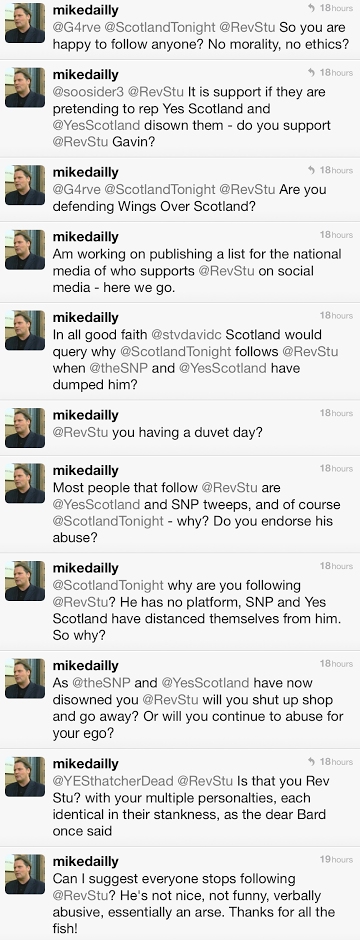
If you’re not on Twitter, readers, you’ve been missing ALL the fun today.

Above are just the creepiest two of a series of tweets posted this morning by “social justice campaigner” Mike Dailly of the Govan Law Centre – previously known to those of this parish – to the effect that he’d really rather prefer if people stopped following my personal Twitter account, @RevStu, because I was so all-around awful.
It didn’t work out quite as well as he’d hoped.
Read the rest of this entry →
Tags: and finallysmears
Category
comment, scottish politics