We’ll keep this one brief, because it’s a bank holiday. We asked our Panelbase poll of English voters this month who they thought – regardless of respondents’ own politics – was doing the best job of leading their party. These were the results, in descending order of perceived competence:
4. Theresa May (Con)
Net rating: -18 (34% well, 52% badly, 14% don’t know)
5. Jeremy Corbyn (Lab)
Net rating: -19 (32% well, 51% badly, 17% don’t know)
Not a single net positive, and it seems particularly telling (and grim) that the two at the very bottom of the list are the only ones with any chance of actually becoming Prime Minister – pending, Lord have mercy on us all, the arrival of Jacob Rees-Mogg – while the top two don’t even sit in the UK Parliament.
(Foster, in fact, doesn’t currently sit in ANY parliament.)
To be honest, readers, it’s a miracle British people bother to vote at all any more.
Like most Scottish politics nerds we’re going to be spending the morning absorbing the report of the Sustainable Growth Commission. But while we do that, we’ve got more data from our Panelbase poll of English voters earlier this month, on what Scotland could expect in the future if it stays in the UK.
We told them: “Under a system known as the Barnett Formula, the government spends more money per head on people in Scotland, Wales and Northern Ireland than it does on people in England, because their populations are more thinly spread so it costs more money to provide the same services.”
It’s been a very sluggish few months in Scottish politics news, with only the significant but rather dry matter of the Brexit power grab to talk about, so you’d imagine that the publication earlier this month of some important new statistics concerning the Scottish economy would have raised some media attention.
Yet fully three weeks after the figures were released we can’t locate a singleword of coverage from any newspapers or broadcasters, and that’s odd.
After all, whenever some economic figures pop up showing Scotland in a bad light – especially when some financial thinktank has also passed comment – the press isn’t usually slow to jump all over them, so oh wait we see what’s happened here.
Perhaps go and take a look for yourself. Because you’ll grow very old waiting for the Scottish press to tell you about it.
After 27 unbroken pages of royal wedding “news” (following on from a full 46 in its Sunday edition), the Scottish Daily Mail finally gets down to reporting other stuff today.
“Union support rising”, eh? Do we have any numbers on that?
To the best of our recollection, today’s Sunday Politics Scotland was the first time a representative from this site has ever been invited onto a BBC Scotland TV show to discuss the affairs of the day since Wings was founded back in 2011. So we thought we better capture it for posterity in case it’s another seven years until the next one.
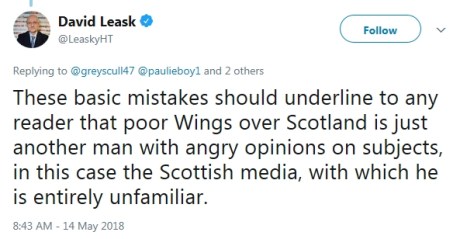
So it seems our article of earlier today rattled the Herald’s cage but good. Scottish political Twitter has been an absolute logjam of incandescent Herald Group hacks all afternoon, making all manner of wild accusations and threats. At the head of the fury, of course, was Chief Reporter And Witchfinder General Mr David Leask.
Unfamiliar with the Scottish media? God, how we wish THAT was true.
Leask issued a long (long) stream of invective on Twitter, while hiding behind a block that means we can’t post any responses to it that any of his Twitter followers will see. So for the record, we suppose we’ll have to address them here.
Apparently (and as recently as this February) baby boxes are “great innovations” and “hugely popular” – so long as the SNP aren’t involved, of course, at which point they turn into grotesque deathtraps.
And it got us wondering: what else is only terrible when it happens in Scotland?
Hatey McHateface on Vibecoding A Better World: ““I see you’re a fan of Better Together” For myself, I’m a fan of Plausible Divorce Plan, although I do…” Nov 2, 17:39
Northcode on Vibecoding A Better World: “I think a further clarity intervention is needed about dates. James Che’s narrative blends two unrelated historical facts into a…” Nov 2, 15:53
Northcode on Vibecoding A Better World: “For even more clarity… Queen Anne’s proclamation dissolving the Scottish Parliament was issued in April 1707, not in 1752. Anne…” Nov 2, 15:16
Chas on Vibecoding A Better World: “How interesting. I have never read interpretations of 300+ year old stuff before. But only if we discount the exact…” Nov 2, 13:53
James Che on Vibecoding A Better World: “Indeed a clever attempt north code, Except England did not update its Calendar year until 1752 to be in line…” Nov 2, 13:25
Dan on Vibecoding A Better World: “@ Northcode at 11:04 am You don’t have waffle some word twisting shite on here. Over the course of the…” Nov 2, 13:03
Hatey McHateface on Vibecoding A Better World: “Cheers, sarah. There was me reading about the Scottish Men’s Curling team’s European Championship triumph on the BBC website and…” Nov 2, 12:55
sarah on Vibecoding A Better World: “Thanks for reporting this achievement. And making clear that once again the BBC has worked to hide a Scotland triumph.” Nov 2, 12:19
McDuff on Vibecoding A Better World: “Scotland’s men pick up a gold at the world curling championships and es far as I can see it has…” Nov 2, 11:13
Northcode on Vibecoding A Better World: “Alf’s argument frames Scotland’s economic condition through a mythic lens of colonial underdevelopment. In its historical and economic framing, these…” Nov 2, 11:04
Northcode on Vibecoding A Better World: “For clarity… James Che’s argument rests on a mythic moment they place in 1606, where they believe the Scottish Parliament…” Nov 2, 10:28
Alf Baird on Vibecoding A Better World: “Yes of course “a radical change in the political (and colonial) landscape” is absolutely critical for recovery and development of…” Nov 2, 10:24
Hatey McHateface on Vibecoding A Better World: “@Aidan The laughable aspect to this is that there are plenty of Scots, myself included, who would love Scotland to…” Nov 2, 10:20
Aidan on Vibecoding A Better World: “Well done Izzie, you’re exactly right. If Nicola Sturgeon had been first minister between 2014 and 2023 Scotland would be…” Nov 2, 10:15
Aidan on Vibecoding A Better World: “You are right James, when people hear about the true nature of what happened in 1606, they will take to…” Nov 2, 09:47
Aidan on Vibecoding A Better World: “So the plan is, Day 1 – become independent and Day 2 – become identical to Norway? Scotland on Day…” Nov 2, 09:41
Hatey McHateface on Vibecoding A Better World: “Awa and shite, Alf. The context is you lying about Scotland having the highest energy prices in the world. The…” Nov 2, 09:39
Alf Baird on Vibecoding A Better World: “The ‘context’ Hatey, which you completely ignore, much like your beloved ‘union’ hoax, is that Norway’s economy is so advanced…” Nov 2, 09:09
Hatey McHateface on Vibecoding A Better World: “Could be so much worse, Bob. At least she’s not claiming the route to Scottish Independence is via climbing on…” Nov 2, 09:01
Hatey McHateface on Vibecoding A Better World: “So true, James. People vowing to edumacate themselves about the shenanigans of 1707 is all I ever hear at the…” Nov 2, 08:56
James Che on Vibecoding A Better World: “One can understand the need and fear of Unionist to Squash Alf Bairds voice before it grows and becomes known…” Nov 2, 08:22
James Che on Vibecoding A Better World: “When enough Scots identify where and when the the treaty of union failed to be completed or accomplish its purpose,…” Nov 2, 08:01
Bilbo on Vibecoding A Better World: “Given that they only teach postmodern theories in the education system nowadays, students are only interested in bringing down the…” Nov 2, 07:40
James Che on Vibecoding A Better World: “To make the theory of of the treaty of union of two parliaments merging to create unitary State of Great…” Nov 2, 07:39
robertkknight on Vibecoding A Better World: “That’s the least of your worries… There’s clearly other issues elsewhere! (I speak as a sufferer of osteoarthritis in both…” Nov 1, 19:59
Hatey McHateface on Vibecoding A Better World: “I get it, Alf. Having higher petrol and diesel prices than ours in Norway doesn’t matter because of “context”. As…” Nov 1, 19:30
Aidan on Vibecoding A Better World: “The charging infrastructure in Norway is excellent – i’ve seen EV chargers on unsurfaced roads. However, just under 70% of…” Nov 1, 19:17