Here’s a very quick one from our latest poll:
“From 0 (absolutely no chance) to 10 (a certainty), what do you currently think is the likelihood of Labour winning the 2020 UK general election?”

Above the midpoint (ie people who DON’T think Labour will win): 56%
Below the midpoint (people who DO think they’ll win): 28%
Get ready for Tories until 2025 at least, folks.
Tags: poll
Category
stats, uk politics
The task facing the Scottish independence movement is to change the minds of just 6% of Scots. That’s all it would take to turn September 2014’s defeat into a victory if and when another referendum comes around, and when you put it like that it doesn’t sound like an impossible job.

The question for Yes supporters is where to focus their energies. A proportion of people who live in Scotland will never vote for independence no matter what, for a variety of reasons we don’t need to go into here. But we’ve always wondered exactly how big that proportion was, so in our latest Panelbase poll we just asked straight out.
Read the rest of this entry →
Tags: poll
Category
analysis, scottish politics, stats
The House of Lords has been in the news quite a bit recently, one way and another. So in our latest poll we thought it might be fun to ask a few questions about it.

We decided to have something for everyone.
Read the rest of this entry →
Tags: poll
Category
analysis, scottish politics, stats, uk politics
As alert readers will know, we’ve just done another Panelbase opinion poll. You’ll be hearing more about the results over the next couple of days, but we thought we’d give you the headline finding first.

The most interesting thing about those numbers is that as far as we can make out that’s the highest Yes figure Panelbase has ever returned for that question. (The last two times, for the Sunday Times in September and July, both came out 47-53.)
Read the rest of this entry →
Tags: poll
Category
analysis, scottish politics, stats
So, it’s our birthday. It was exactly four years ago today, on the 7th of November 2011, that Wings Over Scotland published the first post of what was supposed to be a pretty insignificant spare-time blog picking out interesting politics stories in the day’s Scottish media and challenging any inaccuracies in them.

It got a bit out of control, frankly.
Read the rest of this entry →
Category
history, navel-gazing, reference, scottish politics, stats
Last week the BBC treated viewers to a Question Time hosted in Edinburgh, where a right-wing economics journalist from MoneyWeek magazine called Merryn Somerset Webb explained to a somewhat disgruntled Scottish audience why the government were right to bail out the bankers, but not steel workers.
It capped off an interesting week but to see why we’ll have to rewind a few days and revisit the work of an amateur Unionist blogger of our unwelcome acquaintance.

The amateur blogger in question has been garnering a fair amount of attention lately from straw-clutching Unionist hacks for his “analysis” of the Government Expenditure and Revenue Scotland (GERS) figures, in which he purports to show a sizeable deficit in the economy of an independent or “full fiscal autonomy” Scotland.
In essence, the analysis amounts to dumping all the GERS summary tables into a Microsoft Excel graph, adding the Office of Budget Responsibility (OBR) forecast for oil revenue, and pointing to a resulting £9.1bn gap between Scotland’s public spending and its total revenue.
This, he asserts, is in addition to Scotland’s share of the hefty deficit the UK currently runs. His conclusion, shouted loudly and often by every angry Unionist on Twitter, is that the government of an independent Scotland – which tellingly they always assume to be an SNP one – would either have to drastically cut public services or raise taxes to fill this “black hole”.
It’s an interesting piece of analysis. Or it would be, if it wasn’t total nonsense.
Read the rest of this entry →
Tags: black holeLindsay Brucemisinformation
Category
analysis, comment, idiots, reference, scottish politics, stats
We noticed this on Twitter earlier this evening:

And we thought, “Well, that sounds bad”.
Read the rest of this entry →
Tags: misinformation
Category
media, scottish politics, stats
The award goes to…

Edinburgh Pentlands Constituency Labour Party!
Read the rest of this entry →
Tags: and finally
Category
idiots, stats, uk politics
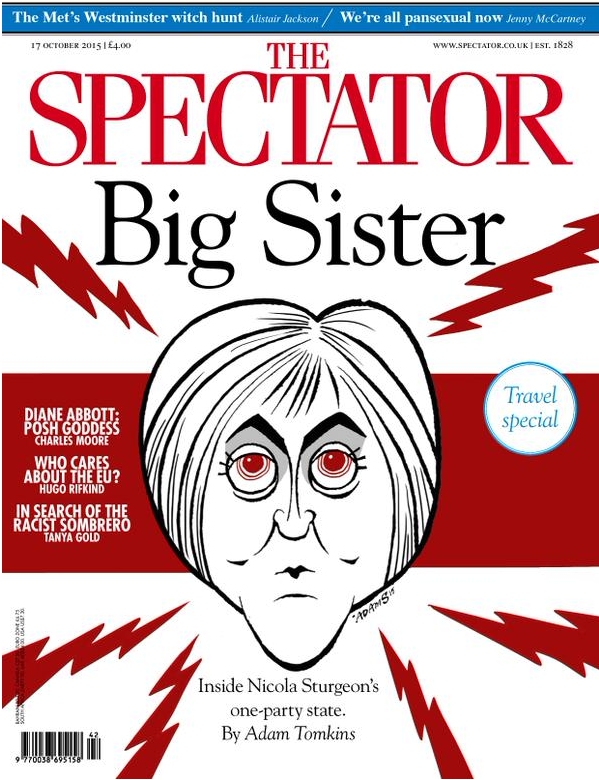
The comedy “obnoxious Tory” stereotype/respected BBC pundit (delete as applicable) Adam Tomkins has a dramatic opinion piece in the Spectator this week, which also commands the magazine’s front cover.
It’s a handy one-stop compilation of some of the most comprehensively-debunked Unionist myths and lies of the past couple of years, livened up for readers with some standard-issue wild-eyed frothing lunacy shrieking about one-party states, “Orwellian” dictatorships, the evil Nats are coming for your children, blah blah etc.

If we were to pull up every absurdly laughable line we’d be here all day, and nobody reads 5000-word articles, so we’re going to restrict ourselves to a single example.
Read the rest of this entry →
Category
comment, media, scottish politics, stats
After this, this and this we were really hoping we’d never have to revisit the subject of the D’Hondt Method and get our calculator out again.

But OH NO!
Read the rest of this entry →
Tags: misinformation
Category
analysis, debunks, scottish politics, stats
The media and Unionist politicians (we really need to come up with a word to describe that single entity), when not concocting hysterical frothing diatribes against Michelle Thomson or complaining about the Scottish Government giving money to T In The Park – a position we must confess we find ourselves in some sympathy with – have recently been loudly protesting about last year’s “underspend” in the Holyrood budget.
There’s an extremely good article here by Dr Craig Dalzell of the Scottish Greens dealing with the broader issue of why such complaints are idiotic, so rather than go over the ground again we thought we’d look at another angle.

Read the rest of this entry →
Tags: arithmetic failmisinformation
Category
debunks, media, scottish politics, stats