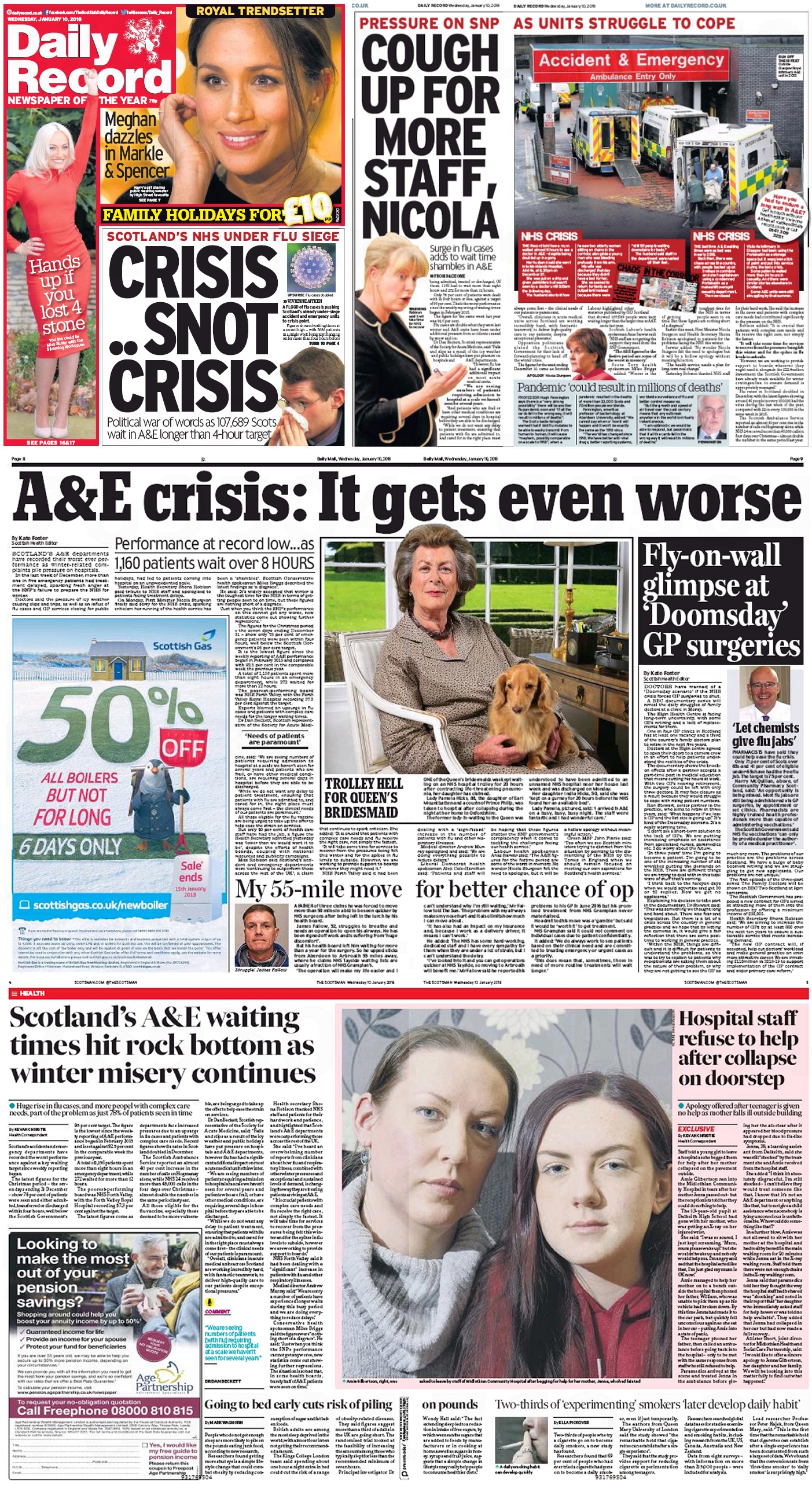
The Scottish media has been operating at what former BBC journalist Paul Mason once called “full propaganda strength” for the last few weeks, trying to inflate some pretty standard seasonal fluctuations into a “WINTER NHS CRISIS”.
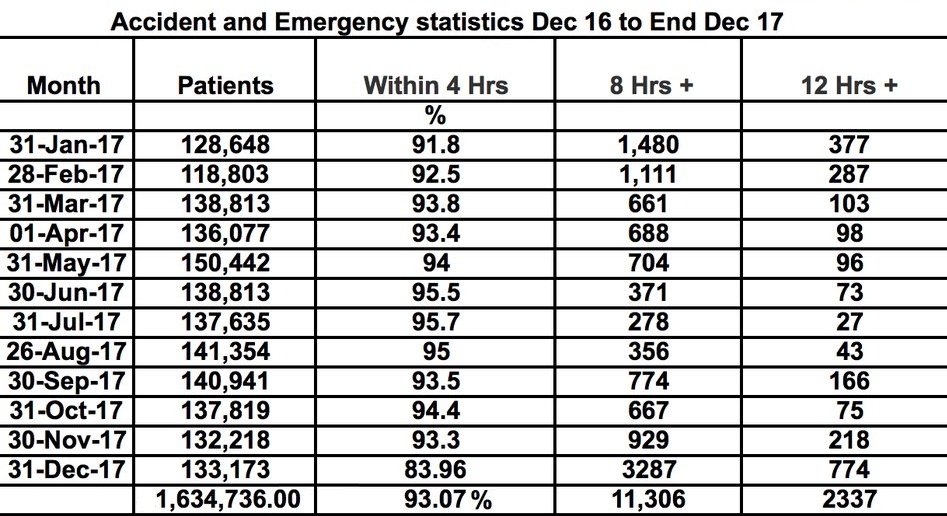
One of the more egregious examples came yesterday when the state broadcaster’s Scotland editor Sarah Smith announced to the nation that 100,000 patients had waited more than four hours at A&E departments last week – a pretty impressive feat since in reality only a quarter of that number actually visited A&Es in Scotland last week, and four-fifths of those were seen in under four hours.
The 100,000 figure in fact refers to an entire year, not a week. Depending on how you look at it, Smith misrepresented the reality by either 2,000% or 5,200%. Yet at the time of writing we’re not aware of the BBC having issued any correction or apology for this, well, let’s be generous and say “error”.
The stats record the time taken for patients presenting at A&E to be dealt with (that doesn’t just mean “seen”, but seen, assessed, and then either treated, admitted or sent home). For the whole of 2017 the figures for Scotland were:
Patients dealt with in four hours or less: 93.1%
In eight hours or less: 99.2%
In 12 hours or less: 99.9%
Which doesn’t sound like too much of a crisis.
Alert observers will of course be aware that this is all entry-level basic operating mode for the media. Even if they weren’t trying to whip up politically-motivated “SNP BAD” material – and most of them are – it’s a deep journalistic instinct to exaggerate and hyperbolise everything into the worst news possible in order to drive traffic and clicks.
Our favourite thing was her quote on the nomination:
“I’m very pleased to be Labour’s nominee for the SPCB. Having argued for gender balance, I’m glad that at least two of the five positions will now be held be women.”
…which suggested that she was unhappy exact gender balance hadn’t been achieved by placing two-and-a-half women on the board. (Unless she was getting at some sort of alternative solution, we suppose.)
But since the Herald raised the subject, it seemed a good time to take a look at voters’ opinions as to whether she might be a fit and proper person for such a role.
This is the well-known hardcore Corbynite commentator John McTernan on the radio yesterday, detailing how outrageous it would be for politicians to attempt to block a second referendum on a divisive but important issue.
Readers, have you ever noticed how the letters pages of Scottish newspapers are full every day of the same names, a clutch of a couple of dozen super-hardcore frothing ultra-Yoons tirelessly and reflexively raging against independence, the SNP and pretty much anything without a Union Jack on it?
Have you ever found yourself thinking it must be some sort of co-ordinated group that gets together, plans topics in advance then writes in backing each other up, to create an illusion of speaking for a wide cross-section of society, before dismissing that idea as a daft paranoid conspiracy and getting on with your day?
Because we thought that too, until an alert reader infiltrated it.
Our very favourite bit is “we must not advertise the existence of the group. It can be mentioned verbally, in safe environment, that some people share letters/encourage each other, but anything more risks editors discriminating, nationalists reacting, and this diverse group being portrayed as a monolithic campaign”.
Probably don’t put it in an email, then. But your secret’s safe with us, lads.
Our poll story yesterday was a pretty interesting piece of politics news considering it’s the Christmas dead season. We put an interesting new angle on the independence question, and posted all the poll data so that reporters had plenty to get their teeth into. And we released it at lunchtime so they had plenty of time to get it into today’s editions.
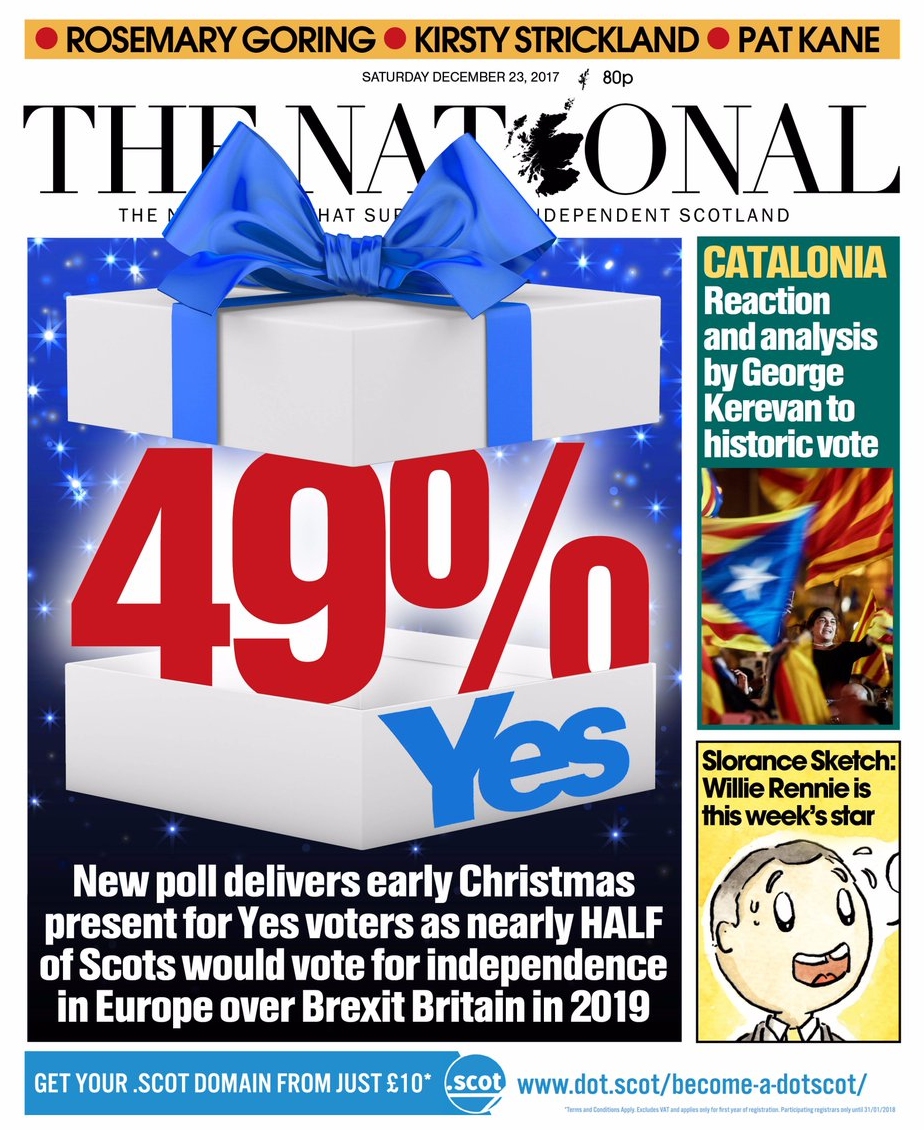
Remarkably, though, none of the Scottish media – with the honourable exception of The National, who made it their front page splash – thought that the best numbers for independence in many months merited even a dismissive passing mention. Scotland’s political hacks doggedly ignored it on social media. And then things got weird.
The tweet above appeared briefly – having been posted at 11.44am it was gone by no later than 12.10pm – on the Twitter account of the Herald. The story it linked to cannot be found through the paper’s website, though it’s still hidden away on the servers.
(Its sister paper the Evening Times carried the story, then outright deleted it.)
And the reason why provides a fascinating insight into how the press operates.
Yesterday we brought you news of the Scottish Mail On Sunday’s deep concern that the new Scottish budget might cost wealthy old people cashing in a £600,000 pension pot as one lump sum as much as £3,000 in extra tax. It was a heart-rending tale, but today we have one even more harrowing.
The Scottish press and opposition have had it in for the baby box ever since the idea was mooted, but this is a pretty spectacular new low in barrel-scraping.
“Almost half”, eh? How many are we talking about exactly?
This week’s Scottish budget threw the opposition parties and the media into panic and disarray. Evidently having expected considerably more swingeing tax hikes than the extremely modest increases that were imposed on higher earners, they’d built up a head of steaming fury that had nowhere to go, and have been reduced to frantically scrabbling around for extreme (or flat-out wrong) examples to try to generate outrage.
Today’s politics lead in the Scottish Mail On Sunday is a case in point.
By going through all the numbers with a fine-tooth comb, the SMoS has managed to pick out a tiny anomaly around National Insurance thresholds, and portrayed it as hitting people on a very healthy but not exactly super-rich salary of £45,000 with a total tax-and-NI rate of 53%.
The small print, as ever, is rather less dramatic.
The Tories kicked off yesterday’s reaction to the budget with a straight-up lie.
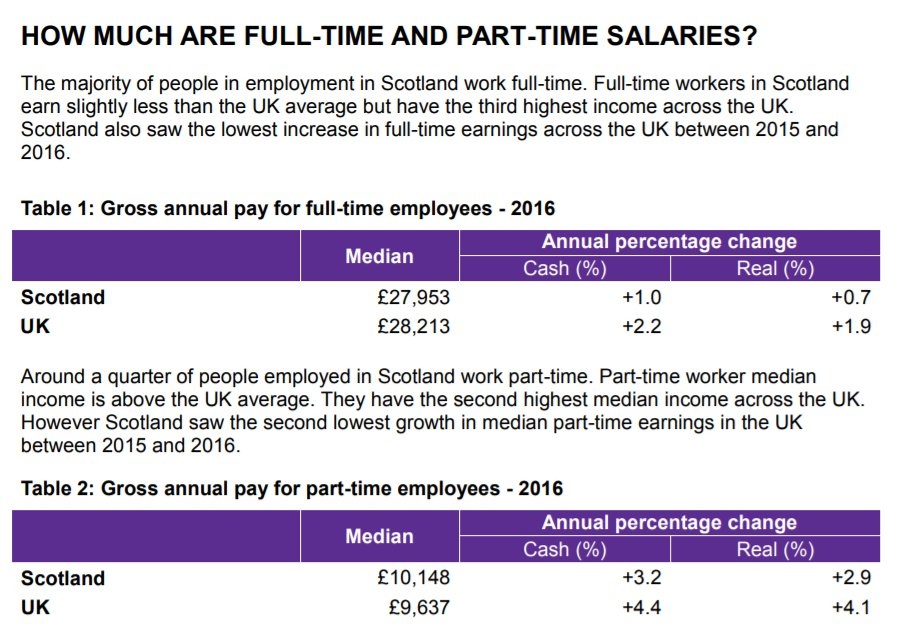
No promise has been broken. The basic rate HAS been frozen, at 20p, and low and middle earners HAVE been protected. Nobody who’s on less than £33,000 – which is considerably higher than the average (£23K) or full-time median (£28K) wages – will pay a penny more tax, and the large majority of Scots will in fact see a small tax cut.
(The weasel-wording justification is of course that pretty much everyone who pays tax pays some of it at the basic rate, and are therefore in a sense “basic-rate taxpayers”. But “nobody will pay any more tax” wasn’t the promise. Indeed, the manifesto pledge is a pretty clear implication that better-off people WOULD be taxed a little more.)
But the numbering was interesting. In order to try to obscure that fact that most Scots would be paying LESS tax as a result of the budget, the Tories went with a nicely vague but high-sounding “hundreds of thousands” for the number of people who’d lose out a little. And then the Scottish media went to work.
Alert readers of the Scottish Mail On Sunday – if any such people exist, that is – will have noticed that the paper has of late been cutting both costs and the middleman by giving Tory MSPs entire pages to spout party propaganda for free rather than paying a journalist to slightly rewrite it.
First Ruth Davidson, and now the party’s finance spokesloyalist Murdo Fraser, have recently had free rein to say whatever they liked to the paper’s readership, and today Fraser chose to go with the topic of “waste”.
Scotland has 2,174 miles of trunk roads, of which 1.7 miles (that’s just under 0.08%) comprise the Queensferry Crossing. For the next few days those 1.7 miles are going to be subject to some partial lane closures on the southbound side for maintenance.
They’ll cause almost no disruption, because as it happens there’s another very similar bridge conveniently located just a couple of hundred yards away – linked directly to all the same roads – that traffic will use instead.
Not much of a story, is it? We don’t know how many miles of Scotland’s roads have roadworks on them on any given day of any given week, but we suspect it’s quite a lot. It tends not to make the news beyond a few seconds on the traffic bulletin at the end, but today was different.
Hatey McHateface on When the law breaks the law: “There’s something about Fanon makes my hair curl.” Feb 20, 10:28
willie on The Future Is Yesterday: “Rejected by the electorate in the constituency but then perchance a seat at the top of the regional list. Why…” Feb 20, 10:23
Andy Wiltshire on When the law breaks the law: “I’m cheering them on, but no doubt someone will explain that it’s all just something straight out of post-colonial theory…” Feb 20, 10:05
Hatey McHateface on When the law breaks the law: ““Movie”, YL? You’re colonised and you don’t even know it.” Feb 20, 08:46
Young Lochinvar on When the law breaks the law: “Anyone else reckon Bain’s heid has a similar(ish) profile to a movie Predator? Just without the odd breathy way of…” Feb 19, 22:36
robertkknight on When the law breaks the law: “Pay day next week…standby! The alphabets and their party connections are no secret. Nor indeed their motivations. They still enjoy…” Feb 19, 22:01
agentx on When the law breaks the law: “O/T – but the Mens’s curling team are through to the final – guaranteed at least a silver medal and…” Feb 19, 22:01
Hatey McHateface on When the law breaks the law: “You were on fire, Willie, until your second last para. Then you crashed and burned. The case we’re discussing here…” Feb 19, 18:40
Hatey McHateface on When the law breaks the law: “We’re only a few weeks out from choosing Scotland’s government for the next 5 years. Surely it’s not too much…” Feb 19, 18:31
Willie on When the law breaks the law: “As is now clear to see the rule of law is a hoodlum’s charter. When the state can maliciously try…” Feb 19, 18:18
Effijy on When the law breaks the law: “I’ve donated as we must when faced yet again by corrupt and immoral practices from government. Your courage is remarkable…” Feb 19, 18:12
Fearghas MacFhionnlaigh on When the law breaks the law: “Not sure whether or not a video link to Fergus Ewing’s Holyrood intervention is embedded in the above article, but…” Feb 19, 17:51
ScotsRenewables on When the law breaks the law: “I;ve donated a tiny amount, and am pleased to see that the appeal is going well – is there any…” Feb 19, 15:04
Hatey McHateface on The Future Is Yesterday: “It’s a good day to bury news, whether bad, or just awkward. Plaid Cymru has dropped its pledge to get…” Feb 19, 14:37
Hatey McHateface on The Future Is Yesterday: “Sez you, Alf. When you continually claim that anyone who disagrees with you is a colonialist, nobody can be surprised…” Feb 19, 14:27
Iain More on The Future Is Yesterday: “Off Topic – I hear that the Sex Trafficker Andrew Mountbatten has been arrested. =============================================================== Re 100%Yes says: I am…” Feb 19, 13:08
Andrew Kidd on The Future Is Yesterday: “Embarrassing position for Tom Arthur. Govt Minister 5th on the West of Scotland list. Resounding vote of confidence for Stuart…” Feb 19, 13:02
Confused on The Future Is Yesterday: “ps – the royal household were paying their gofers below minimum wage. maybe Andy will be found drowned in a…” Feb 19, 12:53
Tony Little on The Future Is Yesterday: “I have felt for a long time, certainly the last 4 Holyrood elections, that NO constituency candidate should also be…” Feb 19, 12:39
Confused on The Future Is Yesterday: “crazy days – the royals are “untouchable” (usually); example – working for the royals is shit and some years ago…” Feb 19, 11:58
Young Lochinvar on The Future Is Yesterday: “Andrew Mountbatten-Windsor’s daily morning routine. 1. Wake up 2. Ablutions 3. Issue daily denial of any wrongdoing 4. Rearrange teddies…” Feb 19, 11:28
Alf Baird on The Future Is Yesterday: “We are no longer in the realm of ‘conspiracy theories’ when even colonialists in Holyrood are calling for another Lord…” Feb 19, 11:27
Hatey McHateface on The Future Is Yesterday: “Sez you, TURABDIN. Requires but an hundred driven, committed, savvy, rational, honest, authentic Scots prepared to stand on a plebiscitary…” Feb 19, 10:00
Aidan on The Future Is Yesterday: “That was the point I was avoiding admitting Hatey 😉” Feb 19, 09:53