Better together 18
Posted on
June 10, 2012 by
Rev. Stuart Campbell
Thursday night’s Question Time from Inverness saw Johann Lamont once again trot out the line that the independence referendum doesn’t offer Scotland its only realistic chance of escaping Tory government for the forseeable future. Once again, the Labour quasi-leader insisted (56m 50s) that the choice between independence and the Tories was a false one, and that her party provided a genuine ideological alternative to the right-wing neoliberal philosophy which has dominated UK politics since 1979.

Unfortunately, that’s a lie. And the really troubling thing about it is that it means NOBODY is speaking for the majority of the British population, which almost certainly means that no mainstream political party is interested in representing your views. Which, you might think, is a pretty odd way to be running a supposed democracy.
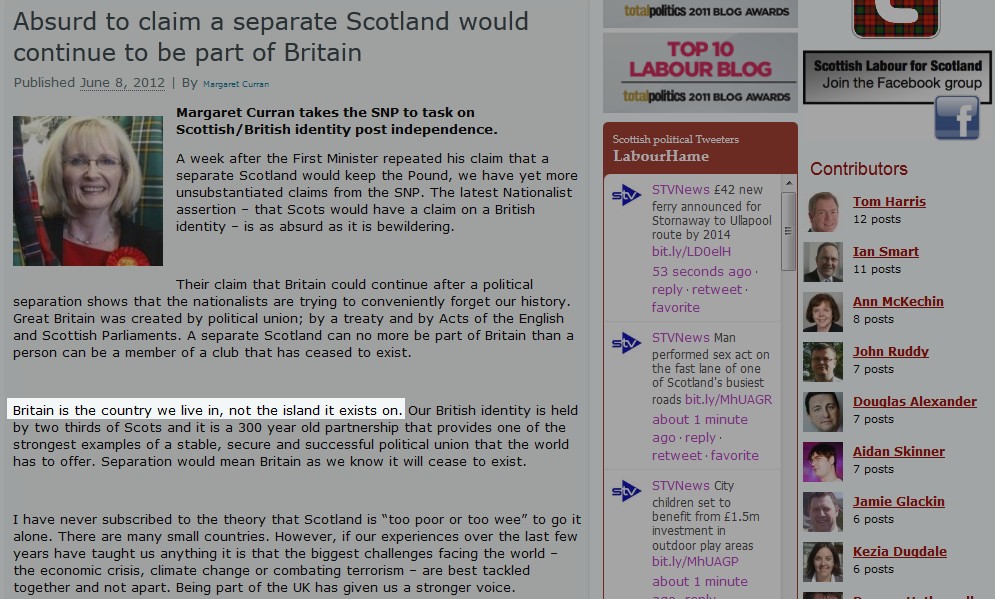
A surprise development today, as the moribund and long-neglected LabourHame website sprang suddenly back to life with its fourth post in as many months. And what a stirring comeback it was, as the party’s Shadow Secretary Of State for Scotland Margaret Curran launched into a vitriolic diatribe awkwardly entitled “Absurd to claim a separate Scotland would continue to be part of Britain“.
(There was plenty of room left in the headline to turn the car-crash grammar into English, for example by prefixing it with the words “Why it’s”.)
The centrepiece of the article’s argument was Curran’s unequivocal assertion that “Britain is the country we live in, not the island it exists on”, which is a claim only slightly spoiled by being completely factually wrong in every respect. Rather than waste all afternoon explaining why, we’ll just quote the Wikipedia entry and let you get on with your day. If you’re really pressed for time, you can stop after the first sentence.
“Great Britain or Britain (Welsh: Prydain Fawr, Scottish Gaelic: Breatainn Mhòr, Cornish: Breten Veur) is an island situated to the northwest of Continental Europe. It is the ninth largest island in the world, the largest European island, and the largest of the British Isles. With a population of about 60.0 million people in mid-2009, it is the third most populous island in the world, after Java and Honshu. Great Britain is surrounded by over 1,000 smaller islands and islets. The island of Ireland lies to its west. Politically, Great Britain may also refer to the island itself together with a number of surrounding islands which comprise the territory of England, Scotland and Wales.
All of the island is territory of the sovereign state of the United Kingdom of Great Britain and Northern Ireland, and most of the United Kingdom’s territory is in Great Britain. Most of England, Scotland, and Wales are on the island of Great Britain, as are their respective capital cities: London, Edinburgh, and Cardiff.
The Kingdom of Great Britain resulted from the political union of the kingdoms of England and Scotland with the Acts of Union 1707 on 1 May 1707 under Queen Anne.”
You’d hope someone aiming to be the Secretary of State for a part of somewhere would at least have a grasp of the most rudimentary geopolitical facts about it, but nobody ever went broke underestimating the intelligence of Scottish Labour.
Wings Over Scotland had a staff outing to London this weekend. We went on Saturday to avoid the Jubilee crowds and the rain, with great success on both fronts – it turned into a beautiful hot summer’s day by the afternoon, and the city was as deserted as we’ve ever seen it. (The Underground, in particular, was eerily quiet almost everywhere, with empty platforms, tunnels and ticket halls as far as the eye could see. At times it was like a scene from 28 Days Later.)

Compared to the last time we found ourselves in the capital on the eve of a big Royal event, there was surprisingly little activity. Plenty of Union Jack bunting and flags littered the streets, but though we crossed the Thames several times, including by London Bridge and the Millennium Bridge, there were no enthusiasts camped out to stake their prime viewing places for the next day.
Despite the launch of the rainbow-coalition Yes campaign on Friday, we’re still fighting the assertion that Scottish nationalism is both racist and bigoted – one typified by a recent article by George Galloway in the Daily Record.
I have to admit to a guilty soft spot for the MP for Bradford West. I know he’s ridiculous in many ways, but I like him. Watching George on Question Time recently, I knew he’d be entertaining and sometimes disrespectful. It’s a nice change from the grey men of politics we usually see. I like the idea that some politicians have the bottle to say and do pretty much what they want and sod everyone else. Not always pleasant and often enough to make your toes curl with embarrassment, George is, at least, a character and we could do with a few more like him in politics.
But as I read the article he wrote for the Record, in which he talked about seeing people who have “what can only be described as a virulent hatred of English people and a belief they are the source of Scotland’s troubles”, I began to wonder what country George was looking at.
I’ve been a nationalist pretty much all my life, or at least since I was old enough to grasp the basic concept of politics (probably from about the age of 10 or so). Leaving aside any precocious notions of specific policies, I’ve never been able to grasp the basic concept of a people who consider themselves to be a nation being afraid to actually stand up and take responsibility for running that nation themselves.
If you think you’re a country, you shouldn’t be having foreigners pick your government for you. And if you don’t, you need to accept that you’re just a region with ideas above its station, and act accordingly – no more “national” football teams, no rugby teams, no flags, no anthems, no different laws or any of the rest of it.
To me, the idea goes far beyond anything so base as cowardice, and belongs instead in the realm of “simply too mad to understand”. It’s like not believing in gravity or evolution or the Earth being round and orbiting the Sun – that is, once someone’s pointed it out to you, it’s just a bit mental to keep disputing it.

Nobody can have two countries, or at least not simultaneously. You can be a citizen of somewhere, carry a passport for it, live there for as long as you like, or whatever else, but countries are like wives and livers – you can only have one at a time. You can change your nationality, if that’s what’s in your heart, but not have two at once. I’ve only agreed with Norman Tebbit about one thing in my entire life, and it’s that.
I’m Scottish. I’m British too, just like I’m from West Lothian and from Europe and from the Northern Hemisphere and plenty more things, but only one of them is my country. As such, I believe that it’s a self-evident truth that the government of Scotland should be chosen by the people of Scotland, and the people of Scotland alone.
But occasionally, just very occasionally, I have the misfortune to witness something like BBC Scotland’s “Big Debate” last night, and I’m not so sure we can be trusted.
It was very pleasant to see Lou Hickey and Dougie MacLean performing “Caledonia” at the Yes Scotland launch – it’s a nice enough tune, if a bit mopey, and “Flower Of Scotland” has been somewhat ruined for us as a national song by years of appallingly murdered, out-of-time renditions at Murrayfield and, especially, Hampden.
(We liked the brief period when The Three McTenors or something did a speeded-up rendition at the football, which was nicely modern and left less room for the crowd to balls it up in – for some reason football fans can’t grasp the concept of a pause – but the SFA with their trademark ineptitude soon abandoned it in favour of Ronnie Corrie barking it out in his Hielan’-wedding get-up again. We also approve of the SRU’s practice of making the band stop for verse two and leaving it to the crowd alone, but why not just count them in and then let them sing unaccompanied from the start?)

We can’t help feeling, though, that music is a bit of a weak spot generally for the Scottish nationalist movement – still basically mired in the misty-blue-hills-of-Tiree era, where Runrig are seen as modernist hep-cats and the SNP’s official song is a 1962 blues tune best known by the staggeringly inappropriate title of “Let’s Stick Together”.
Had it been up to us, the Yes launch would have seen Glasgow’s own Primal Scream stood in front of a giant backdrop of Gordon “British jobs for British workers“ Brown and pummelling out an apocalyptic rendition of “Swastika Eyes“, but we get that that might not have mainstream appeal. Anyway, the point is, it’s time to think positive.
We need to clone ourselves – there’s so much going on today we can’t possibly cover it all. The official launch of the Yes Scotland campaign was better than we expected, with particularly good contributions from Tommy Brennan, Dennis Canavan and a showstopping closing speech from Brian Cox all highlighting the broad base of support for independence – Alex Salmond was the only SNP politician on show, taking up just a couple of minutes of the hour-long presentation.
Online Labour activists were particularly keen to vilify Cox, unleashing a deluge of bitter attacks which succeeded only in drawing attention to how desperately the party wants to silence the 20% or so of Labour voters who actually back independence.
In an attempt to spoil the media coverage, the nascent No campaign chose the eve of the launch to release a YouGov poll they’d commissioned, with a headline figure of 33% in favour of independence and 57% against. Curiously, though – and little reported by the media – the poll didn’t ask the actual question that’s likely to be on the ballot paper, choosing instead the comparatively tortuous “Do you agree Scotland should become a country independent of the rest of the UK?”
Creating such an obvious hostage to fortune is a clumsy and guileless piece of work – especially given the enormous public fuss the Unionists have made about the precise wording and the possibility of bias therein – but the anti-independence parties presumably knew the media could largely be relied on to focus solely on the numbers and not mention what the actual question was.

Our favourite thing today, though, was an extraordinary outburst from Labour MSP Kezia Dugdale, who apparently wants the word “Yes” itself to be outlawed in the years running up to the referendum. On first reading of the piece we thought it was just a complaint that a democratically-elected government was daring to actively pursue the policies it had been elected on, but in fact it’s even nuttier than that – the leaflet and website Dugdale is objecting to isn’t actually anything to do with independence at all, but merely promoting a positive, “can-do” approach to Scottish enterprise.
To Labour, of course, promoting jobs and the Scottish economy is simply despicable populist cheating on the part of the Scottish Government – worse still when, in the immortal words of George Foulkes, the SNP are doing it deliberately. As Labour cling ever more tightly to negativity, as Ms Dugdale herself says: expect more of this.
We had a brief and dispiriting Twitter exchange this week with a prominent Scottish Green activist (if there can strictly be said to be such a thing), in the shape of the party’s former head of media James Mackenzie. The discussion was sparked by a piece in the Guardian reporting the Green leader (sorry, “co-convenor”) Patrick Harvie’s dire warning to Alex Salmond against a “bland, middle-of-the-road” prospectus for independence, which he suggested would risk “alienating” the left-leaning section of the Scottish public (ie most of it) and thereby losing the referendum.
Wading in with our trademark gentle, reasoned tact, we recited our well-worn observation that referenda are for deciding single precisely-defined issues – in this case, who gets to elect the future governments of Scotland – rather than the fine details of multiple policies, and that starting the Yes campaign off by emphasising our differences perhaps wasn’t the smartest move.
To this Mr Mackenzie accused us of having “confused policy with constitution”, and while we won’t bore you with the he-said-we-said in too much depth (you can go and track it for yourself if you really want to), the conversation took in the comradely and left-wing-solidarity-building, if somewhat distant from reality, assertion that “the Green Party make Salmond look like Thatcher“ before culminating in this rather huffy tweet:

Now, the obvious thing that might strike a passer-by would be that the Greens appear to be massively overplaying their hand from the off. They might claim their complaints are about a “democratic” process, but they speak for just 4% of the Scottish electorate, and even among those backing independence they’re a tiny (9%) minority. Democracy has spoken already, and it wasn’t for the policies of the Greens.
(Nor those of the Scottish Socialist Party, who have also offered the media a chance to portray division in the Yes camp over their policies that an independent Scotland must be a republic rather than a monarchy, and be outside of NATO – although the latter in fact remains SNP policy too anyway.)
Clearly, none of that means that they need to shut up and just go along with what the SNP says – the whole point of independence is to give us the chance to debate every aspect of Scotland’s future. But demanding to have all these fights now is wrong in principle as well as pragmatically. We’ll come to the pragmatic part in a moment, but let’s take the moral high ground and examine the principle first.
The official launch of the Yes campaign for the independence referendum takes place tomorrow. We imagine it’ll be a substantial and considered affair. But what it will amount to over the next two years is nothing more and nothing less than the image below. Obviously we can’t do art for toffee, but you get the general idea.

We’ve gone on at some length on this blog (and elsewhere) about how the referendum isn’t for deciding whether Scotland is a republic or a monarchy, whether we’re in or out of NATO/the EU, whether we use the Euro or the Pound or something else entirely, how many ships we need in our navy, which taxes we’ll raise and/or cut, or any of the rest of it. The purpose of the referendum is to decide one thing and one thing only: who elects the future governments of Scotland.
The five counties of South-East England (Kent, Sussex, Surrey, Essex and Greater London) are home to just under 14 million people, compared to the fractionally over 5 million of Scotland. Even if we take Greater London out of the equation, the other four still add up to a population a million higher than Scotland’s.
Those four counties voted so overwhelmingly Conservative in the 2010 general election that they returned 62 Tory MPs from 66 seats – enough Tories alone to outvote the entire bloc of Scottish MPs of all parties (which will soon be even smaller, falling from 59 to just 52). Greater London, despite its large concentration of extremely poor urban areas, still returned another 28 Tories, along with 38 Labour and 7 Lib Dems.
So in the South-East as a whole, even including the huge relative Labour stronghold of London, that’s 90 Tories to 38 Labour, plus 11 others – an overwhelming majority of almost two to one even if you count everyone else as anti-Tory. (If you count the Lib Dems alongside their coalition partners, it’s an even more terrifying 100 to 39.)
But really, the picture tells the story for itself. A small, overwhelmingly Tory corner of England vastly outmuscles the whole of Scotland when it comes to deciding the UK government. (The dark shaded area supplies almost a quarter of all the MPs in the Commons.) We can either face the reality that we get whatever government Kent and Sussex and Essex and Surrey want, or we can choose our own. However much the desperate Unionists try to muddy the waters, it really is as simple as that.
A curious phenomenon occurs when debating the issues of independence with those of the Labour party – one that was highlighted again in the debate published on this site last week. Labour constantly repeats the mantra of being “stronger together” and asserts that the SNP only cares about a poor child in Glasgow but not about a poor child in Bradford, citing this as a reason to maintain the Union.
(Quite why the Scottish National Party would ever be expected to concern itself with the sovereign affairs of England is a question we’ll leave for another day.)
The “solidarity” narrative insists that both issues must be tackled at the same time, and that it would be unfair to focus on only one of the children while failing to provide the same attention and resources to the other. In order to show solidarity, the fate of both children must be tied to that of the worst-off, and if the fortunes of both cannot be improved then neither should be.
(For some reason this narrative doesn’t usually extend to covering children from Istanbul or Delhi. There’s no discernible intent among Labour activists to create a European superstate so that all deprivation can be addressed simultaneously. The party appears to apply double standards for the UK and the rest of the world, only serving to highlight its British-nationalist ethos rather than any commitment to a global brotherhood of man.)

By way of illustration, imagine that (Heaven forbid) you find yourself in a lifeboat in the immediate aftermath of some terrible maritime disaster, and there are two groups of children in the water. The lifeboat can only accommodate one of the groups, and so a decision must be made which to save. At present the boat is captained by the SNP, who are intent on plucking the nearest of the two groups from the ocean and moving them to safety. Within the lifeboat, however, there are also Labour politicians who insist that as they cannot save all the children, it would be selfish and unfair to save only a few, and that therefore in order to show “solidarity” the lifeboat should pick up no children at all, leaving all to drown or succumb to hypothermia, comforted only by the identical fate of their companions.
Below is an open letter released today by the 42 signatories identified at the bottom. Wings Over Scotland endorses its contents, and urges its readers to republish and propagate the text as widely as possible by all available means.
Abdelbaset al-Megrahi has now died without having been able to clear his name of the destruction of Pan Am flight 103 on the 21st of December 1988 during his lifetime. Now all those politicians and Megrahi-guilt apologists who regard compassion as being a weakling’s alternative to vengeance, who boast of their skills at remote medical diagnosis, and who persistently refuse to address the uncomfortable facts of the case, will doubtless fall silent. Finally, the ‘evil terrorist’ has been called to account for himself before a ‘higher power’.
Wings Over Scotland is a thing that exists.