We invite the de facto leader of Scottish Labour to sue us if the title of this article is libellous. But the facts seem to us to be clear and incontrovertible. On BBC1’s weekend political programme Sunday Politics Scotland on the 1st of April 2012, Anas Sarwar was interviewed by Isabel Fraser, along with the SNP’s Stewart Hosie.

Below is a transcript of part of the discussion, on the subject of Labour’s allegations that the Scottish Government’s consultation on the independence referendum was “designed for abuse”. It begins 43m 36s into the show, just after Fraser has suggested to Sarwar that the consultation process is in fact, as stated by Hosie, identical to those previously conducted by Labour.
SARWAR: It isn’t the same as previous processes, because you don’t even have to submit an email address or any form of identity to put in an anonymous response, and you can put in multiple anonymous responses… on the second point that Stewart raised around the Labour Party’s own website, you have to put in an email address and a name to be able to respond, so it’s not an anonymous response that you could put in from our own site.
FRASER: But you could put in multiple responses from that address.
SARWAR: No, you have to put in your own name and an email address, which, which you can’t use multiple…
FRASER: So you’re monitoring it, and you will ensure that?
SARWAR: Absolutely, there’s no multiple responses, they can see exactly who has put in a response with their name and also their email address.
Sarwar then repeats the allegation that the process was“not only open to abuse, it’s designed for abuse” by the SNP. Fraser puts it to Hosie that that’s a very significant accusation and asks him if he accepts the charge.
HOSIE: What’s more disturbing is Anas Sarwar there saying that the responses through the Labour Party website are being monitored. That clearly is very worrying indeed, if the Labour Party are able to monitor responses through their website to a public consultation. That’s extremely concerning indeed that you said that.
SARWAR: That’s not what I said, Stewart. What I said was –
HOSIE: You said they were being monitored.
SARWAR: – there are individual, individual email addresses and names –
HOSIE: You said they were being monitored.
SARWAR: – individual email addresses and names that would go in from our responses. The point I’m making, and this is clear – I am making that accusation that the SNP are looking like they’re trying to rig this referendum.
(We’ll ignore the cowardly weasel-worded smear “I am making the accusation that the SNP are looking like they’re trying to rig this referendum” for now.)
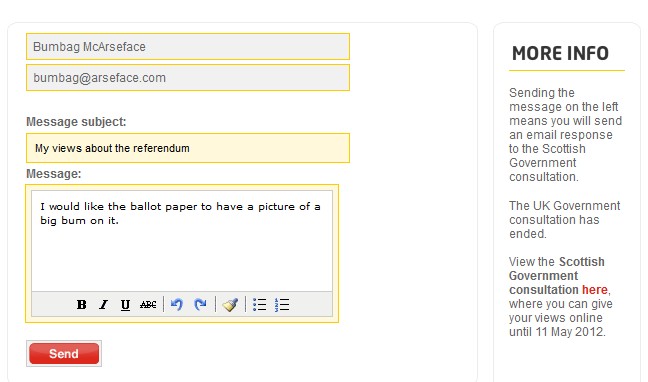
We’ll be clear: Sarwar’s statements in the transcript above are lies. That’s not a matter of our interpretation or opinion, but empirical fact. You do NOT “have to put in your own name” on Labour’s form. Wings Over Scotland has already proved this by submitting a consultation response through the form using Anas Sarwar’s name, along with the email address “anas.sarwar@scottishlabour.org.uk”. We are not Anas Sarwar.
Sarwar’s repeated claim that “no multiple responses” are possible through the form is also a lie – there are no discernible safeguards against either fake names or multiple responses on the site, as we also verified by successfully submitting further multiple entries through the same form, including this one in which we used the name “anonymous” and the email address “anonymous@anonymous.com”.
Sarwar’s position on whether Labour are monitoring the responses in order to potentially catch these abuses is doubly untruthful. When Fraser asks him “So you’re monitoring [the responses via the form]?”, he answers “Absolutely” (although our experiments suggest this is not the case), yet mere seconds later when Hosie expresses concern about this admission, he replies “That’s not what I said”, even though it was, as an indisputable matter of record, precisely what he said.
The Scottish media, it probably goes without saying, has not challenged Sarwar on these easily-demonstrable lies. As Sarwar was nominated by Scottish Labour to be its spokesman for the issue on Sunday Politics Scotland, we believe it’s reasonable to assume, furthermore, that his responses were not made out of simple ignorance.
Should Mr Sarwar contact us to explain that in fact it was the case that he simply had no idea what he was talking about, we will gladly withdraw our allegations and issue an apology to that effect. But in the absence of any such statement, the evidence makes it impossible for us to reach any other conclusion than that he deliberately and knowingly lied to Isabel Fraser, Stewart Hosie and the Scottish people.
We do not believe such a person is fit for office in one of the nation’s biggest political parties, or indeed to be a Member of Parliament. We think most people would agree, and we call on Anas Sarwar to resign both positions immediately.