Alert readers will remember that Gordon Brown, who is apparently some sort of former politician, has recently been spreading the completely baseless scare story that Scots would no longer receive organ transplants or blood transfusions from other people in the UK (and vice versa) in the event of independence.
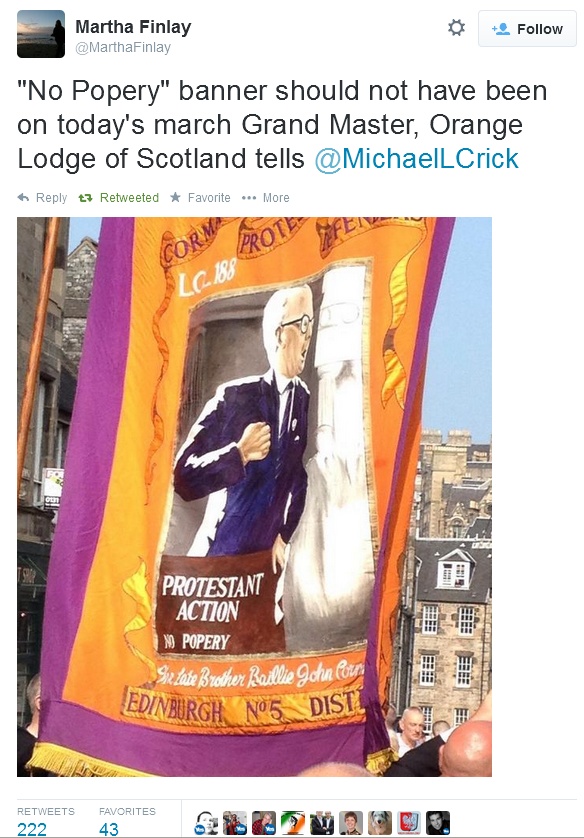
On Friday night, before the Orange Order marched in the streets of Edinburgh with “NO POPERY” banners, a young woman with a life-limiting illness called Alpha-1 Antitrypsin Deficiency climbed the face of Edinburgh Castle with oxygen strapped to her back and tubes up her nose. (The only cure for A1AD is a double lung transplant.)
This is what she did there.

Read the rest of this entry →
Category
pictures, scottish politics
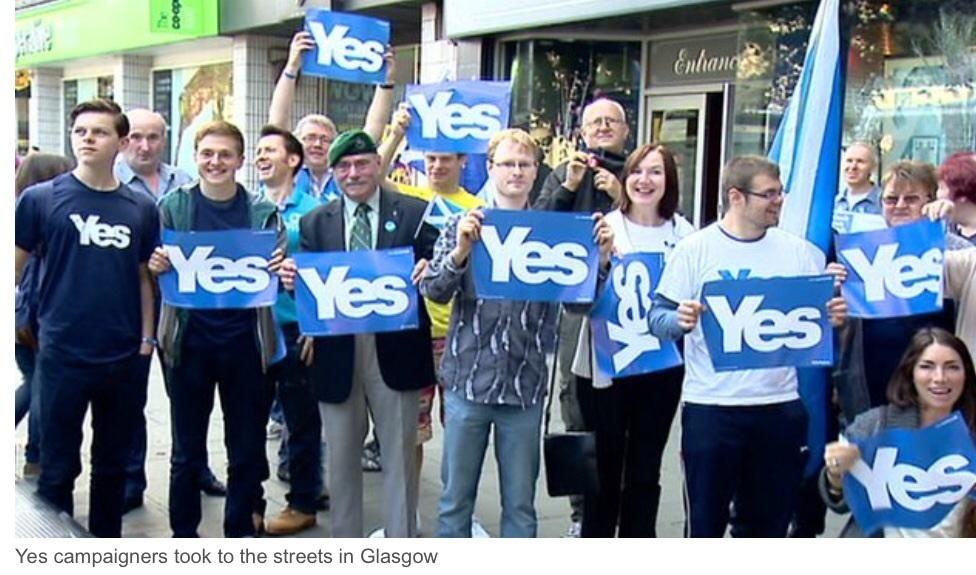
The picture the BBC chose to illustrate events in Glasgow’s Buchanan Street today:

Read the rest of this entry →
Category
media, pictures, scottish politics
Hello. Some of you will know me, but most of you won’t. That’s alright. That’s not important. All you have to know right now is that I’m just like you. We may well be on different sides in this referendum race – I’m on team Yes – but we are the same.
I come from a working-class family, in a working-class area of Glasgow. My father worked for Glasgow City Council in the Parks department, and I followed him there and spent seven years out cutting grass, planting flowers, picking up litter and raking leaves in the rain.

I joined the Labour Party when I was 17, and was a trade union activist a year later. I was a local branch chair at 21, and I was proud to have worked alongside the team at Keir Hardie House to deliver a Labour government in 1997. The Labour Party was my second home.
In 2001 I decided to go to university, so I signed up for night school and for a year I went religiously, doing three subjects a week on top of my job. I passed them all and chose Stirling, where I quickly became involved in student union politics. In my first campaign for an executive post I was tagged one of “Blair’s Poodles”. I wore my party colours on my sleeve.
Read the rest of this entry →
Category
comment, scottish politics
An interesting piece in the Herald today:

Right there, in just two sentences, the spirit of the Union: English people think they should have been allowed to force the Scots to remain in the UK against their will.
If 70% of English people voted against independence (or even in fact, if just 70% of the 56% who think they should have had a vote did), it would have vastly outweighed even 100% of Scots voting Yes. That, readers, is the respect the people of England have for Scottish self-determination and democracy. Every single Scot could have voted for independence, and England’s view is that they should have been able to, and would, force Scotland to stay in the UK.
We’re just going to leave it at that.
Category
comment, disturbing, scottish politics, uk politics
Yeah, okay, we know the joke doesn’t quite work because the spelling’s not right. But there’s already plenty of comedy in the fact that Richard Branson is the latest celebrity to sign up to the No camp. Why?

That’s why. Still, bless ’em for trying.
Category
comment, scottish politics
We couldn’t help but notice Labour peer, Stalin-moustache enthusiast and celebrity Bobby Ball lookalike Lord/Baron Robert Winston standing at the front of the party’s boorish stag-party gathering of MPs and MSPs in Glasgow yesterday, as Ed Miliband railed against the dastardly SNP and insisted that the NHS wasn’t under threat.
(We didn’t see Andy Burnham among the MPs in the footage, so we assume he was still down in London telling anyone who’ll listen that the NHS is under threat.)

And we couldn’t help wondering whether the peer’s presence was a tacit endorsement by Miliband of his proposal to charge people £120 a year to visit their GP.
Read the rest of this entry →
Category
analysis, disturbing, scottish politics, uk politics
An extraordinary letter sent out to members by trade union USDAW this week:

It’s not extraordinary that the union should choose to take a No position. It’s perfectly entitled to do that, and to advise its members of its view. It’s the last paragraph that blows us away. Not just the ironic juxtaposition of “Don’t let others decide what is best for you” with a direct instruction as to which way to vote, but the suggestion that “if you don’t know – then you should vote NO”.
Call us old-fashioned, but our reaction to not knowing something important is to try to find out. USDAW could have said “If you don’t know, here are some sources of information from both sides that you might find helpful” and added a couple of links to, at the very least, the Scottish Government’s white paper and the UK government’s “Scotland Analysis” reports.
Instead, it tells its members to remain ignorant and just do what they’re told. We can’t be alone, surely, in finding that a truly tragic place for the proud and honourable trade union movement of these islands to have found itself in.
Category
comment, disturbing, scottish politics
Former Labour spindoctor Charlie Whelan in the Strathspey & Badenoch Herald:

Click to enlarge as Whelan segues seamlessly from terrible Scottish “nationalism” to racial genocide in Auschwitz, because, you know, Yes voters are all basically Nazis*.
*George Galloway’s comments (made in his capacity as a nominated representative of “Better Together”) from yesterday’s BBC “Big Big Debate” were edited out of the broadcast version. We’re sure it was just to keep the running time tight.
Tags: smears
Category
comment, media, scottish politics
This is astonishing. From tonight’s BBC 6 O’Clock News:
Nick Robinson claims Alex Salmond “didn’t answer” his question at a press conference earlier today. That is a brazen and quite spectacular lie. The First Minister gave the BBC man a detailed and direct response which lasted for over three minutes BEFORE raising the matter of the Treasury link. You can see that response for yourself below.
Read the rest of this entry →
Tags: flat-out lies
Category
comment, media, scottish politics
Earlier today we showed you a clip from a press conference in which Alex Salmond schooled the BBC’s Nick Robinson in some basic financial facts about Corporation Tax, and went on to make a serious allegation about wrongdoing between the BBC and the UK Treasury, in which he claimed that the latter had broken Parliamentary rules by leaking market-sensitive information about RBS.
The BBC dutifully reported the story later in the day.
And as far as we can gather, the First Minister has everyone bang to rights.
Read the rest of this entry →
Category
comment, disturbing, media, scottish politics, uk politics