A failure of memory 65
Posted on
March 05, 2015 by
Rev. Stuart Campbell
In modern Scotland, you’ll struggle to find a politician from any party who won’t agree with two propositions: that Scotland is a nation and that devolution has, on balance, been a positive experience.
Debates about Scottish nationality are rare these days too. A substantial majority of Scots define themselves as “Scottish only”. Even UKIP has quietly ditched its plan to abolish Holyrood and now talks of forming a government.
But for all this consensus, Scotland’s inability to fully represent itself on the airwaves and onscreen remains one of the most critical issues we must now face up to.

The referendum created an eclectic range of alternative media. But, whether we like them or not, large media institutions like the BBC maintain a reach both online and offline that only a very select number of new platforms can begin to rival.
No single project can address this problem. Only a systematic renewal of Scotland’s media landscape will change the current reality of managed decline.
We’ve been observing for some time now that Scottish Labour deputy “leader” Kezia Dugdale has something of a tendency for making claims with a pious, strident conviction that’s in directly inverse proportion to how true they are.

And as we DO like to get our facts straight before we run around asserting things, allow us to illustrate our point with a case study.
The Daily Record is currently faithfully blaring out Labour’s anti-SNP “NHS in crisis” message, as part of the embattled party’s bizarre strategy of fighting a Westminster election solely on policies that are devolved to Holyrood, like health and education.

But an article on its website today dredges new depths even for the Record.
Yesterday we noted that nothing had yet been heard from Scottish Labour’s policy review into universal services, launched amid much hoopla in September 2012 off the back of Johann Lamont’s infamous “something for nothing” speech.

The party has spent much of its time since then attacking the SNP over social justice, claiming that universal benefits are a middle-class subsidy, hurting the poor by spending money on giving the well-off free stuff they could afford to pay for.
Professor Arthur Midwinter, the Labour-friendly academic the party hired to lead the review, was widely reported by the press vowing to “devote at least two days a week for up to two years to prepare a series of reports for the commission, which is being co-chaired by Labour MP Cathy Jamieson and finance spokesman Ken Macintosh”.
Those two years have come and gone, and nearly six months more, and there’s been no sign of a single report from the commission. And it turns out there never will be.
The Scottish media’s daily MurphyGram this morning (which is dutifully reported by the Scotsman, Herald, Courier and doubtless more) is that a vote for Labour in next year’s Holyrood election won’t mean a return to tuition fees for university students.

We’re not absolutely sure why a Holyrood election pledge is news just weeks out from a Westminster one, but we’ll let that slide, because we’re more interested – as ever – in what the reports DON’T say.
Scottish Labour’s mustard-keen Kezia “Deputy” Dugdale bravely tried a tweet all on her own on Friday without running it past Labour central office in London first.

It didn’t go too well.
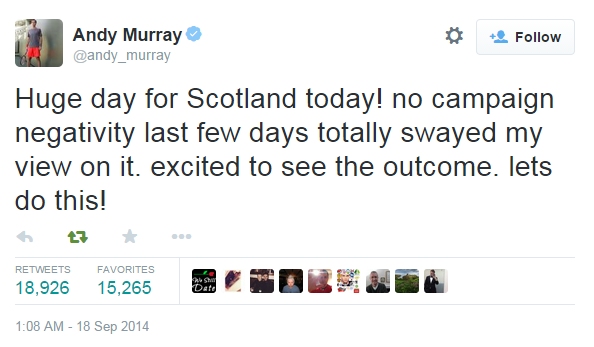
The categorical support of Andy Murray for Scottish independence, though only finally unambiguously revealed in today’s Sunday Times (the tennis star’s day-of-poll tweet backing Yes could by a strict semantic interpretation have been said to be somewhat equivocal), isn’t much of a surprise.

So it’s perhaps worth reminding ourselves what the media told us.
Scottish Labour MEP David Martin chats to the audience about TTIP.
Wings Over Scotland is a thing that exists.