Here’s the doom-and-gloom front-page headline of the Herald today:

It refers to a new report from the Nuffield Trust called “Learning From NHS Scotland”. Its 61 pages contain precisely one mention of independence. Let’s see what it said.
Read the rest of this entry →
Category
comment, media, scottish politics
We’re always loath to criticise political journalists for feeble stories published during the summer season, when parliaments are in recess and there’s nothing much happening to fill space with. But the Sunday Post has started pretty early this year.

Let’s see if we can put a number on the degree of “dilution” here, shall we?
Read the rest of this entry →
Tags: misinformation
Category
analysis, debunks, media, scottish politics
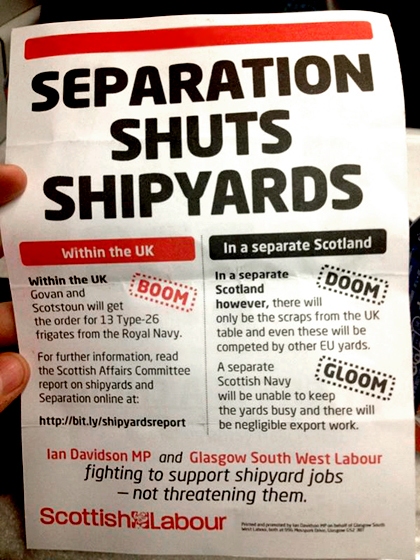
Of all the tropes of the 2014 independence referendum, few were fought over more repeatedly and bitterly, or more dishonestly by the No campaign, than the saga of the Type 26 frigates. The UK government promised Clyde shipbuilders hit hard by years of neglect and job losses that it would build 13 of the state-of-the-art vessels at BAE’s Scotstoun yard, but only if Scots voted No.
Once that vote was secured the number very swiftly dropped to eight, accompanied by a whirlwind of misinformation insisting that there had in fact been no reduction. (As keen social media users will know, this brazen lie was pushed particularly hard by the militarist website UK Defence Journal.)
So we were interested to see a story in today’s Scotland On Sunday which showed how desperate the Unionist side is to cling on to the ships as a future blackmail tool.

The paper has chosen to present the news with a super-positive spin, as you can see from the headline. But the text of the article tells a very different story.
Read the rest of this entry →
Category
analysis, media, scottish politics
The next five years of UK politics:

Tags: cartoons, Lorna Miller
Category
comment, uk politics
A very brief stat post, as our “regular” cartoonist is on holiday YET AGAIN.
Wings had just over 300,000 unique readers in June, despite taking the last couple of weeks off ourselves, bringing the monthly average readership for the first half of 2017 to 346,226. That’s 55,532 up on the same period last year, or a 19% increase.
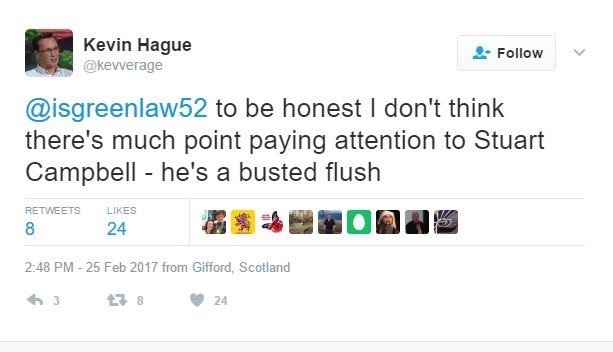
Rarely can a flush have been more busted.
Category
navel-gazing, stats
Pictured below are Ruth Davidson and her 13-strong* cohort of Scottish Tory MPs.

When they were elected earlier this month, the group rushed to tell anyone who’d listen that they were ready and willing to “defy” the UK leadership and act (ironically) as an independent party, standing up bravely for the people of Scotland.
They would be able to do so, they said, from a position of “unprecedented influence”, because without the Scottish Tory group Theresa May cannot get a majority to pass any legislation, even with the support of the DUP. It could be reasonably argued, then, that for that reason Ruth Davidson’s 13 are at least in theory the most powerful group of Scottish MPs in Westminster history.
So what concessions have they extracted with all that power?
Read the rest of this entry →
Category
analysis, scottish politics
Last week the walking monotone drone that is James Kelly MSP lodged a motion (an inescapably appropriate term for his output, it must be said) at the Scottish Parliament instigating his private members’ bill to repeal the Offensive Behaviour (Football) Act, having announced his intention to do so in February after putting together a ludicrously bogus “consultation” on the subject last year.

As ever, Kelly trotted out a mixture of baseless assertions and flat-out lies about the Act in support of his move, because apparently the most pressing issue currently facing Scotland, in the view of Scottish Labour, is that bigoted thugs must once again be free to sing about being up to their knees in Fenian blood, or lionise murderous terrorists, at sporting events without fear of prosecution.
Read the rest of this entry →
Tags: poll
Category
comment, debunks, football, scottish politics
…on last night’s article.
Because the Daily Mail isn’t standing for any of this confusion. It’s absolutely 100% clear that what’s happened is that the First Minister has U-turned and abandoned the prospect of a second independence referendum.

And also that she’s absolutely refused to do exactly that.
Read the rest of this entry →
Category
media, scottish politics
Just so we’re absolutely clear on what happened today:
There’s been a U-turn (The Sun):

Except that nothing has changed (the Scottish Lib Dems):

Let’s see if we can get a rhythm going.
Read the rest of this entry →
Tags: and finally
Category
scottish politics
1. No changes.
2. This article is over.
Category
comment, scottish politics
The Labour Party’s current state of euphoric hubris about losing another election is at least partly explicable. Jeremy Corbyn increased his party’s 2015 vote in England and Wales by a thumping 40%, took the highest vote share of any Labour leader since 2001 (beating Tony Blair’s 2005 victory by five points), the highest actual vote since Blair’s 1997 landslide, and deprived the Tories of their overall majority.

Those achievements are tempered by the fact that while Corbyn vastly overperformed expectations and certainly gave Theresa May a bloody nose (and might well end up depriving her of the Prime Ministership once her party gets a challenger together), the morning-after reality is that Tory rule has been extended to at least 2022 – by which time Corbyn will be 73 – with the nasty hangover of the empowerment of the DUP.
(With both Labour and Corbyn personally now leading in the polls it’s pretty much impossible to see the Tories losing a vote of confidence which would trigger another exemption to the Fixed-Term Parliaments Act. Any new election would very likely lead not only to a Labour government but to a Jeremy Corbyn Labour government, a prospect to chill even the most rebellious Tory into meek and sober compliance.)
But it would be churlish to dispute that Corbyn has put Labour in its best position for nearly 20 years. The same is emphatically NOT true of Scottish Labour, which hasn’t stopped the Scottish media from desperately trying to pretend otherwise.
Read the rest of this entry →
Tags: misinformation
Category
analysis, media, scottish politics