On the rare occasions when this site discusses football, and in particular if we mention the three-year-old Championship club known as “Rangers”, we get complaints on two grounds: one, that football has nothing to do with politics, and two, that we risk alienating supporters of the club who also back independence, of which there are unquestionably a significant number.
The second complaint is one we’ve dealt with in detail here. But the first one is more important. Because whether you’re talking about the original club which died in 2012 and was put into liquidation or the new one currently challenging for promotion to the top division for the first time, “Rangers” is a totem of the Unionist establishment in Scotland, and the way it’s treated by the media tells us at least as much about that establishment and that media as any amount of political journalism.
Alert readers will probably already be familiar with the philosophical proposition of Schrödinger’s cat. (The less alert can click the link for a short and easy primer.) The hypothetical experiment posited by 20th-century Austrian physicist Erwin Schrödinger has entered into popular culture. But increasingly and disturbingly, it’s also becoming the guiding principle of mainstream media journalism.
Certain viewers should steel themselves at this point, because we’re about to briefly talk about football before moving on to other things later in the article. You can consider that your trigger warning. We’ll let you know when it’s over.
The lines above were issued to the press yesterday by The Rangers International Football Club plc, a football club (the clue’s in the name) formed in 2012, yet which lays claim to the history and achievements of a previous club of a similar name which was liquidated for bankruptcy the same year, having been formed in 1872.
And eagle-eyed logic fans may have spotted something of a contradiction.
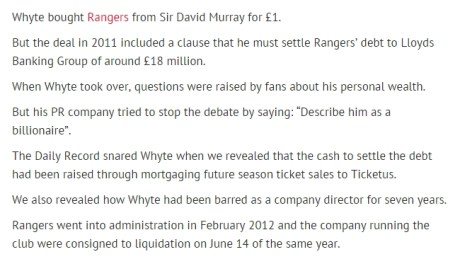
There’s an extraordinary article in the Daily Record today. Here’s a bit of it:
Alert readers might feel that a few lines have gone missing somewhere between paragraphs four and five. And the fact that they have has nothing to do with dead football clubs, and everything to do with the dying Scottish media.
Tonight’s games went as badly as they could have done for Scotland, pretty much as we suggested they would at the weekend, after a truly abysmal Scottish performance (an embarrassing 28% possession) saw them beaten 3-2 by Germany while Ireland scraped past Georgia 1-0.
But as we also said, and despite the clueless honkings of just about every pundit working in a TV studio tonight, it didn’t actually damage the team’s chances of making the playoffs very much.
A very brief post about football, because it was irritating to listen to the avalanche of gloom on social media on Friday night as Scotland lost to Georgia (again), and then have to watch this honking oaf go trolling.
Many pundits are of the opinion that the new Tory Max government will be actively hostile to the BBC, which the party has long believed is an expensive public-sector hotbed of right-on lefties. So when we did our latest poll, it seemed worth finding out how much the people of Scotland valued the state broadcaster.
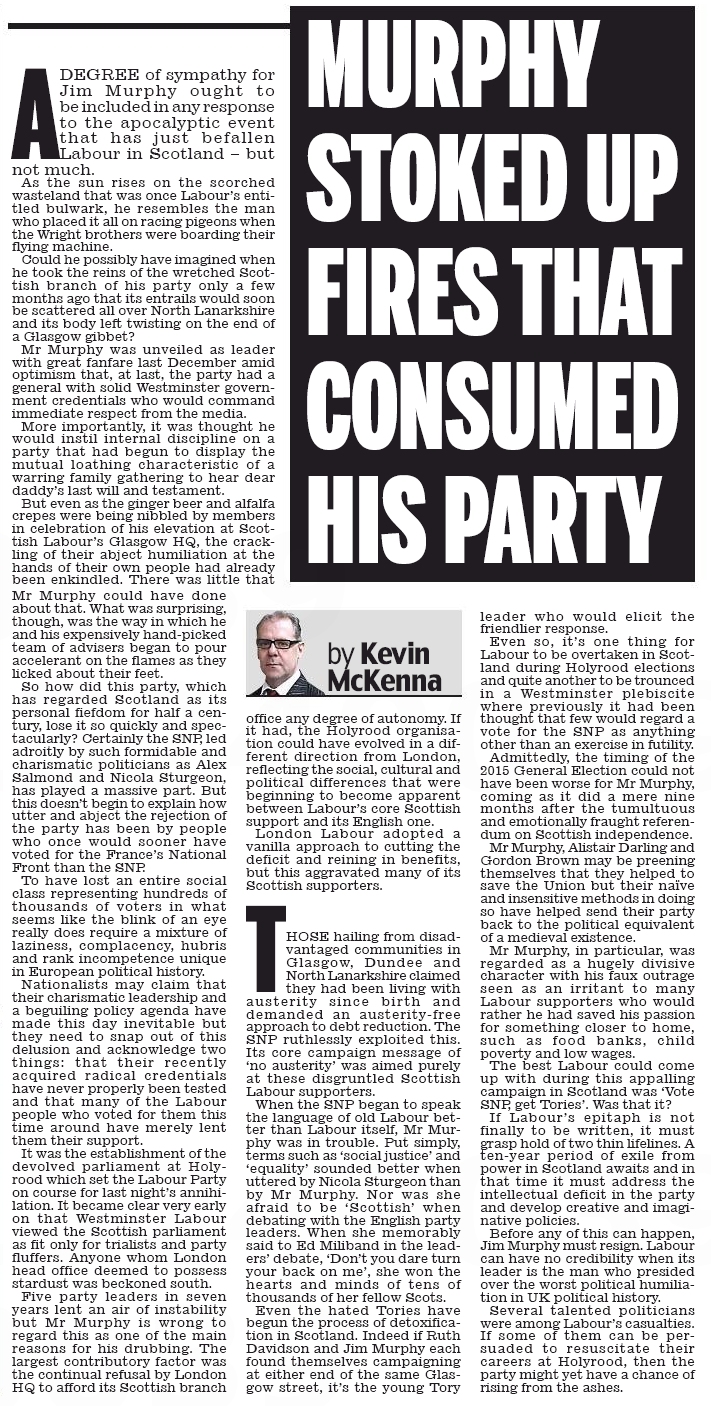
The reasons for Scottish Labour’s obliteration at the hands of the electorate last week are manifold, and most of them were very thoroughly explored in the weekend’s press, for example by Kevin McKenna here and here.
But as is our wont here on Wings, we wanted something a little more empirical to get our teeth into, so a few days before the election we commissioned a poll of 1,013 Scottish voters from Panelbase covering some of the subjects the regional office had campaigned on under its branch manager Jim Murphy.
It gets clearer with every passing day that Scottish Labour’s chief election strategy is to assume that Scottish voters are goldfish. There’s no other explanation for a piece in yesterday’s Courier on the SNP’s Jamie Hepburn’s call for the implementation of a 2009 report into which sporting events should be protected from pay-TV broadcasters.
The article concluded with some comments from Labour.
It looks very much as though Scottish Labour are pinning their hopes of recovery on “Glasgow Man”, and they’ve plainly decided he’s an Old Firm fan.
Today’s press release in the Scotsman – which oddly relegates Jim Murphy to second billing halfway down the page – goes under the unlikely headline of “Miliband will keep Scotland games on terrestial [sic] TV”, and claims that the Scottish national football team’s tournament qualifiers will be added to the “crown jewels” list of games which are only allowed to be shown on free-to-air terrestrial TV, not satellite pay channels.
TURABDIN on Still Time To Save Her: “And that is not just a western historic phenomenon, what happened thousands of years ago continues to influence the present,…” Oct 14, 11:43
Captain Caveman on Still Time To Save Her: “No “struck” nerves here, lad (FYI the correct expression is “touched (a raw) nerve”) You carry on making yourself look…” Oct 14, 11:17
Alf Baird on Still Time To Save Her: “Yes Turabdin, for the more privileged colonized native their oppression remains somewhat obscured via assimilation into the colonizer’s culture, an…” Oct 14, 11:08
TURABDIN on Still Time To Save Her: “@alf baird TRULY, it’s an affair of dont mention the Union, the giant union jack draped dinosaur occupying the comfy…” Oct 14, 10:45
Alf Baird on Still Time To Save Her: ““the Supreme Court is a superior court” Perhaps in regard to colonial law, but according to international law it is…” Oct 14, 10:38
TURABDIN on Still Time To Save Her: “southernbystander & captain caveman verily i may have struck your raw nerves on the matter…..invasion & conquest, the conquerors still…” Oct 14, 10:37
Alf Baird on Still Time To Save Her: “‘Cultural obliteration’ (Fanon) is a fundamental aspect of colonial rule, so why is Bella or anyone else all of a…” Oct 14, 10:34
Hatey McHateface on Still Time To Save Her: “Autocorrect substituted “wanging” with “wanting”. Could have been worse.” Oct 14, 09:43
Hatey McHateface on Still Time To Save Her: “It’s environmentally friendly, MH. Any temporary blip in carbon emissions is compensated for thousands of times over by the removal…” Oct 14, 09:29
Minceheid on Still Time To Save Her: “I’m trying to work out whether burning someone at the stake would be carbon-neutral or not. These things matter, you…” Oct 14, 09:06
Hatey McHateface on Still Time To Save Her: “Burn the heretic at the stake! That’s always the way to silence an inconvenient truth teller.” Oct 14, 08:54
Aidan on Still Time To Save Her: “Because Gender Ideology is an absolute driving priority for the SNP and the Green’s, whereas independence is merely a transient…” Oct 14, 08:49
Ex President Xiden on Still Time To Save Her: “Exactly. As I said elsewhere, the decision to charge never mind prosecute in cases like this, lies solely with the…” Oct 14, 07:39
Ex President Xiden on Still Time To Save Her: “The decision to prosecute in cases like this lies solely with the Crown Office. The police only follow their instructions.” Oct 14, 07:36
Willie on Still Time To Save Her: “Destroy the language,the culture, the history and you destroy the people. The UK needs Scotland’s resources and so that is…” Oct 14, 02:27
Bilbo on Still Time To Save Her: “Funny how there are sections of our society that has called on the Supreme court ruling about women to be…” Oct 13, 21:29
Bilbo on Still Time To Save Her: “These constant constitutional conversations are interesting when they are done on a civil basis but the reality is that they…” Oct 13, 21:11
Aidan on Still Time To Save Her: “As you know Alf – the Supreme Court is a superior court to the inner house (before we get into…” Oct 13, 20:09
Alf Baird on Still Time To Save Her: ““on ending the sovereignty of the Parliament of the United Kingdom over Scotland” Ignorance and wishful thinking on the part…” Oct 13, 19:56
Aidan on Still Time To Save Her: “Agreed Northcode – happy to let others decide, we’ve put our respective cases forward” Oct 13, 19:08
Northcode on Still Time To Save Her: “Thanks for the exchange. I think we’re reading the judgment differently, and that’s fine — the Supreme Court’s reasoning is…” Oct 13, 16:21
Aidan on Still Time To Save Her: “Sorry Northcode – you need to go back and read the case again in detail. What you are saying there…” Oct 13, 15:49
Northcode on Still Time To Save Her: “I think there’s a misunderstanding here about what the Supreme Court actually decided. The Court did describe a referendum as…” Oct 13, 15:15
Hatey McHateface on Still Time To Save Her: “sarah, have you tried using the “Contact” button at top of page?” Oct 13, 14:58
Hatey McHateface on Still Time To Save Her: “Frightening that people still have belief in the criminal justice system, isn’t it. Commit a serious sexual assault on a…” Oct 13, 14:52
sarah on Still Time To Save Her: “Rev, please re-post on here your article of 13th October 2024, “The Giant”. It will be a comfort to true…” Oct 13, 14:42
Anthem on Still Time To Save Her: “I hope you’re including Reform in that H.” Oct 13, 14:39
Aidan on Still Time To Save Her: “@Northcode – again that is objectively untrue, the Supreme Court did not say that the proposed referendum could not be…” Oct 13, 13:54
Hatey McHateface on Still Time To Save Her: ““curtailing them as the foreigners in their own Countries” There’s only one political party in with a shout of being…” Oct 13, 13:40
Hatey McHateface on Still Time To Save Her: “Always amusing to see Confused praising the Norwegians whilst simultaneously lambasting those who believe defense is a key government priority.…” Oct 13, 13:22