A strange phenomenon we’ve remarked upon a few times since the independence referendum is the inexplicable undying rage of a certain subset of Unionist voters.
Having won the vote, a casual observer might expect them to be happy, but instead they appear to exist in a constant state of fury.
(Our own best guess is that they were expecting to triumph by a crushing margin of two or three to one – some fretted that it might only be a 20-point victory – and then suffered the double blow of a much closer result that kept the Yes movement very much alive coupled with a massive surge in SNP membership and support.)
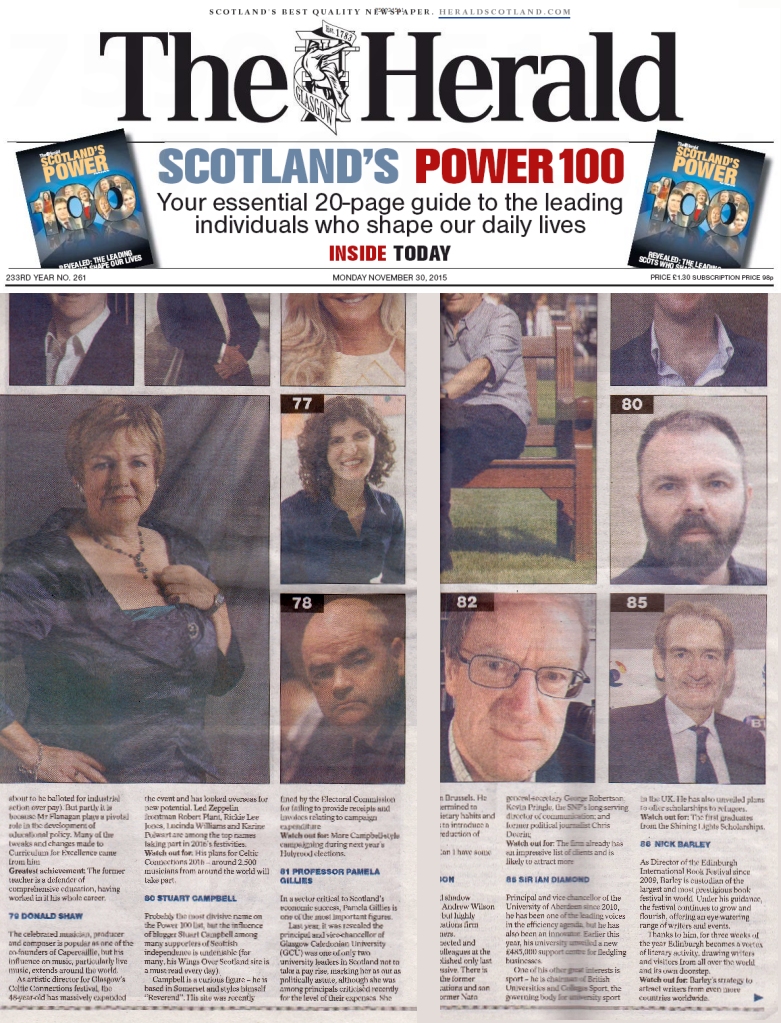
A demented anti-SNP tactical-voting campaign for this year’s general election – led by, among others, a frothing ultra-Loyalist-nutter-type by the name of Andrew Skinner – recorded one of the most spectacular failures in history as the Nats captured 56 out of 59 Scottish seats, only narrowly missing the other three, and the party’s poll ratings have continued to rise since then.
So this week, Mr Skinner decided to try for a more manageable target.
Let’s start off by losing some more friends. This site has no time for the Gaelic lobby. The obsolete language spoken by just 0.9% of Scotland’s population might be part of the nation’s “cultural heritage”, but so were burning witches and replacing Highlanders with sheep and we don’t do those any more either.
Being multilingual is an excellent thing, but the significant amount of time and effort taken to learn a literally-pointless second language (because everyone you can talk to in Gaelic already understood English) would be vastly better directed to picking up one that was actually of some use, and every extra fraction of a second spent scanning a road sign trying to find the bit you can read is a fraction of a second spent with your eyes off the road.
Non-primary native languages are a tool whose main utility in practice is at best the exclusion of outsiders, and at worst an expression of dodgy blood-and-soil ethnic nationalism. They’re a barrier to communication and an irritation to the vast majority of the population, who are made to feel like uncultured aliens in their own land.
But we’d still rather put up with Gaelic than complete idiots making our laws.
Earlier today Gordon Brown gave a speech in London, on a subject and for reasons which are unclear. It was widely trailed in the press, however, as an intervention in the Labour leadership campaign, with the particular goal of stopping Jeremy Corbyn from winning. It was – naturally – broadcast live and in full by the BBC News channel.
Corbyn wasn’t mentioned by name so far as we noticed, but to tell the truth we drifted in and out of the rambling, 49-minute, 30-page monologue full of celebrity namedrops and unconnected anecdotes, hypnotised as we were by Brown’s relentless pacing up and down the room like a caged animal.
Nobody who isn’t getting paid should have to endure the entire grimness of it, so using the magic of technology we’ve compressed it all down to a mere fraction of its length (just 20%) for you, but without losing any of the tone, content or intellectual nuance.
We offer it to you as an elegy. It marks the day that Labour reanimated the walking corpse of the only person left in the party that it considers to have any gravitas – not to win an election, but to try to crush the first man in living memory to enthuse tens of thousands of new members to join a political party in the hope of restoring the values it was created to uphold.
It is the day the soul of the Labour Party finally died.
These pages from the 14 March 1998 issue of NME (just 10 months after the election of Tony Blair’s first Labour government) are a fascinating historical document.
They needed saving. So we found them and we saved them.
Mark Beggan on Whatever Can Have Happened?: “Wings very own Father Jack Hackett. ‘Drink, Drink! Arse. Feckin Girls! Drink!’” Oct 1, 14:23
Aidan on Whatever Can Have Happened?: “So your polling says that support for a united Ireland in the EU is both 34% and 63% does it?” Oct 1, 14:15
Captain Caveman on Whatever Can Have Happened?: ““it’s like having a filthy thieving vagrant squatting in your front room, eating all your food, drinking your beer and…” Oct 1, 14:03
Captain Caveman on Whatever Can Have Happened?: “It’s not “squealing”, Fatso, it’s “unrestrained, raucous laughter (and pointing)” at you hilariously deranged foamers. Fucking state of you embittered,…” Oct 1, 14:01
sam on Whatever Can Have Happened?: “Polling in NI says that the current opinion is that support for a united Ireland is at 34%. Polling by…” Oct 1, 13:46
Mark Beggan on Whatever Can Have Happened?: “– the ones who dream. Dreaming is free. Everything else has a price. Even death has a price. But dream…” Oct 1, 13:29
Aidan on Whatever Can Have Happened?: “We get it mate – you hate the English, and thanks to a complete accident at birth you are somewhere…” Oct 1, 12:52
Hatey McHateface on Whatever Can Have Happened?: “The real world loves a winner, Confused. That’s the big problem with you instinctive tea towel sympathisers. You’re always sympathising…” Oct 1, 12:51
Hatey McHateface on Whatever Can Have Happened?: ““perversion of christianity” Careful, Confused, mask is slipping.” Oct 1, 12:34
Hatey McHateface on Whatever Can Have Happened?: “I think the issue is many from NI coming to live here. Unionists. Protestants. Stubborn, opinionated ones. And what that…” Oct 1, 12:32
Confused on Whatever Can Have Happened?: “Sometimes I end up watching the news through the night – it was during such that trump started all this…” Oct 1, 12:25
Hatey McHateface on Whatever Can Have Happened?: ““sic as the UN itsel” Last time I checked, Alf, Scots wasn’t a language recognised by the UN. Or at…” Oct 1, 12:25
Confused on Whatever Can Have Happened?: “this is why anglos rage – when their theft is blatant, no longer protected by cheap sophistry https://archive.ph/e4Gje “When the…” Oct 1, 12:23
Northcode on Whatever Can Have Happened?: “I’ve just realised that the “Three Phases of Decolonization” text functions like a mythic narrative built on the same structural…” Oct 1, 12:19
Captain Caveman on Whatever Can Have Happened?: “You cut a truly lamentable, laughable figure, Alf. No one to blame but yourself I’m afraid.” Oct 1, 11:38
Mark Beggan on Whatever Can Have Happened?: “Just another day in the NI. We don’t care. If you care so much then go live there.” Oct 1, 11:34
Hatey McHateface on Whatever Can Have Happened?: ““28 years of no marches, then permission given” Correct, permission given. By the same legal decision making process that didn’t…” Oct 1, 10:52
Alf Baird on Whatever Can Have Happened?: ““we’ve been shafted by our own kind” Well noticed, although postcolonial theory does tell us that ‘colonialism is always a…” Oct 1, 10:52
Hatey McHateface on Whatever Can Have Happened?: ““unless you class biblical names as Scottish” Superb ignorance of our historic Scottish Christian heritage there. Every now and again,…” Oct 1, 10:33
Hatey McHateface on Whatever Can Have Happened?: “C’moan, Bob, now do the bit where they all awarded themselves medals. Come tae think on’t, that might be the…” Oct 1, 10:19
willie on Whatever Can Have Happened?: “Yes, some interesting comments and speculations why Big John has shifted position and now wants an independent enquiry. One thing…” Oct 1, 10:02
sam on Whatever Can Have Happened?: “Long ago I knew the name Mina as the name of a woman who was of Scottish origin. It seems…” Oct 1, 10:00
robertkknight on Whatever Can Have Happened?: “Jeez… The Rev was simply quoting from Winnie Ewing’s speech at the opening proceedings in 1999, and whilst some may…” Oct 1, 09:42
Spartan 117 on Whatever Can Have Happened?: “Sorry Alf, that’s complete and utter pish. You can’t accept the simple truth (Occam’s Razor applied) that we’ve been shafted…” Oct 1, 09:35
diabloandco on Whatever Can Have Happened?: “I support Chas and I think the clue might be in the word temporary. Rachel wasn’t that Scottish either unless…” Oct 1, 09:28
Hatey McHateface on Whatever Can Have Happened?: “Noo, noo, CC, nae need tae be sae harsh. “Mr” Lavrov will be a bit of an expert on taking…” Oct 1, 09:25
John McNab on Whatever Can Have Happened?: “Your writings are almost always entertaining and absorbing, meenister, but when you come away with such achingly pretentious nonsense like,…” Oct 1, 09:17
Aidan on Whatever Can Have Happened?: “@CC – Lavrov and his boss “P” enjoy a favourability rating of around 3% in the U.K. So tying the…” Oct 1, 09:15