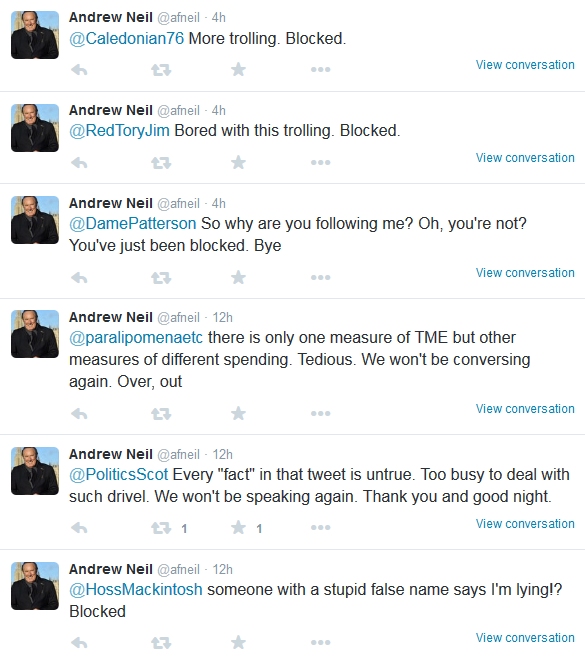
As we observed last night, the BBC’s Andrew Neil has reacted with rather poor grace to his chiding at the hands of respected statisticians Jim and Margaret Cuthbert. Neil embarked on a Twitter blocking spree and tried to rewrite history, claiming that he’d “simply offered” the blunt claim that there had been no cuts to the Scottish budget in the last five years “as one measure” of the money available to Holyrood.
The problem for Neil is that we recorded video of his Sunday interview with the SNP’s Angus Robertson, and anyone can see for themselves that Neil made an unequivocal assertion with no suggestion whatsoever that there were any alternative measures.

“In real terms there’s been – no – cut”, said Neil, spitting out the last three words with dramatic pauses between them for emphasis, in a statement whose stark absence of ambiguity unfortunately left him no wiggle room when the Cuthberts politely but firmly pointed out that it was “ridiculous” to argue that there hadn’t been any cuts, and that the budget “clearly has gone down”.
But Neil’s embarrassment is illustrative of a much wider delusion.
Read the rest of this entry →
Category
analysis, comment, debunks, idiots, scottish politics
We’ve had no answer from the BBC’s Andrew Neil to the question we asked him at the weekend. There has, however, been an interesting development in the debate over whether there have been severe real-terms cuts to the Scottish Government’s budget since the Conservatives came to power in 2010.

The extremely highly-respected economic analysts Jim and Margaret Cuthbert (the former of whom was Chief Statistician for the Scotland Office) have today written an article for Bella Caledonia seeking to establish the truth of the argument between Mr Neil and ourselves. Their conclusions are expert, detailed and very clear.
Read the rest of this entry →
Category
analysis, scottish politics
Labour put out a press release yesterday a few hours before the tax credits fiasco. It concerned the much-ballyhooed new arrangements for Scottish Labour “autonomy”, of exactly the sort that the branch office has been telling us it already had ever since the election of Johann Lamont as leader in 2011.

We were excited to find out what they were, because we’re sure this time they’ve definitely happened, not like all the times when they said they had but were joking.
Read the rest of this entry →
Category
analysis, comment, scottish politics
So tonight the Labour Party tweeted this:

It’s a lie.
Read the rest of this entry →
Category
analysis, comment, uk politics
We’ve been having a bit of a ponder over the effective passing into law of English Votes for English Laws, which has been remarkably little mentioned in Scotland’s media today. The BBC website has nothing about it at all on its Scotland front page, forcing readers to dig down into the politics section for some coverage.
The Daily Record, as far as we can tell, doesn’t have a word about it – nothing in the print edition and nothing online, even though as we write this it’s gone 3pm the next day, around 21 hours after the vote was passed in the Commons. The Scottish Daily Mail relegates it to a small feature taking up barely a third of page 12, even though the move supposedly ends the Union.

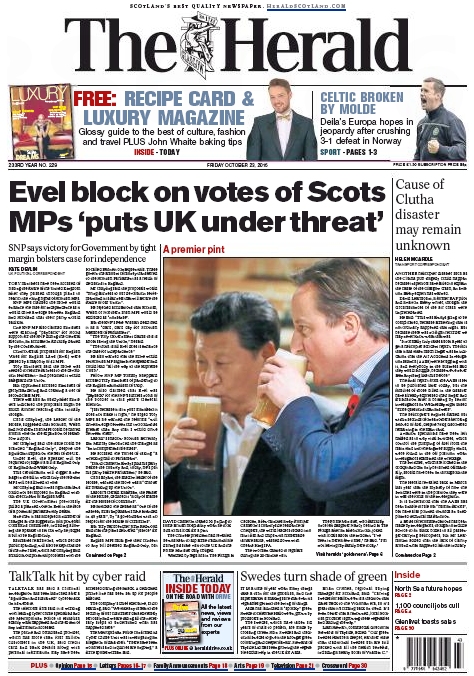
The Scotsman gives it a tiny corner of the front page and half of page 6, and only the Herald treats it as a lead story, although even there it only gets a couple of columns, less space than that devoted to a picture of David Cameron and the Chinese president Li Xinping having a pint in a pub.
All of which is remarkable, because it’s arguably the most radical change made to the UK constitution since the creation of the devolved Parliaments 16 years ago, and perhaps more significant even than that.
Read the rest of this entry →
Category
analysis, scottish politics, uk politics
The reaction of the Scottish media and political opposition to Audit Scotland’s annual report on the NHS today has been nothing if not predictable. But we thought you might like an instructive and enlightening look at the two very different types of approach they’ve taken to trying to mislead the Scottish people about it.
First up is the non-specific Scottish Labour apparatchik (as far as we’re aware he has no official role in the party since Jim Murphy quit – indeed we don’t know what he does for a living at all any more) Blair McDougall:

This is what we in the writing trade call a “flat-out lie”.
Read the rest of this entry →
Tags: flat-out liesmisinformation
Category
analysis, comment, media, scottish politics
This month we’ve been noting a sudden avalanche of factually-questionable articles in the media attacking the SNP’s record in government. At the weekend and yesterday we also picked apart a highly misleading and disingenuous claim by Andrew Neil on the BBC’s Sunday Politics that there had been no cuts to the Scottish Government budget since the Conservatives came to power in 2010.

And today we can see why.
Read the rest of this entry →
Category
analysis, media, scottish politics
We weren’t going to take Professor Adam Tomkins’ hysterical “NATMAGEDDON!” article for this week’s Spectator seriously enough to pull it apart line by line.

But once we’d wiped the tears from our eyes we thought we’d better do our job.
Read the rest of this entry →
Tags: flat-out liesmisinformation
Category
analysis, comment, debunks, media, scottish politics, uk politics
As readers may have noticed, it’s been an extremely slow news week this week. The papers, having strung out the Michelle Thomson “crisis” beyond all endurance, have been reduced (in the case of today’s Daily Mail) to printing shock-horror pictures of her still sitting beside SNP MPs in the Commons, so little else is there to report.

(As far as we’re aware the Commons doesn’t have an official naughty step, so even if Thomson HAD been found guilty of doing anything wrong she’d have had to sit on the opposition benches just the same.)
But it seems the dastardly Nats have been getting up to something even worse than associating with a (currently) former colleague.
Read the rest of this entry →
Category
analysis, media, scottish politics
After this, this and this we were really hoping we’d never have to revisit the subject of the D’Hondt Method and get our calculator out again.

But OH NO!
Read the rest of this entry →
Tags: misinformation
Category
analysis, debunks, scottish politics, stats