As the mandate for a second independence referendum currently sits gathering dust in the SNP vaults, discussion has started on ways to generate some movement. One of these has been the possibility of a Wings political party being set up to campaign for Holyrood list seats, which has generated rather a lot of attention.

Various pundits have been loudly vocal about the perceived pros and cons, but I’ve been extremely dissatisfied – in particular with those dismissing the value of a Wings party – with the quality of evidence and analysis that they’ve produced to justify their negative opinion. So I thought I’d use my day-job skills in commercial data science to analyse and understand the benefits, or otherwise, of the idea.
Read the rest of this entry →
Tags: Gavin Barrie
Category
analysis, debunks, psephology, scottish politics
Yeah, we know, that could be a really long article. But we have a specific thing in mind.
Over the last few days, Jo Swinson and Willie Rennie have both endured toe-curling interviews trying to defend the comically-indefensible hypocrisy of the party’s positions on Brexit and independence.

(If you haven’t been following, official policy now is that a Lib Dem election win is a clear and unimpeachable mandate to carry out their manifesto promises, but an SNP election win isn’t a mandate to carry out theirs.)
But it’s not the mere crass, transparent hypocrisy that makes them stupid.
Read the rest of this entry →
Category
analysis, comment, idiots, scottish politics, uk politics
In normal times we’d at least find today’s landmark defeat of the UK government in a Scottish court amusing. But these are not normal times, and at the present moment our toxic loathing of every politician in Westminster makes it a bitter fruit.
Although we must admit this bit still did manage to raise a smile:

(The reason, incidentally, is that the English High Court wasn’t sitting in August.)
What does it all actually mean, though? Well, nothing good.
Read the rest of this entry →
Category
analysis, scottish politics, uk politics
We saw this earlier, and thought “Oh God, what now?”

So we had a look.
Read the rest of this entry →
Category
analysis, europe, idiots, uk politics
Supporters of the opposition’s plan to block a no-deal Brexit have been proclaiming vindication this weekend over a couple of polls which show significantly lower support for the Tories, and a lead for Labour, in the event that a general election is called after 31 October with Brexit not having happened.
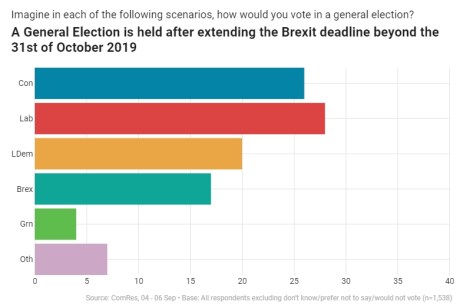
In that scenario, Tory voters tell pollsters that they’re more likely to defect to the Brexit Party, and the resulting split in the Brexit vote appears to point towards a Labour-led government if you plug the figures into a site like Electoral Calculus.
The reality is much more complicated than that. But what we’re specifically interested in is how it would affect the chances of securing a second indyref, so let’s take a look.
Read the rest of this entry →
Category
analysis, psephology, scottish politics, uk politics
So, British politics, eh? We’re basically on strike until things make at least an iota of sense, because there’s no point in attempting political analysis right now when events can overtake you before you’ve finished typing a sentence.

But let’s just have a quick recap on what we know.
Read the rest of this entry →
Category
analysis, comment, europe, idiots, scottish politics, uk politics
We really can’t be bothered with having the GERS “debate” again, in which all the same people make all the same exactly opposite spins on the exact same data. Minor annual fluctuations aside, the core reality is the same as the one we repeat every 12 months, and serious economists on both sides of the political divide still treat the figures with the disdain they properly merit.
One such person is Richard Murphy, and in an excellent piece today he posted a version of this graph which did catch our jaded eye. It purports to show the share of UK debt supposedly accounted for by Scotland – which has, let’s remember, just 8% of the UK’s population – in each of the last 16 years, and which immediately prior to the SNP’s 2011 majority stood at almost exactly that of our population share.
(Which is itself a gross calumny against reality, but let’s stay focused.)

How very remarkable, some readers may feel, that the extent of Scotland’s supposed responsibility for the UK’s debt should have rocketed so very dramatically at the exact point when independence became a live political question.
It does rather make you wonder why the UK government, scraping as it is for every penny of possible savings, seems more and more desperate to hang onto Scotland as the terrible economic burden we become on the rest of the country grows ever heavier.
Truly, our partners in this great equal and bountiful union must be the most generous and forgiving people on Earth. We don’t deserve them.
Category
analysis, comment, scottish politics, stats, uk politics
Oh dear God in Heaven, not THIS again.

Helen Thompson is apparently the “Professor of Political Economy” at Cambridge University. No wonder the country is being run by imbeciles.
Let’s speak really slowly and see if the idiots can get it into their thick heads this time.
Read the rest of this entry →
Category
analysis, comment, debunks, idiots, media, scottish politics, uk politics
This poll from Opinium came out a few days ago, but didn’t get as much attention as people might normally have expected, possibly because it was presented in a very difficult-to-follow graphical form. So we’ve sorted it out, and also added in the missing Lib Dem voters.

The takeaway is that a clear majority of voters both in Scotland and the UK now believe that the UK government should accept the Scottish Government’s request for a second independence referendum.
Read the rest of this entry →
Category
analysis, comment, psephology, scottish politics, uk politics
Crazy stuff happens when we have a thought.

Buckle in for a bumpy ride if you don’t like pictures of my ugly mug.
Read the rest of this entry →
Category
analysis, media, reference, scottish politics, stats
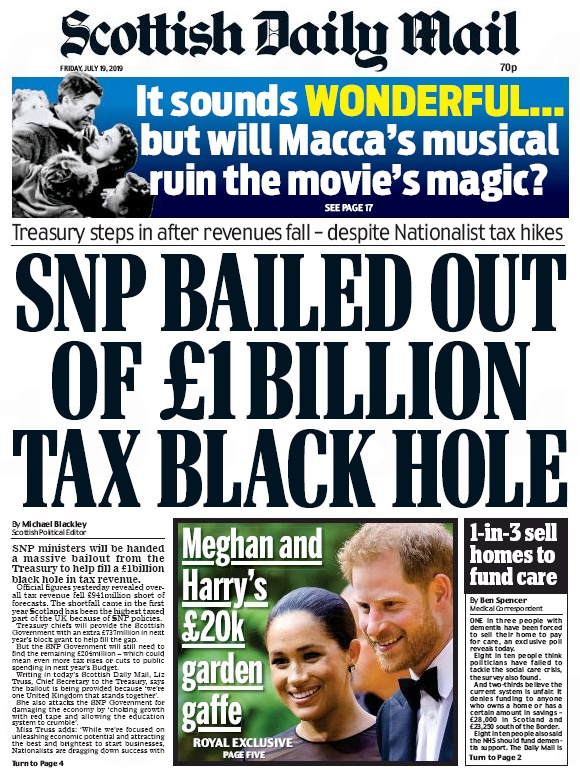
From today’s lurid Scottish Daily Mail cover splash about a “£1 BILLION TAX BLACK HOLE” appearing in the Scottish budget “despite [imaginary] Nationalist tax hikes”:

But hang on a minute.
Read the rest of this entry →
Category
analysis, media, scottish politics
Last night, grudgingly, we watched the whole of the final Tory leadership debate, for a contest in which pretty much everyone believes Boris Johnson has already gathered enough votes to comfortably win even though there are several days of voting to go.

The headline outcome the media appears to be focusing on is that both candidates proclaimed the Irish backstop “dead”, to which the EU’s response will without a doubt be “Is it, aye?”
So where does that leave us? Let’s have an update.
Read the rest of this entry →
Category
analysis, comment, europe, scottish politics, uk politics