Last week, Yes voters only hated their families, not Scotland.

This week it’s both. Can you feel the fear, readers?
Category
comment, scottish politics
So worn-down are we by the job of scrutinising Scotland’s exhaustingly terrible media for three years for you, our beloved readers, that we often can’t bring ourselves to watch current-affairs shows live any more, steeling ourselves to catch up with them on iPlayer only if people say there was something of particular note on them.
We’re glad we didn’t miss this, though. Because it might be the case that no politician in human history has ever been as hopelessly, pitiably, comically out of his depth as Willie Rennie was on this morning’s Sunday Politics Scotland.
Read the rest of this entry →
Category
analysis, comment, scottish politics, video
Thank goodness there are only 18 days of the independence campaign remaining. We’re not sure we have the capacity to absorb much more idiocy like the below.
Read the rest of this entry →
Tags: arithmetic fail
Category
comment, idiots, media
If you’ll forgive one of my very rare switches to the first-person view, readers, I’ve found the last few days in the independence referendum particularly weird.
That’s because my current life is curiously mirroring my previous one as a videogames journalist. The gaming community is at present mired in a convulsive orgy of the most mindboggling horror over something called “GamerGate”, which I couldn’t even begin to decribe adequately to you, because frankly you wouldn’t believe me and I’m not sure the words exist to do it justice anyway.

By way of illustration of that fact, this article on games website VG24/7 is, genuinely, by far the best, most accurate summary and analysis of the situation that I’ve read. (Twitter followers will already have seen me tweet a couple of random samples of what’s going on. I urge you, if you can, to endure the entirety of that second link, and note that it’s had almost FOUR HUNDRED THOUSAND views.)
But while proving that the sort of abusive insanity pervading the world of videogames makes even the absolute worst of indyref name-calling look like two kittens with woolly hats on having a meow-off over who gets first shot at a saucer of milk, the core principles are the same – a tiny handful of total boneheads having their actions blown out of all proportion by the press in a shock-horror frenzy bearing no relation to the actual experiences of 99.9% of people.
Read the rest of this entry →
Category
comment, culture, media, scottish politics
Last week I was working in the tattoo studio and got chatting to a client on whom my colleague was completing a large, Japanese-style sleeve on his upper arm and chest. He was sitting upright in his chair, stripped to the waist, his new ink glowing.
We got talking about the referendum. Unusually, this guy was a No voter. I say ‘unusually’ because the vast majority of our clients in the studio are vocally keen Yes types. Perhaps there’s something in the inked person’s character – a bohemian or experimental quality that naturally favours thoughts of change or progression.

This guy was a very nice, friendly, middle-aged small business owner from North Lanarkshire. As a Yes voter, I try not to get too preachy on the subject in the studio simply because it wouldn’t be professional – I wouldn’t want to get into any kind of heated debate with someone I have to tattoo for hours on end.
Still, I lightly prodded him on some of the independence issues. I was curious to hear his perspective as I rarely encounter it in someone face to face.
“Bad for business”, he mumbled in an offhand way. “I just don’t like the sound of it”
Read the rest of this entry →
Tags: perspectivesTim Sandys
Category
comment, culture, scottish politics
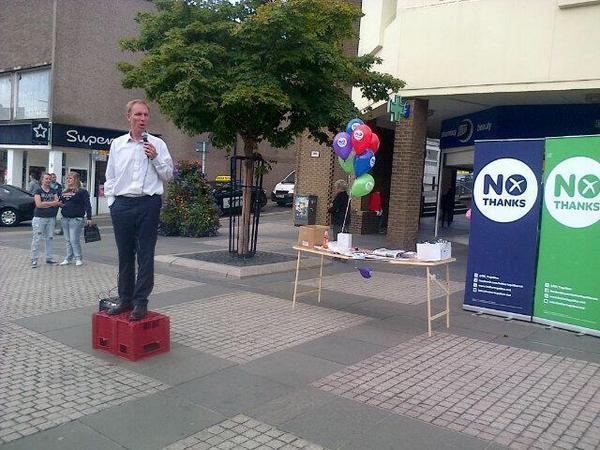
Earlier today we bemoaned some chump throwing an egg at Jim Murphy this week during his Shouting At Old Ladies In Shopping Centres Tour of Scotland, thereby enabling the Scottish press to enjoy an easy orgy of hypocritical “cybernat”-baiting. Murphy has unsurprisingly made the most of the incident, suspending the tour and bizarrely alleging that Yes Scotland is directly co-ordinating the abuse.
Egg-throwing is of course an act of protest rather than violence, and reactions to it tend to depend on whether you support the politics of the “victim” or not. (After all, the entire point of using an egg is that it’s fragile and breaks on impact, making a mess but doing no damage – insult rather than injury.)
This long-standing form of protest was treated as a national joke when someone did it to John Prescott – as was his actually violent reaction – and we don’t seem to remember anyone minding too much when it happened to Nick Griffin.

(For all his vileness, Griffin was a democratically elected politician just as Murphy is.)
Now, we actually have no way of knowing that this week’s culprit was a real Yes supporter rather than a stooge – it seems odd that with Murphy surrounded by so many Labour goons at every event and in a very public place, nobody managed to apprehend or photograph the assailant. But let’s apply Occam’s Razor and assume for the purposes of this piece that they were a genuine disgruntled opponent.
Because the question that then arises is “What else could they do?”
Read the rest of this entry →
Category
comment, scottish politics, uk politics
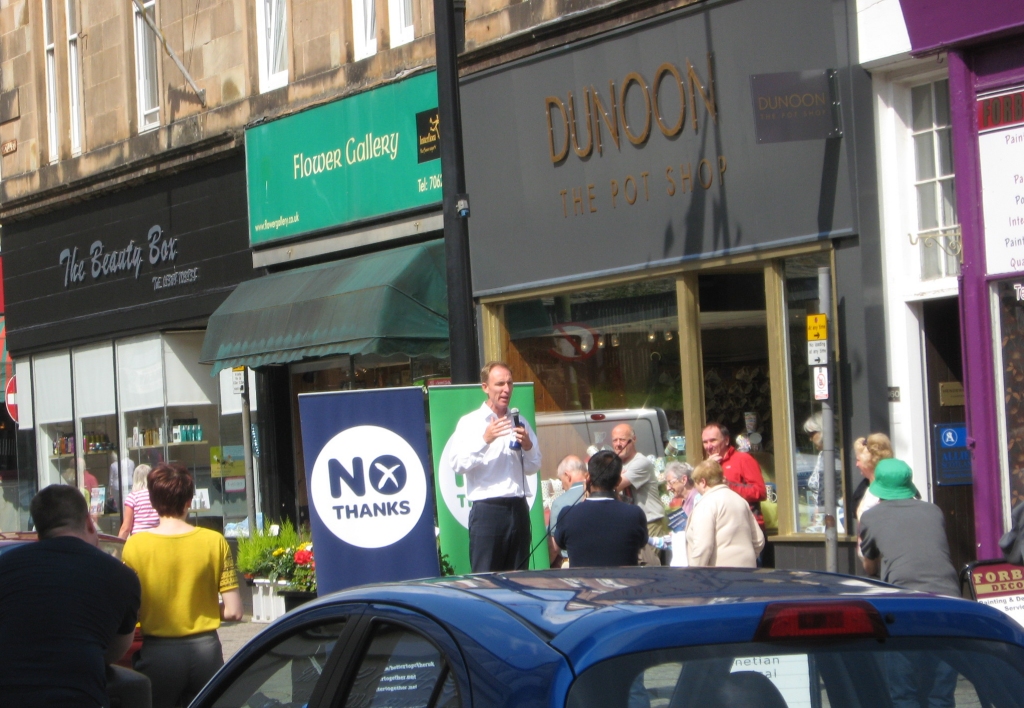
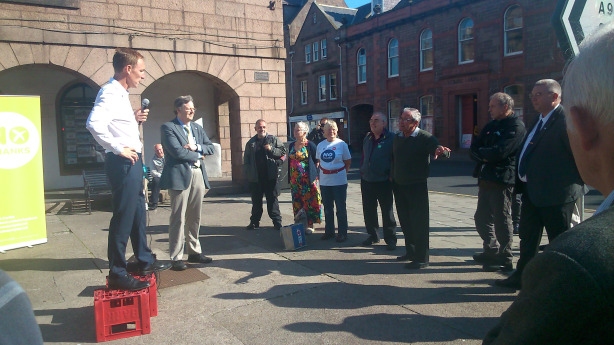
A couple of months ago we observed that Jim Murphy’s sparsely-attended tour of 100 Scottish street corners appeared to be mostly populated by Labour politicians and activists following him around multiple locations to pad out the, well, let’s call them “crowds”. It’s interesting to note that he now seems to have abandoned any pretence.

And it makes the point of the exercise a little hard to discern.
Read the rest of this entry →
Category
comment, scottish politics
This is Polly Toynbee of the Guardian and Eddie Bone of the Campaign for an English Parliament in a remarkable nine minutes of “Good Morning Scotland” this morning.

It’s the nearest to sounding like a Yes voter you’ll ever hear James Naughtie. Enjoy.
Tags: and finally
Category
audio, comment, scottish politics, uk politics
One of the most commonly-observed facets of the independence referendum so far has been the lack of a real grassroots “Better Together” campaign, and as a historian of Scottish popular politics I’ve found myself pondering why there wasn’t one.

It’s not like there aren’t thousands of Scots who passionately believe in the Union and will be voting No, and are perfectly capable of arguing their case. We all know some – I certainly do, both family and friends. But there’s no organised grassroots campaigning of any serious note. Tiny handfuls of Labour activists, some of them shipped up from England and paid, have done almost all of the donkey work so far.
But as a historian of Scottish popular politics I should have an explanation, shouldn’t I? And when I had a think about it, something occurred to me.
Read the rest of this entry →
Tags: Mark Nixon
Category
analysis, comment, culture, history, scottish politics