Scotland On Sunday has a very odd front-page splash today.

In a truly remarkable feat of sheer journalistic incompetence, the paper’s Tom Peterkin manages to cover three pages discussing the idea of an independent Scotland renting the Faslane naval base to the UK without once even mentioning the two very recent opinion polls conducted on that exact subject, on both sides of what would in those circumstances be the international border.
But that’s not the weirdest bit.
Read the rest of this entry →
Category
analysis, media, scottish politics
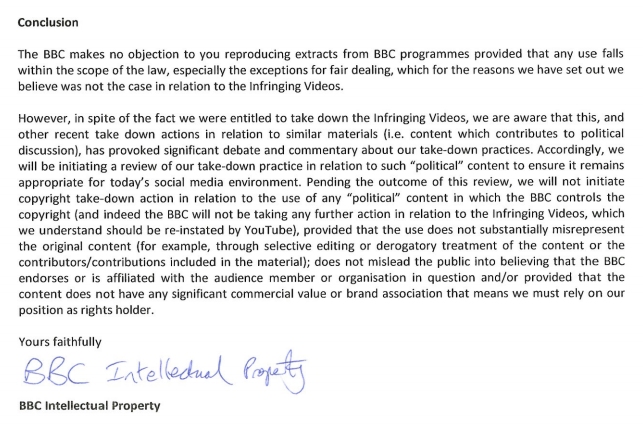
Right, let’s wrap this up and hope some actual politics happens soon. By now readers will presumably be aware of our successful fight against the BBC’s shutting down of our YouTube channel last week. The channel is now fully back in service, including all 13 of the clips the BBC complained about.

But the job’s by no means all done. Technically the restoration is only temporary while the BBC conducts a “review” of its attitude towards copyright of news clips, and Peter “Moridura” Curran’s large YouTube archive remains terminated (although we’re not sure to what extent he’s pursuing its return).
And quite a few questions are still hanging unanswered in the air.
Read the rest of this entry →
Category
analysis, disturbing, investigation, media, scottish politics
Before we were so rudely interrupted, we were about to write a little more about the issues around the BBC’s takedown of this site’s YouTube channel. Because while we got a very respectable five-and-a-half minutes on Good Morning Scotland earlier today, you never have the time on radio or TV to say everything you want to.

Incidentally, we get the impression – nothing more solid than that – from a number of sources that BBC Scotland are somewhat out of the loop over the whole affair, and the impetus to silence Wings has actually come from London, which is slightly scarier. But aside from that, there are a number of really rather disturbing aspects to the situation.
Read the rest of this entry →
Tags: memory hole
Category
analysis, comment, disturbing, media, scottish politics, wtf
Oh God. Would you look at the absolute state of this, readers?

Let’s make like everybody’s mental health and break that down.
Read the rest of this entry →
Category
analysis, apocalypse, comment, europe, uk politics
The Daily Record’s politics lead story today is a slightly underwhelming poll that shows 41% of Scots believe the Tories are carrying out a power grab against the Scottish Parliament, against 34% who think they aren’t (and 25% who have no idea).

Which seems a good time to round up the last results of our own most recent poll, and some slightly disturbing revelations about the Scottish public’s grasp of devolution.
Read the rest of this entry →
Tags: poll
Category
analysis, scottish politics
Alert readers may recall that a few weeks ago we revealed how an independent Scotland could reduce its budget deficit by billions of pounds a year – by renting out the Faslane naval base to the rest of the UK to keep their nuclear weapons in.

Voters in England, we learned, were more than happy to pay Scotland £5bn annually – and perhaps even more – for a Trident submarine park during the decades that it would take to build a replacement base south of the border.
Of course, that plan is only any good if the people of Scotland would accept it too.
Read the rest of this entry →
Tags: poll
Category
analysis, scottish politics, uk politics
So this is an interesting one. The UK government currently finds itself in an appalling mess over the UK’s post-Brexit relationship with Ireland, due to the inconvenient fact of a small part of Ireland being in the UK, and has no idea what to do about it.

The closest thing Westminster has to a plan – and it has to be said that it’s not VERY close to a plan – is the so-called “backstop”, which isn’t a backstop at all and merely kicks everything down the road a couple of years, and which the EU has already said is a non-starter.
The fallback on the backstop, as announced last December, is “regulatory alignment” on the island of Ireland, which would effectively mean Northern Ireland staying in the EU and a border coming into existence in the Irish Sea (or to be more geographically accurate, the North Channel).
This would be, um, bitterly opposed by the DUP, on whom Theresa May’s government notionally depends, but given the absolute trainwreck of Labour’s position on Brexit it’s not at all clear that the DUP’s opposition would be enough to scupper any vote, so it could happen anyway, opening a simply massive can of worms.
That’s about the shortest rendition of the situation we can manage. But of course, in reality it’s much more complicated than that.
Read the rest of this entry →
Category
analysis, europe, scottish politics, uk politics
We noticed a recurring theme in our latest Panelbase poll. In recent years Scottish politics has of course been defined mainly by the constitution, with all three major UK parties united in opposition to the SNP more or less reflexively. But if you strip out questions about the constitution, voters have largely reverted to the previous norm of a broadly centre-left consensus against the Conservatives.
For years now Lib Dem voters have shown up in polling as essentially Tories Lite, not because individual people’s opinions had changed but because most of the party’s traditional left-leaning voter base had abandoned it in disgust after the 2010 coalition which saw Lib Dem support plunge from 23% to 8% in a single Parliamentary term.

But now – although Lib Dem support has barely increased – things are changing.
Read the rest of this entry →
Tags: poll
Category
analysis, scottish politics
Yesterday we reported on the Sunday Herald’s bizarre and blatant reversal of the plain facts about OBFA prosecutions in its front-page lead. But it wasn’t the only paper pulling that trick this weekend.

The Sunday Times ran a major piece on results from a poll it conducted at the same time as our most recent one, spinning the outcome as voters rejecting the SNP’s plan to boost the Scottish economy via more immigration.
But as so many stories in the press do, the article simply disintegrated before readers’ eyes almost immediately after the headline.
Read the rest of this entry →
Tags: misinformation
Category
analysis, debunks, media, scottish politics
In our latest Panelbase poll, we asked the same independence question we asked in the last one, and got much the same answer. (Technically the indy vote went up by about a sixth of one percent, but that’s statistically meaningless.)

That’s a bit disappointing after the events of recent weeks, but also not very surprising – after all, the way the question is framed pretty much guarantees at least 38% of the population will choose the second option straight off the bat.
Much more interesting is the question we asked next.
Read the rest of this entry →
Tags: cringepolltoo wee too poor too stupid
Category
analysis, comment, culture, disturbing, europe, scottish politics
As alert readers will know, we’ve heard little from the Unionist parties in Scotland over the last couple of years but “SCOTLAND SAID NO!”, “SCOTLAND DOESN’T WANT ANOTHER REFERENDUM!” and “WHAT PART OF NO DON’T YOU UNDERSTAND?”
That clutch of blunt, angry slogans was (and remains) pretty much the entire Scottish Conservatives manifesto, for example, and it rests on the claim – based on some extremely misleading selective reading of opinion polls – that the nation is implacably opposed to a second vote. The reality, as we know, is somewhat more balanced. But it’s never been quite THIS balanced before.

Read the rest of this entry →
Tags: poll
Category
analysis, scottish politics
Part 1: the story.

This year’s Scottish Social Attitudes Survey has found, yet again, that Scottish people trust their government in Holyrood vastly more than they trust the one in Westminster. The figures transcend party loyalties, with far more people saying they trust the Scottish Government than vote for the SNP.
Trust in both governments was down by five points, which meant the Scottish Government had lost 7.6% of its trust (66 down to 61) while the UK government had lost 20% of its trust (25 down to 20).
Now let’s see how two newspapers owned by the same company reported the news.
Read the rest of this entry →
Category
analysis, comment, media, missing context, scottish politics, stats