Organisation does job 166
Posted on
October 13, 2013 by
Rev. Stuart Campbell
This is the front page lead story from today’s Sunday Post:
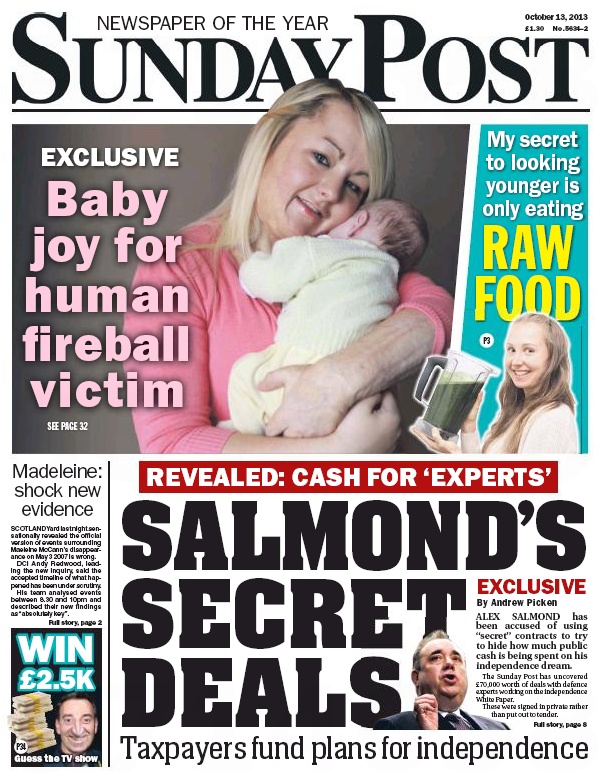

There’s a curious line there. Can you spot it?
This is the front page lead story from today’s Sunday Post:
There’s a curious line there. Can you spot it?
We must confess, we’ve never quite understood the No campaign’s longing to turn the independence referendum into one on Alex Salmond. The First Minister certainly divides opinion, but his personal ratings are consistently more impressive (and by a considerable distance) than poll figures for Yes.

The latest one we could find (from a month ago) suggests that if the referendum question was “Do you want to entrust Scotland’s future to Alex Salmond?”, the Yes side would win by an 11% margin on an 85% turnout.
So it makes stuff like this, from today’s Sunday Herald, all the more puzzling.
From another ridiculous, barrel-scraping right-wing tabloid piece today:
Welcoming refugees from all corners of the globe, while simultaneously promoting “separatism”? Is it just us, or is there maybe a wee bit of a logical contradiction there?
The stench of panic from the No camp is getting overwhelming.
Few people seem to have noticed the appearance of a new TNS-BMRB Scottish opinion poll today. After taking a bit of a savaging for their previous poll, whose sample suggested that Labour had won the 2011 Holyrood election, the company has changed its methodology to reflect reality – though it’s made little difference to the headline findings, of which the most dramatic aspect is the huge 31% figure for “Don’t Know”.

The Yes camp still needs a 10% swing to catch up, but as readers will know we place very little store by the Yes/No questions in polls this far out, with the white paper still unreleased. We’re a lot more interested in digging around in the data below the surface, and this poll has one particular nugget that caught our eye.
Those clued-up, cutting-edge sorts among you who follow our Twitter account will have seen this last night, but it definitely needs to reach a bigger audience.
It’s a recording of a meeting held by Clydebank TUC earlier this month on the subject of whether the working class should support independence. The working class is the sector of the Scottish public whose voice is least heard in the debate (which is largely dominated by middle-class media-intellectual sorts), and perhaps not coincidentally is the demographic which tends to favour independence most strongly.
The footage is raw and often angry, and readers sensitive to adult language might wish to steer clear. Anas Sarwar probably wishes he’d done the same.
If you’ve been waiting (as we have), here are all six episodes of Jack Foster’s superb overview of the Scottish political scene, collected into one punchy 34-minute film.
Adam Curtis would, we hope, be proud.
Particularly alert readers will have noticed that this site isn’t called Wings Over Wales. Which is a shame in one sense, because “WOW” would be a great acronym to have.

But we’re going to make an exception to our normally all-Scottish, all the time agenda today, because of something that happened in the smaller of mainland UK’s sub-states about which we happen to have some personal experience, and which ties in to Labour peer Lord George Robertson’s extraordinary assertion in a debate last month that Scotland has “no language or culture or any of that”.
We’ve highlighted some truly gruesome displays of anti-Scottish bigotry on this website over the last couple of years, the large majority of them from right-wing English newspapers. But today sees perhaps the worst case we’ve ever seen, and we’re sad to report that the blame for this one lies squarely at Scotland’s own door.

We hope you have a strong stomach.
It’s funny what people think when they only read the Daily Express.

(Click image for source.)
That doesn’t happen terribly often.

But on this matter, we simply can’t find fault with her logic.
I was introduced to politics at a very young age.
One of my first memories is of watching John Major giving a speech of some kind on television, possibly to do with Black Wednesday. I was only three at the time, so the conversation of the adults around me went somewhat over my head, but I learned early on that words like “government,” “Prime Minister,” and “economy” were important ones.

I was old enough to be aware of the palpable feeling of relief when Tony Blair won in 1997, and I remember celebrating with my mother when the double “Yes” result came in the same year. Devolution, I learned, was about getting the best deal for Scottish voters. But Scottish independence, for most of my life, simply never crossed my radar.
Below is an extract from an article published in the US quarterly Dissent Magazine, entitled “Cockblocked by Redistribution: A Pick-up Artist in Denmark”.

We tweeted a link to it yesterday but dismayingly nobody seemed to notice it (not a single retweet last time we looked), and it really deserves reading. It’s an aspect of Nordic social democracy and gender equality that you don’t hear much about.
Wings Over Scotland is a thing that exists.