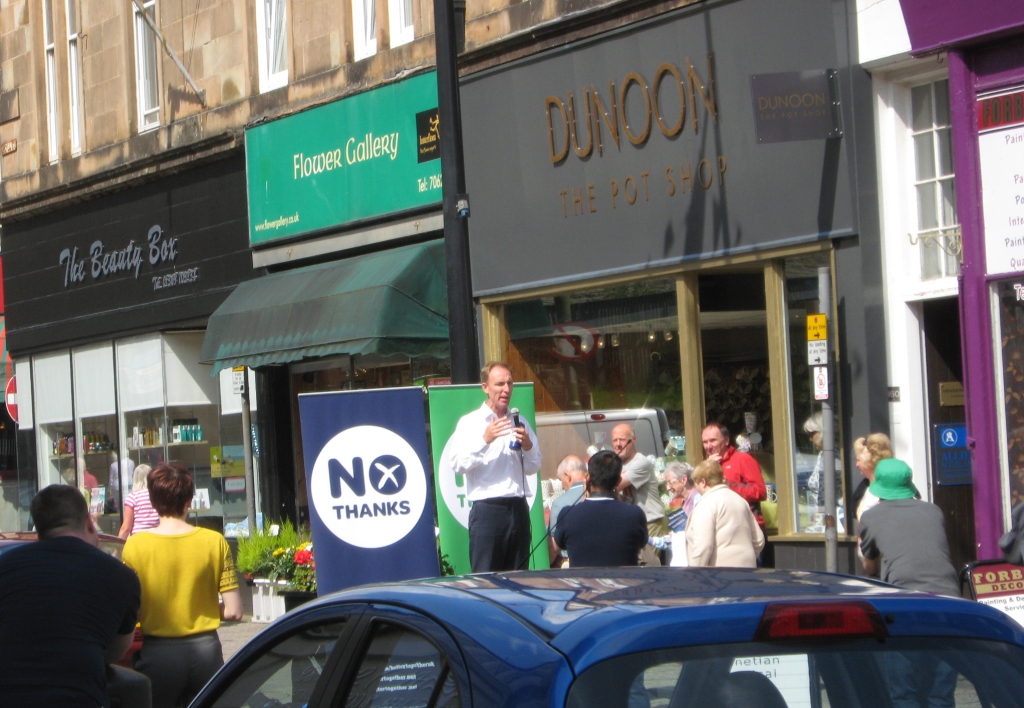
Here’s an extraordinary display from Labour’s Jim Murphy, still standing on an Irn Bru crate and drawing crowds of up to a dozen people (several of whom sometimes aren’t even Labour staffers) in 100 locations across Scotland. This one’s apparently Ayr.
Not only does the former Secretary of State for Scotland spend most of his time bellowing furiously despite already being the only person with a microphone, but the demented rant he embarks on when asked a question by a lady in the crowd about Gordon Brown’s disgraceful lies over organ transplants will have readers used to Mr Murphy’s normal TV persona blinking and rubbing their eyes.
Most striking, though, is his complete refusal to meet the woman’s eye at the end of his extended “SNP BAD!” outburst, in which he’d completely ignored her simple and reasonable question. Several times at the end you can see him consciously turn away from her so as not to catch her gaze, presumably out of shame.
Vote No and trust him with Scotland’s future, readers.
The above is a deceptively simple question and one to which the answer, of course, is as varied as the people you might ask it of as we approach September’s vote.
The debate so far would suggest that at one end of the scale, we’re a nation of poor wee souls, much safer shackled to a United Kingdom that gifts us stability and security in the face of choppy global waters and saves us from the hassle of making crucial political decisions for ourselves. At the other end, we’re a proud nation of untold prosperity, a nirvana of wealth and social justice primed to emerge after our divorce from our oppressors in Westminster.
For anyone in between and still grappling with their identity, the Economist helpfully informed us recently that being Scottish means painting a Saltire on your face, wearing a Jimmy hat and shouting at nothing in particular. Glad that’s sorted then.
The truth is that very few of us will see ourselves in these broad-brushed caricatures of Scottish identity. I certainly don’t. In fact, the more I force myself to think about it, the clearer it becomes that I don’t have a bloody clue what it means to be Scottish.
…for us off their own bat this week, unasked. It’s pretty awesome, though we haven’t the slightest idea what we could use it for. (What it really makes us want is a snazzy 1cm-thick cutout metal version of the logo to use as a poker guard. Anyone?)
But when we have our own nightly current-affairs TV show on an independent Scottish Broadcasting Service, it looks like the intro is pretty much sorted. 🙂
One of the more persistent scare stories deployed by the No campaign is the claim that Scottish higher education will be crippled by a Yes vote, thanks to the weight of applications to Scottish universities from students in the rest of the UK, who will then be entitled by EU law to free tuition, whereas they currently have to pay up to £9000 a year (with the figure set to increase).
For good measure they also claim that tens of thousands of young Scots will be “frozen out” of university education by the flood of incomers from, in particular, England. Those damn foreigners, eh?
The UK government is about to put another taxpayer-funded leaflet through every door in Scotland, laden with dire warnings about the consequences of independence.
Boiled down to just five bullet points – one of which is the meaningless “best of both worlds” – it presents the case for the UK as amounting to keeping the pound (which Scotland can do either way), higher public spending (omitting the fact that Scots pay over the odds for said spending), jobs with UK companies (which would be unaffected because EU law demands freedom of employment) and lower energy bills.
The latter is based on the oft-repeated claim that fuel bills would rise in Scotland because the rUK would no longer pay to import subsidised Scottish renewable energy. But an article in The Ecologist this week, by two respected academics from Robert Gordon University in Aberdeen, blows that argument out of the water.
We’re big fans of Kevin Bridges. Not only is he one of the finest comedians Scotland has produced in many years, it turns out the Glasgow comic is also a top fella. On seeing a tweet last month from the Maryhill food bank showing some perilously empty shelves, Kevin got straight in touch, asked how much money it would need to fill them and turned up with Tesco vouchers for the whole £1000.
We salute him wholeheartedly, and it was right and proper that the story was widely covered in the press, with the Scottish Sun (pictured above), Daily Record and STV News all reporting the generous gesture, and all of them also mentioning that Celtic star Kris Commons’ wife Lisa Hague had made much-needed contributions too.
This man is still regularly invited on TV by both the BBC and STV as a serious pundit.
Were anyone to still be unsure of the fact that different rules of behaviour apply to Unionists and Yes supporters, we invite them to consider the evidence.
We can only assume the No campaign and media are in a growing panic about the imminent TV showdown between Alex Salmond and Alistair Darling or something. Even by the high previous standards of insanity from the UK side of the referendum debate, this week has seen something of a disintegration in sanity.
Hatey McHateface on The Nobodies: “A trifle harsh, Wally. I’m convinced my comments continue to improve. Any chance you could change your handle? We already…” Aug 1, 10:41
Fearghas MacFhionnlaigh on The Nobodies: “Further “Colonial Victimhood” (sic) from Bill Rolston, emeritus professor at Ulster University: BILL ROLSTON: IRELAND, COLONIALISM AND THE UNFINISHED REVOLUTION…” Aug 1, 10:28
Captain Caveman on The Nobodies: “You’re the only “Whopper” round here, Fatso. 🙂” Aug 1, 10:21
James on The Nobodies: “Just what this site needs; yet another Tory Whopper. Jesus wept.” Aug 1, 09:59
Captain Caveman on The Nobodies: “Very true. This whole left wing inspired “Colonial Victimhood” is truly nauseating, childish, monotonous and frankly offensive misappropriation.” Aug 1, 09:53
william G Walker on The Nobodies: “I do enjoy the opening sentence of Wally’s message! Wally Jumblatt says: 1 August, 2026 at 8:47 am The articles…” Aug 1, 09:13
Wally Jumblatt on The Nobodies: “The articles are always articulate and compelling, but the comments get worse and noisier. Colonies and Freedom, you’ll never get…” Aug 1, 08:47
Anthem on The Nobodies: “Ah, so that’s why BP bought up all those natural energy licences and about to pump £bn’s into it. They’re…” Jul 31, 21:21
Hatey McHateface on The Nobodies: “Because the Scottish government is even keener on Nutt Zero than WM. Because the Scottish government has committed Scotland to…” Jul 31, 19:51
Hatey McHateface on The Nobodies: “Strange as it is for me to be sticking up for Confused, he does have a point. I am willing…” Jul 31, 19:43
Hatey McHateface on The Nobodies: “It’s doable if we get the towel heids to do all the hard bits. No doubt that’s the part of…” Jul 31, 19:32
Insider on The Nobodies: “Anthem @ 6:05, You’re having a laugh, aren’t you ?” Jul 31, 18:53
Anthem on The Nobodies: “A little off topic, but why can’t the Scottish government purchase the oil & Gas from BP? It would make…” Jul 31, 18:05
Jay on The Nobodies: “Thank you Agent x” Jul 31, 17:16
Minceheid on The Nobodies: “To be fair they did have a few clever ideas back in yer Golden Age, but sadly it all went…” Jul 31, 16:59
100%Yes on The Nobodies: “The words coming out of your mouth started Nazi Party in Germany. But its only joking, its a same that…” Jul 31, 16:26
Hatey McHateface on The Nobodies: “Occam’s Razor suggests they did invent zero. They needed to put something on the measuring stick to record their cultural…” Jul 31, 15:25
agentx on The Nobodies: “Headline: “Craig Murray unveils Scottish independence plan – that could trigger war” ———————————– Read the full fantasy proposals here: https://archive.ph/okGN0#selection-1235.0-1235.72” Jul 31, 15:18
Hatey McHateface on The Nobodies: “All very true, Northy, but on an Indy supporting site like this one, you omit (I’m certain accidentally 🙂 )…” Jul 31, 15:12
Confused on The Nobodies: “spain invaded by 49 BILLION potential workers to boost the ECONMYUNTHENETZERO (ursula never done lyin was down there, taking line…” Jul 31, 15:01
Hatey McHateface on The Nobodies: ““Black Skin, White Masks”, eh, Alf? If only we could fathom what that might be about, we could deduce how…” Jul 31, 14:59
Alf Baird on The Nobodies: “A highly informative paper, Fearghas. I especially noted the following, although there is much more in the paper to explain…” Jul 31, 14:40
Hatey McHateface on The Nobodies: “MSM now reporting 60,000 migrants. The usual population of Ceuta is approximately 84,000. This is the second mass invasion. The…” Jul 31, 14:38
Northcode on The Nobodies: “Ceuta is land-joined to North Africa and is not a part of mainland Spain. Most of the 49,000 migrants walked…” Jul 31, 14:28
Captain Caveman on The Nobodies: “Well, I don’t think the Italians are best pleased with Spain’s hopelessly lefty government right now. Not at all. Not…” Jul 31, 13:59
Minceheid on The Nobodies: “Captain Caveman says: 31 July, 2026 at 12:52 pm I love the way the BBC described these 49,000 as “500…” Jul 31, 13:32
Hatey McHateface on The Nobodies: “@Captain Caveman says: 31 July, 2026 at 12:52 pm ‘I love the way the BBC described these 49,000 as “500…” Jul 31, 13:31
Young Lochinvar on The Nobodies: “HMcH In yer haste tae respond you missed the opportunity to quip about the face that launched a thousand boats…” Jul 31, 13:19
Fearghas MacFhionnlaigh on The Nobodies: “A 2016 (English-subtitled) interview with Fearghal Mac Bhloscaidh. 1916 Centenary analysis. 1916-2016 COTHROM CÉAD BLIAIN: Fearghal Mac Bhloscaidh (Gaeilge: NvTv)…” Jul 31, 13:03