The faithful toady 436
Posted on
July 20, 2019 by
Chris Cairns

We weren’t sure whether tomorrow’s Cairnstoon was going to be delayed by technical gremlins (it turns out it isn’t), so we prepared an emergency backup plan on the same theme and you may as well see it now as a sort of trailer.
It’ll be good every time they dig him up yet again in the future too.

(With profound apologies to Oliver Frey.)
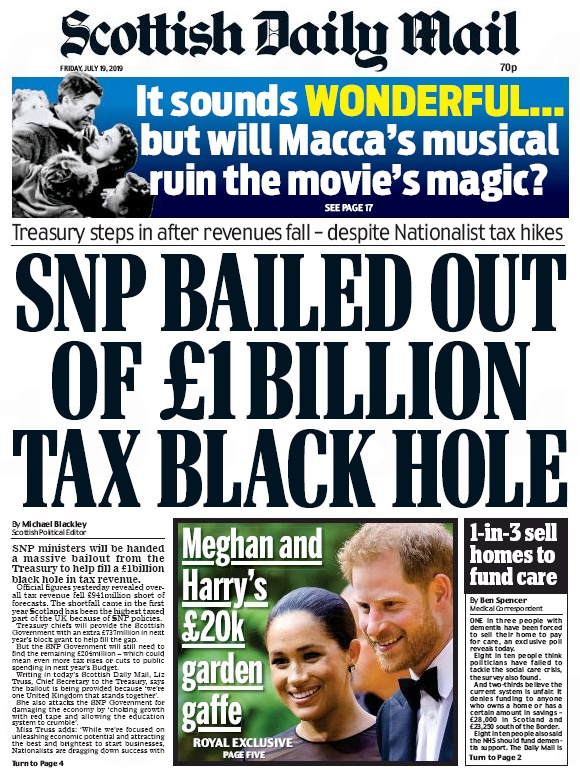
From today’s lurid Scottish Daily Mail cover splash about a “£1 BILLION TAX BLACK HOLE” appearing in the Scottish budget “despite [imaginary] Nationalist tax hikes”:

But hang on a minute.
Last night, grudgingly, we watched the whole of the final Tory leadership debate, for a contest in which pretty much everyone believes Boris Johnson has already gathered enough votes to comfortably win even though there are several days of voting to go.

The headline outcome the media appears to be focusing on is that both candidates proclaimed the Irish backstop “dead”, to which the EU’s response will without a doubt be “Is it, aye?”
So where does that leave us? Let’s have an update.
Galaxy Wars, released by Universal in 1979, is one of the first wave of "proper" arcade videogames (defined here as coded on ROM chips rather than being semi-mechanical or solid-state like Pong).

Running on a hacked Space Invaders board (as most of the first wave did), it actually bears a lot of similarities to Taito's 1978 blockbuster. It's got UFOs running across the top of the screen, above a field of asteroids which move one way across the screen, then drop down a level when they reach the edge and start moving back across in the opposite direction.
The screen was a monochrome reflector – sometimes supplemented by sheets of coloured cellophane to mimic a colour display – and all the sound effects are ripped straight from Invaders.
It was a pretty dull game, and other than an inexplicable Japan-only SNES port in 1995 (which seems to have been the only ever licenced home version on any format) it made very little impact on posterity.
Until this week, when it suddenly threatened to become mildly interesting.
Hey readers, remember that time when England went to war with Germany?

You know, just England, under its Union Jack flag. Nobody else.
Things were different in 2009.

Of course, they meant if they LOST the first one. But readers might feel that a certain degree of irony has perhaps manifested itself since then, particularly in terms of people knowing “what they would be in for” after June 2016.
So just to recap the UK government’s rules for the Yes movement:
– If you win, you don’t really win and you have to go again in case things change.
– If you lose once, that’s it forever, no matter how much things change.
Always remember what we’re dealing with, folks. The rules are always whatever they say they are, regardless of what they might have said a minute ago, and no matter what happens we’re swimming against the sea.
We’ve just received the verdict in the hearing over costs in our court case against Kezia Dugdale, and it’s an incomprehensible one. The sheriff has awarded costs in full to Dugdale, plus a 50% “uplift” mainly on the grounds of the “complexity” of the case, despite Dugdale having employed the services of perhaps Scotland’s highest-paid specialist defamation QC.

Full costs were awarded despite the sheriff having found that the core complaint on which the case was brought – namely that Dugdale had unjustly defamed me with a damaging and wholly false claim that I was a homophobe – was in fact wholly upheld, and that I had indeed been so defamed.

No explanation was given with regard to the supposed complexities from which the uplift arose. The case was in fact a quite straightforward one in defamation terms: an allegation was made, no supporting facts were provided for it and it was found to be entirely false, but the defender was excused liability on the grounds of honest belief – despite being unable to provide the sheriff with any rational basis for that belief.

That’s just about the bare minimum of complexity that could ever possibly exist in a defamation case, and readers might understandably feel that it ought to have been well within the normal skill set of the defender’s representatives, particularly given that the document comprising the entire core of the case was a single tweet of less than 140 characters.
Apparently if you’re a lawyer who’s been paid tens of thousands of pounds to debate a single tweet you also deserve a 50% bonus by way of extra compensation for all the stress and trauma of, um, doing your normal job.
Kezia Dugdale at no point before, during or after the case apologised for or withdrew her remarks – indeed, after our initial complaint she repeated and expanded them, leaving us with no remedy but to pursue the matter in court, and to compete as best we could with the astronomical sums spent on Dugdale’s defence by external parties and approved by the court even though the sum being sued for was relatively modest.
We don’t yet have a final bill, but we expect it to be in the rough vicinity of £100,000 as previously advised. We’ve already polled readers on their desired response in that event, and received an overwhelming majority of 9:1 in favour of filing an appeal against the substantive judgement on the case.
(The verdict on expenses cannot in practice be appealed itself, but were a substantive appeal to be successful the expenses verdict would automatically be overturned.)
We intend to carry out that decision, but any further views are welcomed.
There’s quite an interesting piece in today’s Sunday National detailing the extremely unequal representation of various parties on the BBC’s network politics shows in the last month, in which readers will be astonished to learn that the SNP (and Scotland in general) come off very poorly.
(Five appearances compared to eight for the Lib Dems, 40 for Labour and a startling 143 for the Tories.)
As it happened, it coincided with our coming by a list of people who’ve appeared on the Corporation’s nightly newspaper-review show, so we wondered whether the brave members of the press whose job it is to scrutinise politics independently might have redressed the balance somewhat.

Let’s find out.
We haven’t done a good old-fashioned Quoted For Truth in quite some time, but on occasion someone else makes a point in a way that just can’t be improved on.

We’ve always known/said that this is THE core case for independence, of course, but sometimes seeing it from another country’s perspective brings the message home.
Wings Over Scotland is a thing that exists.