As so insightfully predicted by Lallands Peat Worrier yesterday, the media has raced to proclaim victory for Alistair Darling in tonight’s STV debate. For our money, the only winners were the people who watched something else.
The debate was a mess – not quite as shambolic as Nicola Sturgeon and Johann Lamont’s effort on the same channel a few months back, but none of the lessons from that trainwreck were learned. Darling was angry and personal from the start, while Salmond was off-form and the strategy he adopted for dealing with the only subject Darling wanted to talk about – currency – was absolutely dreadful.
We warned back in February that Yes couldn’t just keep flatly saying “There will be a currency union” for seven months, even if it’s true, and the studio audience was deeply and audibly unimpressed with Salmond’s evasion of Darling’s repeated question, even if the tactic got old and tired when the No man was still using it an hour later.
But we’re not going to get into too much spin, because our view is partisan. The main evidence used for the hasty declarations of a “triumph” for Darling was a snap poll conducted immediately afterwards by ICM for the Guardian. But on even a cursory examination, the poll actually found the opposite of what the media said it did.
We encourage readers to keep an eye out for the soon-to-be-released work of the Scottish Research Society. You won’t have heard of them before – they’re only three months old, with just 48 “likes” on Facebook – but they’ve already amassed some serious funds and have registered as campaigners for No in the referendum debate.
The society’s website notes that it “was formed on May 6th, under the Act of 1854, permitting Scientific and Literary Societies to be set up to inform and educate the public on social, economic and scientific matters.”
It goes on to add that “the material contained in the Society’s works, is used to provide accurate and informed commentary on aspects of the issues relevant to the question of Scottish independence. The Society is not a campaign group, but an organisation seeking to inform and provide balance.”
An alert reader was listening to the Today programme on Radio 4 this morning when they heard something unexpected that made them sit up and take notice. It came as part of a segment on Northern Irish people living in Scotland, 45 minutes into the show, and was stated in passing as an unremarkable statistic by BBC reporter Andy Martin.
We’ve isolated it for you – click the image above to listen to the short 13-second clip. (The full six-minute piece can be found here for when it expires on iPlayer.)
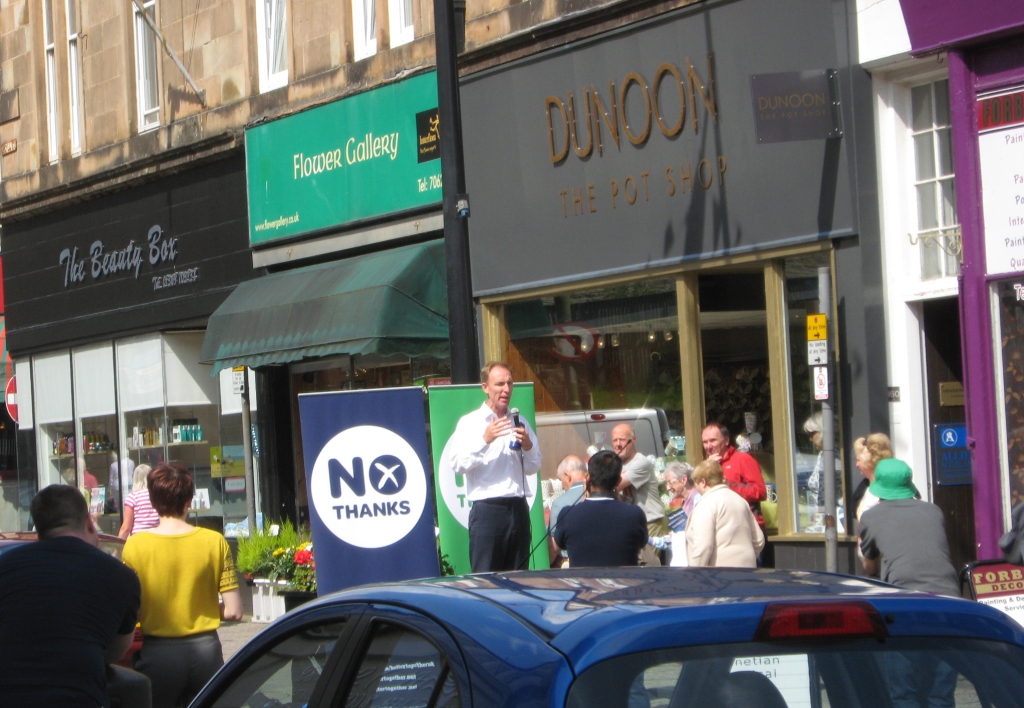
Here’s an extraordinary display from Labour’s Jim Murphy, still standing on an Irn Bru crate and drawing crowds of up to a dozen people (several of whom sometimes aren’t even Labour staffers) in 100 locations across Scotland. This one’s apparently Ayr.
Not only does the former Secretary of State for Scotland spend most of his time bellowing furiously despite already being the only person with a microphone, but the demented rant he embarks on when asked a question by a lady in the crowd about Gordon Brown’s disgraceful lies over organ transplants will have readers used to Mr Murphy’s normal TV persona blinking and rubbing their eyes.
Most striking, though, is his complete refusal to meet the woman’s eye at the end of his extended “SNP BAD!” outburst, in which he’d completely ignored her simple and reasonable question. Several times at the end you can see him consciously turn away from her so as not to catch her gaze, presumably out of shame.
Vote No and trust him with Scotland’s future, readers.
The above is a deceptively simple question and one to which the answer, of course, is as varied as the people you might ask it of as we approach September’s vote.
The debate so far would suggest that at one end of the scale, we’re a nation of poor wee souls, much safer shackled to a United Kingdom that gifts us stability and security in the face of choppy global waters and saves us from the hassle of making crucial political decisions for ourselves. At the other end, we’re a proud nation of untold prosperity, a nirvana of wealth and social justice primed to emerge after our divorce from our oppressors in Westminster.
For anyone in between and still grappling with their identity, the Economist helpfully informed us recently that being Scottish means painting a Saltire on your face, wearing a Jimmy hat and shouting at nothing in particular. Glad that’s sorted then.
The truth is that very few of us will see ourselves in these broad-brushed caricatures of Scottish identity. I certainly don’t. In fact, the more I force myself to think about it, the clearer it becomes that I don’t have a bloody clue what it means to be Scottish.
One of the more persistent scare stories deployed by the No campaign is the claim that Scottish higher education will be crippled by a Yes vote, thanks to the weight of applications to Scottish universities from students in the rest of the UK, who will then be entitled by EU law to free tuition, whereas they currently have to pay up to £9000 a year (with the figure set to increase).
For good measure they also claim that tens of thousands of young Scots will be “frozen out” of university education by the flood of incomers from, in particular, England. Those damn foreigners, eh?
Iain More on The Marshalling Plan: “I cant stop laughing at events, my ribs are cracking due to laughing so much. I cant get over how…” Feb 5, 04:04
Fearghas MacFhionnlaigh on The Marshalling Plan: “« Thit a shúil ar bharr tí in aice leis an gcairéal. Cosúil le splanc tintrí osclaíodh na fuinneoga ann,…” Feb 5, 00:34
Fearghas MacFhionnlaigh on The Marshalling Plan: “« His eyes fell on the top storey of the house at the edge of the quarry. The casement window…” Feb 5, 00:30
Cynicus on The Marshalling Plan: “@ Sarah “ A better system existed in Scotland before 1707 ” ======== In what way? Better that in the…” Feb 5, 00:29
Cynicus on The Marshalling Plan: “100%Yes says: 4 February, 2026 at 9:12 pm “The PM has no intention of standing down……” ======== He may have…” Feb 4, 23:58
James on The Marshalling Plan: “YL; Indeed. A very pertinent question.” Feb 4, 23:44
James on The Marshalling Plan: ““Do us all a favour and stop posting mince on here.” Oh, “Chas” – please, PLEASE!” Feb 4, 23:39
James on The Marshalling Plan: “What’s the collective noun for two ****’s in a row?” Feb 4, 23:35
James on The Marshalling Plan: “Randy Andy & Mandy are being lined up as patsies; fall guys to cover th rest of them. 6 months…” Feb 4, 23:33
James on The Marshalling Plan: “#Site Prick; “Bet I’m a fascist…” First truth you’ve ever posted. Well done. Own it.” Feb 4, 23:29
James on The Marshalling Plan: ““..that a handful of folks got some scraps off the table, to lick the spoon, is no cause for celebration,…” Feb 4, 23:24
Young Lochinvar on The Marshalling Plan: “Well said Sarah. As I have said here several times though; why does this site ignore such initiatives? Why?!” Feb 4, 22:10
100%Yes on The Marshalling Plan: “The PM has no intention of standing down and why does he need too. These politicians aren’t the same as…” Feb 4, 21:12
DaveL on The Marshalling Plan: “Why would he be apoplectic? It’s par for the course and nothing unusual. Colonialism, it’s invasive and everywhere. You obviously…” Feb 4, 21:03
sarah on The Marshalling Plan: “Great news that Alliance to Liberate Scotland is now registered with the Electoral Commission. This gives a real pro-independence option…” Feb 4, 20:58
Southernbystander on The Marshalling Plan: “Maybe they like the colour?” Feb 4, 20:52
James Barr Gardner on The Marshalling Plan: “Birds o’ a feather flock the gither……..” Feb 4, 20:38
Willie on The Marshalling Plan: “Anybody like to put odds on how long before the Prime Minister stands down. Like a rat in a trap…” Feb 4, 20:32
Rev. Stuart Campbell on The Marshalling Plan: ““I dont think the constituency vote is first past the post” The constituency vote is DEFINITELY First Past The Post.” Feb 4, 20:03
Chas on The Marshalling Plan: “Did you notice that the curlers are British? That colonialism gets everywhere! Baird will be apoplectic.” Feb 4, 19:52
Nae Need! on The Marshalling Plan: “Apparently there’s pressure on McSweeney to take the rap for Mandy’s appointment. But, without McSweeney where is 2Tier?” Feb 4, 19:02
Cynicus on The Marshalling Plan: “@ agentx “Speaking to ITV Border on Wednesday, Scotland’s first minister……” ========= Swinney was also on STV an hour later…” Feb 4, 18:57
The Flying Iron of Doom on The Marshalling Plan: “Ah, so Reform won’t be coming up with the goods either? That’s going to annoy a few folk, but what…” Feb 4, 18:44
Nae Need! on The Marshalling Plan: “The conversation has moved since I was last here, and so has my thinking (or what passes fir thinking in…” Feb 4, 18:40
agentx on The Marshalling Plan: “Don’t forget the curlers are in action in the Winter Olympics – live on iPlayer now.” Feb 4, 18:08
Cynicus on The Marshalling Plan: “A Farage fanboy opines. I have no idea what he means and don’t really care.” Feb 4, 18:08
Aidan on The Marshalling Plan: “‘No judges’ – so how do you think the law might be administered in that context?” Feb 4, 18:08
Hatey McHateface on The Marshalling Plan: “If Reform do what they say, reform our politics, then they will have succeeded in working themselves out of a…” Feb 4, 17:21