After it became the most-watched episode in the show’s history, the producers of The Alex Salmond Show made a double-length “Director’s Cut” of our recent interview, which you can watch below if you should feel so inclined.
In news that will come as a shock to absolutely no readers at all, McDougall wasn’t just lying, and wasn’t just wrong about one thing, but was both wrong and lying about pretty much everything he said.
Both of the Yes camp’s “scare stories” which were sneeringly mocked by McDougall during a BBC debate in Inverness actually came true – the Tories DID win the next election, and Johnson DID end up as leader of the party and then as Prime Minister.
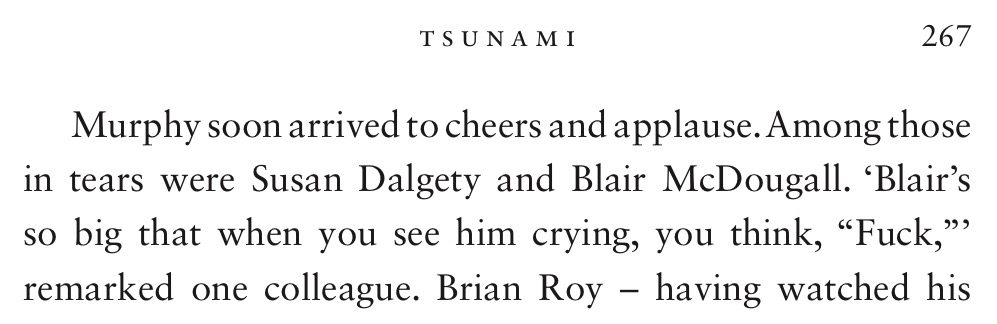
(McDougall burst into tears at Scottish Labour HQ on the night of the 2015 election as his party lost 40 of its 41 seats despite his services as Jim Murphy’s speechwriter and adviser, his powers of chortling seemingly having deserted him.)
Still, at least the Record hasn’t been so completely lacking in self-awareness as to point a finger at others in Scotland and say something like “far too many people who should know better are complicit in the tragedy”.
We weren’t sure whether tomorrow’s Cairnstoon was going to be delayed by technical gremlins (it turns out it isn’t), so we prepared an emergency backup plan on the same theme and you may as well see it now as a sort of trailer.
It’ll be good every time they dig him up yet again in the future too.
From today’s lurid Scottish Daily Mail cover splash about a “£1 BILLION TAX BLACK HOLE” appearing in the Scottish budget “despite [imaginary] Nationalist tax hikes”:
Last night, grudgingly, we watched the whole of the final Tory leadership debate, for a contest in which pretty much everyone believes Boris Johnson has already gathered enough votes to comfortably win even though there are several days of voting to go.
The headline outcome the media appears to be focusing on is that both candidates proclaimed the Irish backstop “dead”, to which the EU’s response will without a doubt be “Is it, aye?”
So where does that leave us? Let’s have an update.
Galaxy Wars, released by Universal in 1979, is one of the first wave of "proper" arcade videogames (defined here as coded on ROM chips rather than being semi-mechanical or solid-state like Pong).
Running on a hacked Space Invaders board (as most of the first wave did), it actually bears a lot of similarities to Taito's 1978 blockbuster. It's got UFOs running across the top of the screen, above a field of asteroids which move one way across the screen, then drop down a level when they reach the edge and start moving back across in the opposite direction.
The screen was a monochrome reflector – sometimes supplemented by sheets of coloured cellophane to mimic a colour display – and all the sound effects are ripped straight from Invaders.
It was a pretty dull game, and other than an inexplicable Japan-only SNES port in 1995 (which seems to have been the only ever licenced home version on any format) it made very little impact on posterity.
Until this week, when it suddenly threatened to become mildly interesting.
Of course, they meant if they LOST the first one. But readers might feel that a certain degree of irony has perhaps manifested itself since then, particularly in terms of people knowing “what they would be in for” after June 2016.
So just to recap the UK government’s rules for the Yes movement:
– If you win, you don’t really win and you have to go again in case things change.
– If you lose once, that’s it forever, no matter how much things change.
Always remember what we’re dealing with, folks. The rules are always whatever they say they are, regardless of what they might have said a minute ago, and no matter what happens we’re swimming against the sea.
sam on A matter of class: “https://onlinelibrary.wiley.com/doi/full/10.1111/1467-923X.13214 “Exploring Sovereignty in Scotland” David McCrone Michael Keating “The largest proportion in the sample, 30 per cent are ‘Scottish…” Dec 22, 14:21
Captain Caveman on A matter of class: “I couldn’t care less whether the likes of you believes me or not – as I’ve already told you. Feel…” Dec 22, 14:09
Aidan on A matter of class: “The bigger picture Dan is that the only thing you seem to be in favour of is highest taxes on…” Dec 22, 14:09
Andy Ellis on A matter of class: “@Alf Baird 8.24pm Like any peoples language the Scots language plays ‘a vital role in shaping and defining ethnic identity’,…” Dec 22, 14:07
James on A matter of class: “We’ve only got your word for that though, haven’t we sweetie? You’re a Reform shill so probably a born liar.” Dec 22, 13:53
James Cheyne on A matter of class: “Alf Baird. Even with the trickery, bribery and deceit it must be remembered that the Scottish participation was only set…” Dec 22, 13:48
Captain Caveman on A matter of class: ““A braw chortle at young unionist Aidan whining about the demise of industries in Scotland.” Aw, look at old Dan,…” Dec 22, 13:17
diabloandco on A matter of class: “Just caught up with Led by Donkeys projection on Windsor castle – nice work!! And Nicola Jennings cartoon in the…” Dec 22, 12:33
Northcode on A matter of class: ““Scotland does need to wake up…” She surely does, James. Her bedside alarm is now ringing, at least, and I…” Dec 22, 12:32
Northcode on A matter of class: “I’ve always thought of the word ‘inchoately’ as being a particularly unhelpful word; a word with no clear and singularly…” Dec 22, 12:17
Alf Baird on A matter of class: “Indeed so, James, and in addition, there is plenty of evidence of bribery and coercion involved at the time which…” Dec 22, 12:15
Alf Baird on A matter of class: ““Unreasoning nativists can scream inchoately” You mean like American Professor Michael Hechter in his detailed scientific analysis of the ‘UK…” Dec 22, 11:49
Northcode on A matter of class: “Yet another excellent and informative post, Alf. Personally, I’m sick of swallowing Westminster’s green and mouldy moon cheese. An observation:…” Dec 22, 11:45
Northcode on A matter of class: “Foul language restrained in writing is a sad and pathetic sight to behold. Foul language by its nature is wild…” Dec 22, 11:25
James Cheyne on A matter of class: “The Union remembers and fears the day coming in and shining a light over the treaty, It fears that Scotland…” Dec 22, 11:09
Alf Baird on A matter of class: “Yes, and the stink of “colonialism …drives the most peaceable populations to despair” (Cesaire) Aside from the obligatory racism and…” Dec 22, 11:09
The Flying Iron of Doom on A matter of class: “Hatey McHateface says: 20 December, 2025 at 3:30 pm Thanks for your reply, Stuart. As it happens, I lack a…” Dec 22, 11:06
Northcode on A matter of class: ““What fascinating dialogues we could have” Here’s some dialogue for you (really more a command): “DANCE!” Dance tae whitiver tune…” Dec 22, 11:01
Captain Caveman on A matter of class: “@Hatey “… As to their younger years, a casual look at their typical posts suggests they could never have done…” Dec 22, 11:00
James Cheyne on A matter of class: “England did not need a referendum to leave the treaty of union in 1800. But Scotland does need a referendum…” Dec 22, 10:58
James Cheyne on A matter of class: “I understand the unionist mind to try keep us voting for a construct that is not there, to keep us…” Dec 22, 10:37
Dan on A matter of class: “A braw chortle at young unionist Aidan whining about the demise of industries in Scotland. Sad to see such a…” Dec 22, 10:36
Northcode on A matter of class: “Guid mornyng aw… A howp ye aw hae a guid Monday day the day.” Dec 22, 10:13
Hatey McHateface on A matter of class: “A fascinating article, Dan. As you say, much to mull over in it. If only Wings BTL provided a forum…” Dec 22, 09:53
Hatey McHateface on A matter of class: “Mair car park mayhem in mos cow. Some cant must have cut up some other cant at a junction and…” Dec 22, 09:41
Hatey McHateface on A matter of class: “@Aidan It’s overwhelmingly likely that none of the usual suspects pay any taxes, being well past the age when they…” Dec 22, 09:30
Hatey McHateface on A matter of class: “Rather disappointing to hear that about Viz. I would have expected that more than half of every Viz issue could…” Dec 22, 08:59
Hatey McHateface on A matter of class: “Check out the ablest prejudice from Beggan. To him, the differently abled really do not exist.” Dec 22, 08:47
Hatey McHateface on A matter of class: “Calm doon, James, and hauld oot fer jist a couple mair days. Ye’re certain tae get new socks fer Xmas,…” Dec 22, 08:42
Aidan on A matter of class: “@Twat – a pre-paid prescription certificate for 12 months in England is £114.50. Someone earning £100k a year (comfortable, but…” Dec 22, 08:37