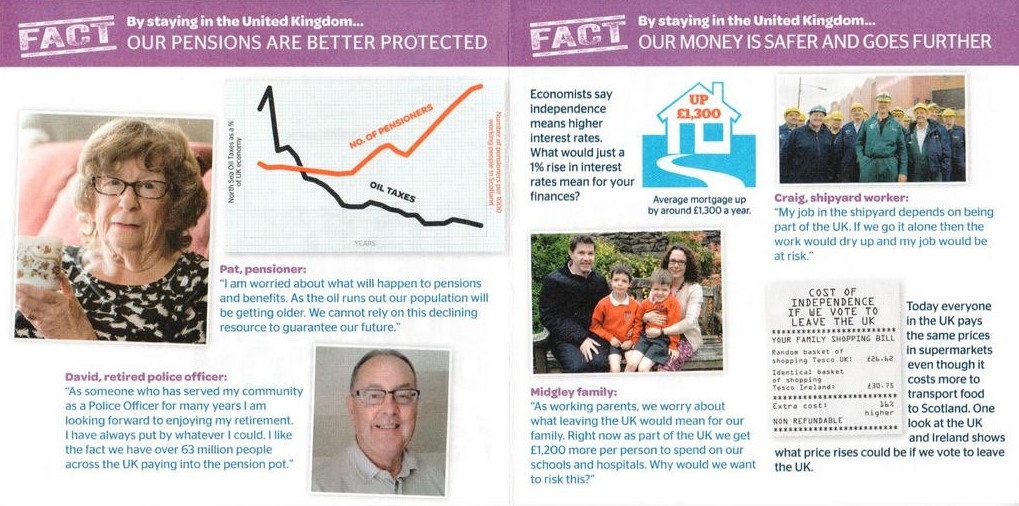
There’s something fascinating about the latest “No Thanks” leaflet that’s slithering its way through letterboxes in Scotland this week, and it’s not the empty sloganising it deploys in lieu of an argument. (“We’re better together because best of both worlds!”)

It’s this graph.
Read the rest of this entry →
Tags: misinformationproject fear
Category
analysis, investigation, scottish politics
Several papers today report that “Better Together” are filing a complaint with the BBC about the audience at Monday’s debate between Alex Salmond and Alistair Darling, alleging bias in both audience composition and question selection – claiming that 10 questions favoured the Yes side to only three favouring No.

We’re not really sure how a question can favour either side, but the sour-grapes move does raise an interesting issue, which we’re going to illustrate with an example from the debate the BBC ran the following evening in Edinburgh.
Read the rest of this entry →
Category
analysis, comment, investigation, media, scottish politics
Stand by, readers. We’re about to post some porn for stat nerds.

Yeah, you like that, don’t you? What’s a bit less sexy, though, is what the table above means for the “safety and security” of the UK, and the cost of your mortgage.
Read the rest of this entry →
Tags: misinformation
Category
analysis, debunks, scottish politics
As part of his Apocalypse Of Doom Revue this week, Gordon Brown provided the Daily Record with a no-questions puff-piece the paper summarised as, “we must continue to share costs of health care and welfare with rest of the union – or pay the price”.

So that’s nice and positive.
Read the rest of this entry →
Tags: Scott Minto
Category
analysis, scottish politics, uk politics, world
As readers of this site will be well aware, 40 years ago the UK government economist Professor Gavin McCrone analysed the effect of North Sea oil on the finances of a notional independent Scotland, which at the time seemed a real and possibly even imminent prospect. His assessment was so alarming to Westminster that its findings had to be kept secret from the Scottish public for over three decades.
With the information suppressed, Scotland remained in the UK (and was even refused modest devolution despite voting for it in a referendum), resulting in the imposition of a series of Conservative governments elected on English votes, beginning with Margaret Thatcher’s turning-point victory in 1979.

Ironically, we have Mrs Thatcher’s government to thank for the collation of the data which demonstrates the true state of Scotland’s finances within the UK, in the shape of the GERS figures (Government Expenditure and Revenue Scotland).
The data was subsequently collected into the Scottish National Accounts Project, which provides the figures (Excel document) for the following analysis. What it reveals provides a surprisingly unambiguous statement of Scotland’s financial condition, and one which is agreed across a broader political spectrum that you might imagine.
Read the rest of this entry →
Tags: Dale Ross
Category
analysis, disturbing, scottish politics, stats, uk politics
As we’ve already noted this morning, today’s newspapers “reveal” something this site told you nine months ago – that a No vote in the independence referendum will see Scotland punished with a massive cut to its budget.

But some voters still don’t really know what the “Barnett Formula” is or how it works, so it seemed worth putting together a concise step-by-step guide to how it’ll be used to steal billions of pounds from Scots, should they vote next month to leave control of their affairs with Westminster.
Read the rest of this entry →
Category
analysis, reference, scottish politics
Perhaps the most notorious injustice ever committed by the UK government against Scotland (with the possible exception of the infamous “40% rule” in the 1979 devolution referendum in which the dead were counted as No votes) was the suppression for 30 years of the McCrone Report, which revealed how wealthy an independent Scotland would have been after the discovery of oil in the North Sea.

Successive Labour and Conservative governments at Westminster frantically fought to deceive Scots over the value of the bounty for decades. And now, on the eve of another referendum, it looks like they’re about to try it again.
Read the rest of this entry →
Category
analysis, comment, scottish politics
The Scottish and UK press has been more and more careless about disguising its bias as the referendum nears. Almost every paper, for example, reported without question the recent “Better Together” press release about being “inundated” with small donations after the first TV debate between Alex Salmond and Alistair Darling.
Normally headlines would put the statement – which was completely unsubstantiated by the slightest scrap of evidence – inside quote marks or accompanied by qualifiers like “No camp claims”, but instead it was almost universally presented as fact.
“Better Together inundated with cash after debate” (The Guardian)
“Flood of donations sees Better Together hit campaign limit” (Daily Express)
“The official pro-UK campaign has publicly called for Scots to stop giving it money after a flurry of donations following Alex Salmond’s TV debate defeat.” (The Telegraph, slipping a sneaky wee bit of editorialising in too)
Calling for people to stop sending money was nothing more than a moderately clever PR stunt – the official No campaign already has more cash from millionaire Tory donors than it’s actually allowed to spend by September 18th, so there’s little point in continuing to accumulate it – but the papers obediently played along anyway.

The donations story, though, was essentially a piece of trivia. A much more serious matter was the Bank of England’s inflation report yesterday, and the embellishment and exaggeration applied to it by certain outlets revealed a great deal about publications which still officially claim to be neutral.
Read the rest of this entry →
Tags: misinformation
Category
analysis, comment, media, scottish politics