The media is positively jumping with analyses of Mark Carney’s much-anticipated speech about currency unions, with thousands of words being expended to discuss something we’ve already summed up accurately in eleven. It’s almost comical to watch the amount of anti- (and very occasionally pro-) independence spin being put on a text which went pathologically out of its way not to make any kind of judgement whatsoever on the subject.
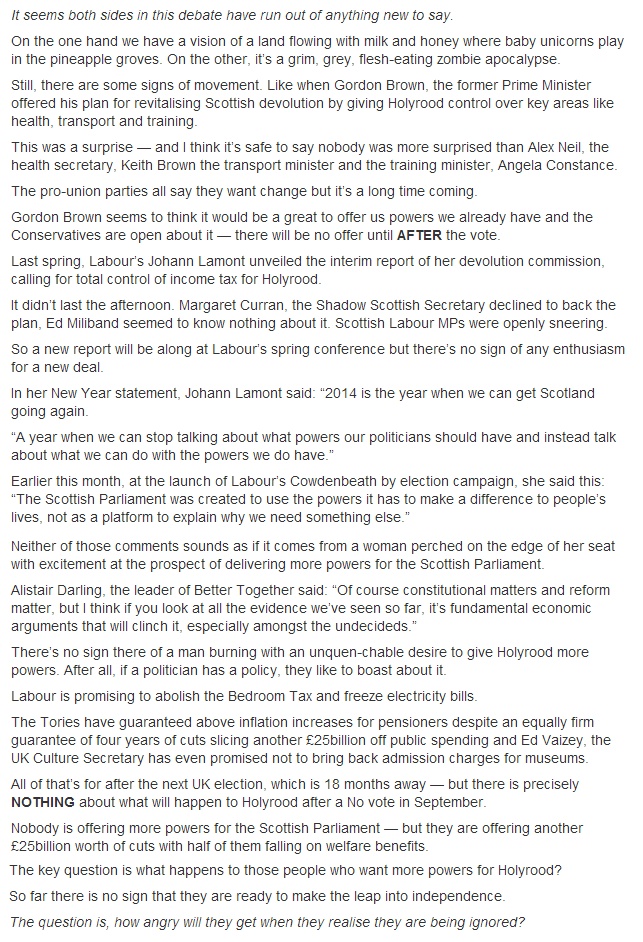
(Something Carney continued to do at the post-speech Q&A with journalists, at which he frequently looked bemused as a series of political hacks asked him massively leading questions along the lines of “So, you said X…” which he then had to wearily but firmly point out he hadn’t actually said at all. If you click the image below you can listen to an audio recording of the session.)

However much of an awful grump he is, the best, most sensible and balanced analysis (okay, the second-best after ours) is probably David Torrance’s.
Read the rest of this entry →
Category
analysis, comment, scottish politics, uk politics
The Daily Record’s run a whole clutch of articles of a vaguely positive nature towards independence recently, which is nice. We assume Torcuil Crichton must be ill. But an editorial leader column today commenting on the Yes campaign’s encouraging poll figures and identifying the SNP’s social-justice policy programme as the reason had an intriguing line buried in the middle of it.
“Only Labour can win this battle for the UK and they have to run up a red flag for Scotland and sail under it. If that is a different banner from the rest of the UK, so be it.”
Hang on. What does that mean, exactly?
Read the rest of this entry →
Tags: vote no get nothing
Category
analysis, media, scottish politics
Yesterday’s Telegraph contained another example of something we’ve noticed becoming increasingly common in newspapers recently where Scottish independence is concerned – the incredible vanishing story. Check out these first two paragraphs from a piece about investment in the oil industry:
“UK Energy Minister Michael Fallon warned on Monday that uncertainty over the outcome of the referendum on Scottish independence was already hitting investment in the North Sea.
Tags: misinformationproject fear
Category
analysis, comment, scottish politics, uk politics
We’re not sure which of The Scotsman and Murdo Fraser of the Scottish Conservatives was most confused this morning. Reporting on the second half of its intriguing ICM poll (which put the gap between Yes and No votes as low as six points), the paper publishes some data about the attitude of Scots to the EU.

Excluding don’t knows, the results provide a clear 16-point margin for Scotland remaining in Europe, at 58% to 42%. (The raw numbers put it only slightly lower, at 46 to 33.) But for some odd reason the newspaper chooses to reveal this vote of confidence under the bafflingly negative headline “A third of Scots would back exit from EU”, without even an “only” in there to reflect the implication of the stats.
Weirder still is Murdo Fraser’s reaction, though.
Read the rest of this entry →
Tags: flat-out liesmisinformation
Category
analysis, europe, media, scottish politics, stats, wtf
We were feeling a bit gloomy earlier on today at the realisation that we’d wasted two irreplaceable minutes of our life reading a load of vacuous waffle that Labour MP Douglas Alexander is apparently going to deliver today at what the Daily Record described as a “Better Together rally” somewhere in Glasgow.
(It must be one of those sorts of “rallies” that are kept secret until the last possible moment so that too many people don’t show up – it isn’t mentioned on the “Better Together” website and there’s nothing listed in their “Events” section within 50 miles of Glasgow until a bit of leafleting in a car park in East Kilbride on 22 February.)

So we thought if we could at least get a feature out of it the time wouldn’t be such a total write-off, plus it’s always fun to have a wander through one of Wee Dougie’s barnstorming, rabble-rousing addresses. Let’s go!
Read the rest of this entry →
Category
analysis, scottish politics
Something annoyed us a great deal this week, and for once it wasn’t some fatuous statement from Alistair Darling or Alistair Carmichael or Ruth Davidson (though all of those were in plentiful supply too). Rather, it was a comment from a distinguished academic and professional in what was otherwise a good-news story.

The chap in question was Patrick Layden QC, former Deputy Solicitor to the Scottish Executive (as was), prior to giving evidence to Holyrood’s European and External Relations Committee, and the quote published in several papers was a troubling one.
Read the rest of this entry →
Category
analysis, europe, scottish politics, uk politics
“Better Together” must be nearly out of green bottles by now. 2014 has seen a bonfire of the scare stories. First to go was the terror of debt, which also all but guaranteed that there WILL be a Sterling currency union after independence (because the last thing the UK government needs is to have whatever amount Scotland takes as a share of UK liabilities being denoted in a fluctuating foreign currency).

Then the warnings about EU membership crumbled from several directions at once, culminating in today’s rather low-key story in which respected expert (and Unionist) Sir David Edward dismissed the idea of Scotland being thrown out of Europe as being nonsensical and impractical, having made similar comments last week.
The latest pillar of the No campaign’s case to collapse in the blink of an eye is the much-pushed line that independence means forcing Scots to choose between being Scottish and British. But who says so?
Read the rest of this entry →
Category
analysis, europe, scottish politics, uk politics
The headline findings of the Scottish Social Attitudes Survey compiled every year by ScotCen are of limited use in the context of the independence referendum. The main constitutional question it asks is deeply unhelpful, with a vague, all-encompassing “devolution” option that tell us next to nothing about how Scots will vote.

(To be fair, that’s not the survey’s fault – it was designed long before the referendum was ever thought of as a reality, for a broader purpose, and asks the same questions every year for consistency of comparison.)
But the results for 2013 are interesting – as they always are – because they tell us what Scotland thinks when the debate is moved away from overtly political questions, they tell us where the arguments are being won and lost, and they enable us to determine just why Scots are the only people on Earth who’ve been (so far) successfully made scared of running their own country.
Read the rest of this entry →
Category
analysis, scottish politics, stats, uk politics
It’s a start, we suppose. But it doesn’t take long for the UK government’s latest independence “fact sheet” to start telling fibs again. It barely gets a quarter of the way through its very first sentence before dropping a big old porky on those assembled:

Much as we’d like to think otherwise, there’s no such thing as a “forever decision” in politics. Whether Scotland votes for or against independence, it could change in the future. The USSR fragmented, East and West Germany reunited (having been abruptly split up after the “Thousand Year Reich” only actually managed 12), and even our own lifetimes have seen countless realignments and redivisions of states across the world.
So what else in the paper is, to use the technical term, total cobblers?
Read the rest of this entry →
Tags: misinformation
Category
analysis, comment, scottish politics, uk politics
Veteran readers will be aware that there are basically two types of misinformation perpetrated by the Scottish media. The rarer type is the flat-out lie, where things that are simply demonstrably untrue are presented as facts – a common example being the regular assertion by journalists that all three Unionist parties are committed to giving Holyrood new additional powers after a No vote, which was neatly skewered by Andrew Nicoll in yesterday’s Sun (image link, no paywall).

The subtler variety is when newspapers and broadcasters report true information in a misleading way, sometimes so drastically that it comes out meaning the exact opposite of what it actually means. A story today is a case in point.
Read the rest of this entry →
Tags: misinformation
Category
analysis, media, scottish politics
The latest in the UK government’s “Scotland Analysis” series of independence briefing papers was released this week on the back of William Hague’s visit to Glasgow.

At 119 pages, the EU and International Issues paper is nobody’s idea of a slim pamphlet, but it’s remarkably light on meaty content.
Read the rest of this entry →
Tags: Andrew Leslie
Category
analysis, scottish politics, uk politics, world