Supporters of the opposition’s plan to block a no-deal Brexit have been proclaiming vindication this weekend over a couple of polls which show significantly lower support for the Tories, and a lead for Labour, in the event that a general election is called after 31 October with Brexit not having happened.
In that scenario, Tory voters tell pollsters that they’re more likely to defect to the Brexit Party, and the resulting split in the Brexit vote appears to point towards a Labour-led government if you plug the figures into a site like Electoral Calculus.
The reality is much more complicated than that. But what we’re specifically interested in is how it would affect the chances of securing a second indyref, so let’s take a look.
Sitrep: we’ve given up any hope of turning on the television and seeing a politician – any politician – telling the truth.
Boris Johnson is lying about negotiating a new deal with the EU. Jeremy Corbyn is lying about pretty much everything (in so far as he even knows what he wants the truth to be, let alone what it actually is). Jo Swinson is lying about wanting to meaningfully work with other parties to stop Brexit. Nicola Sturgeon is lying about wanting to stop a no-deal Brexit – she just wants to stop Brexit full stop.
(Unfortunately, this also means she’s lying about having any real intention of holding a second independence referendum before 2021. If she did, she wouldn’t have all her MPs and MSPs frantically running around parliaments and courtrooms trying to destroy her own democratic mandate for it, which would leave her needing to secure a fresh one 20 months from now. And assuming she’d have any more idea how to put it into practice than she has with the ones she’s already got.)
The government is lying about the fact that it doesn’t have confidence in itself, and the opposition is lying about the fact that it does. Everyone now says they want an election, but somehow it isn’t happening because nobody wants it yet, and nobody can agree when they DO want it, and they’re all lying about why.
And absolutely everyone is lying about the fact that whatever they’re trying to do right now has any chance of solving the present shambles. Johnson is just stalling to run the clock down until no-deal, although he swears blind that he isn’t, and the opposition just wants to drag the whole agony out for several more months with not the slightest clue what they’d actually do then.
Grimly, the closest thing that British voters currently have to an honest man is Nigel Farage, who is at least clear about what he wants and what he’s prepared to do to get it. Which is ironic, as he’s only anywhere near getting it because he’s spent his entire political career lying through his teeth about it.
We don’t mind telling you, folks, it’s been pretty hard to get up in the mornings.
So, British politics, eh? We’re basically on strike until things make at least an iota of sense, because there’s no point in attempting political analysis right now when events can overtake you before you’ve finished typing a sentence.
But let’s just have a quick recap on what we know.
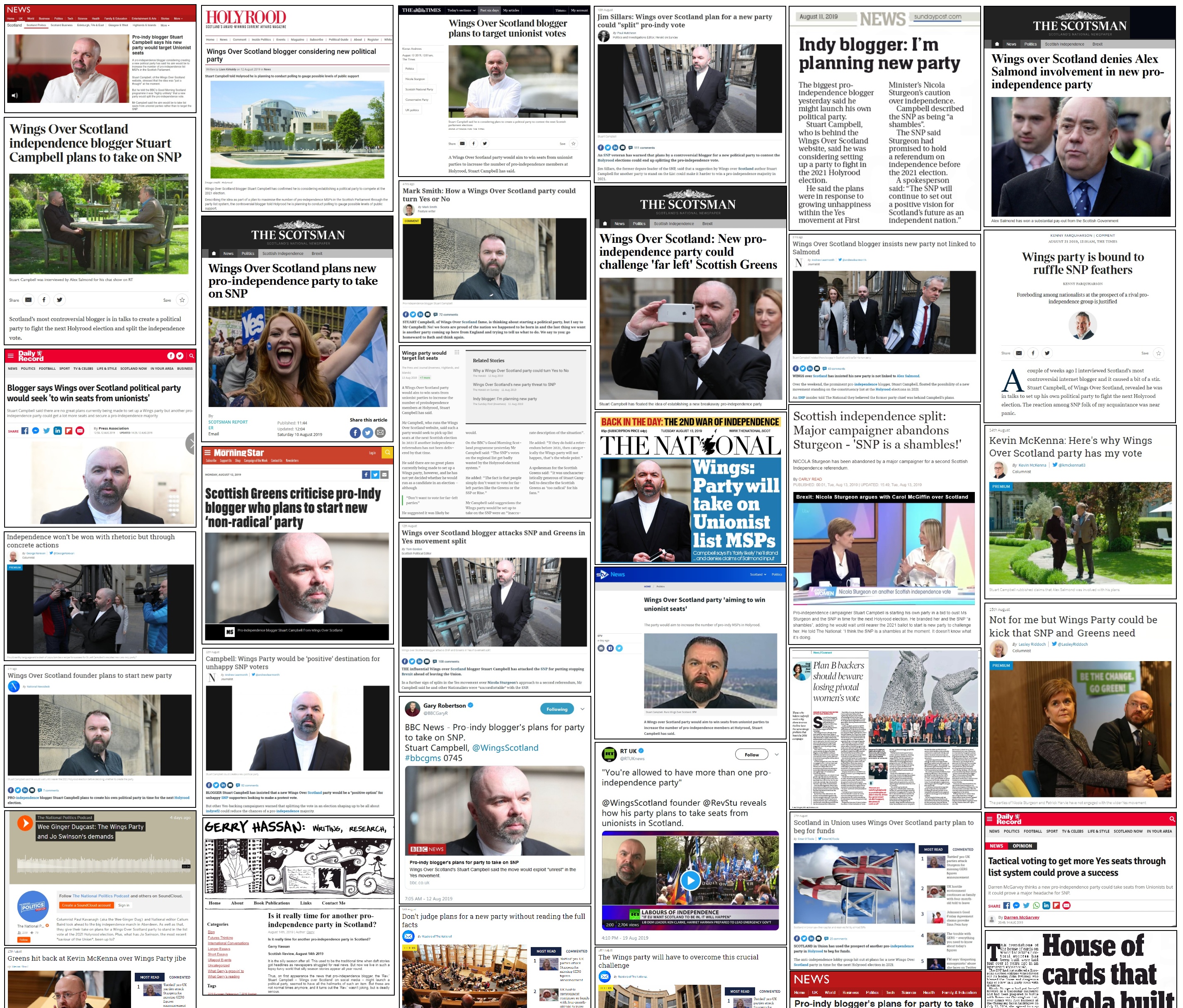
So it seems like our semi-idle musings about the possibility of starting a new list party for the Scottish Parliament generated some interest last month.
(That’s more than the whole of 2018, more than the whole of 2017, and over five times the previous biggest single month since we moved to our current stats provider in December 2014.)
But yeah, nobody cares and it’d be certain to fail, apparently.
We just watched a nine-minute segment on Sky News, purportedly on the subject of “Is the Union between Scotland and England under threat?”, which for maximum balance and impartiality included views from both Labour and the Tories – in the forms of Paul Sweeney MP and John Lamont MP – but nobody else.
Both men spouted some quite extraordinary claims, all of which went unchallenged by presenter Adam Boulton. Let’s just take a quick look at a couple of the best ones.
Boris Johnson’s move to prorogue Parliament for most of September and a chunk of October actually only represents a couple of weeks of extra holiday time for MPs – Westminster would be shut for most of the time in question anyway for party conference season.
The Commons would open for business again on 14 October, in time to debate the outcome of a crucial European Council summit on 17-18 October. If that meeting doesn’t provide any new deal – and it’s vanishingly unlikely that it will – then there’ll be no time for anything other than a no-deal Brexit.
We see Gordon Brown is celebrating his 500th article promising “federalism” in the Scottish media today. Which is nice. We always enjoy hearing about the stuff Labour pretends it’s going to do when it’s in power.
But like everyone who’s been waiting 100 years and counting for it to abolish the House Of Lords (a pledge which also gets another runout in Brown’s latest intervention, bless him), we won’t be holding our breath.
John McGregor on Blue In The Face: “I would have a referendum on Devolution then if the country voted for it too be kept then go for…” Jul 15, 02:21
Northcode on Blue In The Face: “I should have said for clarity that although the 2014 Scottish independence referendum used the local-government franchise that franchise is…” Jul 15, 01:38
robertkknight on Blue In The Face: “Not that it’s going to happen in my lifetime, but if Indyref2 was ever to be held, only those entitled…” Jul 15, 00:34
Northcode on Blue In The Face: “This is a long one… scroll on by if you can’t be bothered ;earning something interesting and informative. I feel…” Jul 15, 00:16
Young Lochinvar on The Unstoppable Lie Machine: “SHM I served then, but not in the Falklands, indeed I remember seeing the remnants of the Argentinian debris of…” Jul 15, 00:03
StrangerHereMyself on The Unstoppable Lie Machine: “Cheering on the Argentinians and not the exploits of the Scots Guards at Tumbledown? This self-identification lark is good, eh?…” Jul 14, 22:23
Young Lochinvar on Step One: “Pastor Fagat Wow! And you suggest I am thick? Phew you’ve got a nerve. Read again your own summaries against…” Jul 14, 22:21
robertkknight on Blue In The Face: “Sorry… Should say “got” not “hot”. Either way, it’s not in the interests of the British State to see the…” Jul 14, 22:00
Andy Ellis on Step One: “@ Young Lochinbore Not even close, no cigar…soz. Any variations are minor. The principle remains: all of them used broad,…” Jul 14, 21:29
Innocent bystander on Blue In The Face: “Within the second paragraph of PS response they apologise that reference was made that they had been advised HOW to…” Jul 14, 20:50
robertkknight on Blue In The Face: ““Would be sweet karma if Nicola bust the SNP by self-obsessed accident.” I’d say by design rather than by accident.…” Jul 14, 20:19
Dan on Blue In The Face: “Aye, indeed it is a rather self-induced wretched state of affairs, but I’m not sad, more frustrated and somewhat angry…” Jul 14, 19:41
Young Lochinvar on Step One: “Pastor Fagat 2nd attempt to post this reply, fingers crossed this time. I am using your numbered list, see below…” Jul 14, 19:39
sarah on Blue In The Face: “Urgent and Important: Scotland’s independent legal status has just been directly denied by the UK government in the Court of…” Jul 14, 19:35
Chris on Blue In The Face: “Apologies Stuart,, I was a bit impatient, sorry.” Jul 14, 19:18
James on The Interests Of The Many: “Aye, just like you, petal. Why don’t you three get a ‘family room’ somewhere for a night?” Jul 14, 19:00
James on Blue In The Face: “Light bulb moment, Inglis?” Jul 14, 18:56
Wally Jumblatt on Blue In The Face: “I don’t know the details of the SNP’s Articles of Association or whatever, but I suspect that they are now…” Jul 14, 18:44
MP on Blue In The Face: “Worth the follow-up Q’s, but I think that they are saying (1) they knew that the money had been spent…” Jul 14, 18:44
agentx on Blue In The Face: “Those Bloody English!” Jul 14, 18:40
Alf Baird on Blue In The Face: “Aye Robert, for a people who are out of the game, “all roads lead to Rome”. The native seldom looks…” Jul 14, 18:32
Eric on Blue In The Face: “There seems to be more buck passing here. It states these “matters were … reported to the COPFS for guidance”.…” Jul 14, 18:25
barelybare on Blue In The Face: “I agree, Houston leaves us hanging by ending the story with report to COPFS. One could conclude he is saying…” Jul 14, 17:54
Captain Caveman on The Unstoppable Lie Machine: “Heh, well maybe – but not if we’re talking about the Court of Public Opinion? That’s really quite the cliff…” Jul 14, 17:17
Young Lochinvar on Step One: “AI Dun Well you would wouldn’t you! Remember; A is B, black is white and up is down in your…” Jul 14, 16:46
robertkknight on Blue In The Face: “It is becoming clearer by the day that Police Scotland and/or the COPFS have been told this far, (Murrell trial/conviction),…” Jul 14, 16:35
Andy Ellis on Step One: “@Young Lochinbore I see you have comprehension difficulties on top of you other issues. The point of the list is…” Jul 14, 16:33
Young Lochinvar on The Unstoppable Lie Machine: “Pastor Fagat & 1.51 The classroom creep.. “Please Miss! Please Miss! Please Miss!; Alf used the “C” word!!!!”” Jul 14, 16:30
Aidan on Step One: ““Some English person took the piss out of Scots and therefore we better deny all English people living in Scotland…” Jul 14, 16:28