Having solved cat hunger in Greece, the tireless Holiday Boy has now turned his hand to addressing Scotland’s crippling golfing shortage, so we’ve got a different sort of cartoon again for you this weekend.
The clip below is from a 1981 arcade videogame called Venture, by Exidy, in which you play a cheerful character called Winky on a mission to loot treasure from a series of monster-infested dungeons.
For the purposes of this article the treasure in the room above, which takes the form of a castle tower, represents Scottish politics. The room itself is the Union.
Back in the 1980s there was a hit game for the ZX Spectrum home computer called Worse Things Happen At Sea. In it you play a robot whose job is to get a heavily-laden cargo ship safely to port, except that more and more disasters keep befalling it.
It springs leaks, it veers off course, the engine overheats and the robot’s power runs down, until eventually the catalogue of catastrophes overwhelms the harassed metallic custodian and the boat slides down into the murky depths.
We wonder if that feels familiar to anyone at the moment.
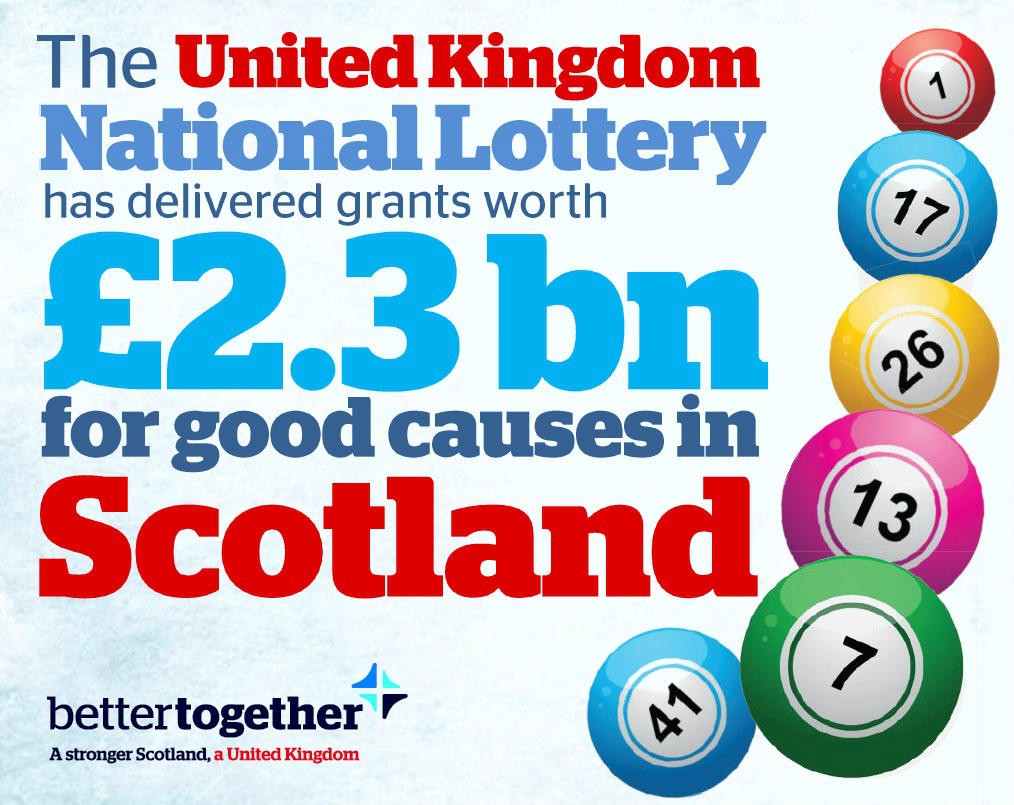
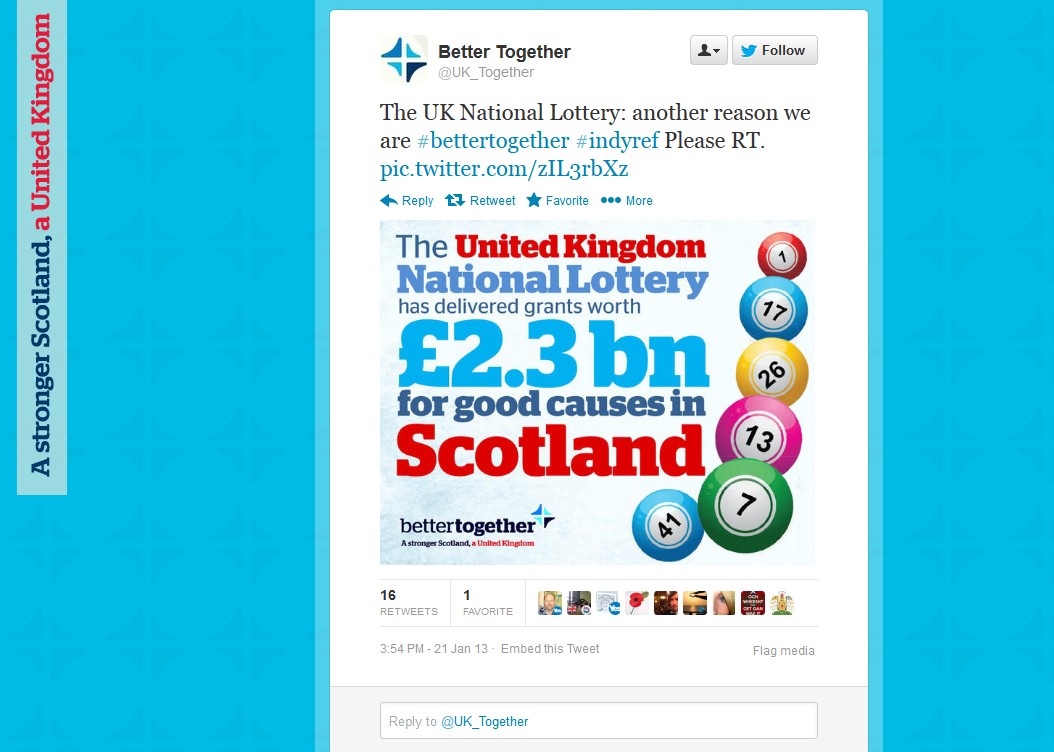
(We suspect this might become a regular series.) We try not to take any notice of the often-ludicrous propaganda churned out by the official “Better Together” campaign, but today’s was too utterly ridiculous to ignore. We’re not going to deface our nice pages with the image, though you can see it here if you want to without giving them any hits.
The graphic claimed, mind-bogglingly, that the award of £2.3bn in grants to good causes in Scotland by the National Lottery since its advent in 1993 was “another reason we are better together”, as if the figure represented some great largesse towards Scotland on the part of the UK. This, as any reader with an IQ higher than the number on a lottery ball will immediately realise, is such a monumental and obvious misrepresentation of how the lottery works that we can only concur with the Twitter user who enquired “When will the glue-sniffing stop at BT strategy HQ?”
When watching the Olympics over the coming couple of weeks, it’s probably not likely that you’ll be pondering the massive spending that goes into the defence and security industry as a result of such events. Yet in both superficial and deeper senses, it now represents the primary purpose of the Games, with sport merely the disguise under which the true agenda is smuggled past the unsuspecting public.
The precedent for this phenomenon was set over 70 years ago, by the event which would go on to become the template on which all subsequent Games were based. We refer, of course, to the 1936 Berlin Olympics in Nazi Germany.
On the 13th of May 1931, the International Olympic Committee awarded the 1936 Summer Olympics to Berlin. The choice was intended to signal Germany’s return to the world community and its rehabilitation after the defeat and humiliation of World War I. However, two years after the award was made Adolf Hitler seized power, and spurred on by his Propaganda Minister Joseph Goebbels he set about making the games a showcase for Nazi Germany.
The intention was simple – set up the games to portray the new Germany in the best light possible. The Games were to be a place to play down plans for territorial expansion, and would be exploited to instead bedazzle foreign spectators and journalists with an image of a peaceful, tolerant Germany. The opportunity to portray an image of how the Nazis wanted to be seen, with the world watching and listening, was too good to pass up, and so political will was deployed behind the Games, with Hitler himself becoming an ardent supporter.
Plans to boycott the Games in response to the maltreatment of Jews and non-whites already apparent under the regime were discussed in the United Kingdom, France, Sweden, Czechoslovakia, and the Netherlands, but were short-lived. The outcry was more vociferous in America, but the President of the American Olympic Committee at the time, Avery Brundage, declined to back a boycott, on the now-familiar grounds that “The Olympic Games belong to the athletes and not to the politicians”. Little did he know what the Nazis had in store.
There seems to be a disconnect for many Scots between how they feel about the London Olympics and how they’ll act when the Games are on. Many will bemoan the cost, lost opportunities, lack of access or significant national legacy, but will simultaneously be cheering on the athletes in Team GB. Is it a form of Olympic schizophrenia that we should despise the Games and yet love them at the same time?
Schizophrenia isn’t, of course, really the correct term to use for this phenomenon. It’s a mental disorder characterised by a breakdown of thought processes and by poor emotional responsiveness. Despite the etymology of the term from the Greek roots, schizophrenia does not imply a “split mind” and it is not the same as Dissociative Identity Disorder – also known as “multiple personality disorder” or “split personality” – despite often being confused with it in the public’s perception.
So perhaps it’s more accurate to say that myself, and many others, suffer from a form of Olympic split personality disorder. But what is it that causes this affliction? In order to find out, we need to look at the history of London 2012.
Readers of a spiritual or elderly bent may be aware of the parable of the Deck Of Cards. (You can listen to a splendidly reverby take of Wink Martindale’s definitive version by clicking this convenient link here.)
But you don’t have to go back to the 1950s for a similarly instructive metaphor for the contemporary age. Because the iOS game Coin Dozer serves, if you don’t want to carry around a bulky copy of Das Kapital, as a bible of the modern capitalist world. Shut up, it’s not bollocks.
James on Clocks And Calendars: “YL; Here’s to Good King Robert. Cheers! They don’t like it up ’em.” Mar 30, 18:50
Dan on Sicknote Slippers: “I had an ironic chuckle at Stu having a go at Slipper’s albeit limited hair! At least as the cost…” Mar 30, 18:39
James on Protest But Don’t Survive: “Aye, draw a great big ‘Captain Caveman’ on your ballot paper, folks.” Mar 30, 18:37
twathater on Clocks And Calendars: “The Scotsman in conjunction with every other shite rag is trolling the electorate with this insulting PISH The Headline should…” Mar 30, 18:26
Young Lochinvar on Clocks And Calendars: “Happy anniversary tomorrow of the 1307 battle of Glentrool. Bruce’s looking at spiders days were put behind him at Glentrool…” Mar 30, 18:19
Frank Gillougley on Clocks And Calendars: “Aye, ‘Vote fur Jack Duggan Sarwar’, it’s definitely got a ring tae it. Pure wild wae it so he is.” Mar 30, 17:23
Young Lochinvar on Clocks And Calendars: “Yee haw pardner.. Uncle Sam’s getting all worked up about a super bigly expensive low gear fly by mission “to…” Mar 30, 17:21
Alf Baird on Clocks And Calendars: “Past time The Hootsman changed its teetle tae ‘The Hoose Jock’; or just go the hale hog as ‘The Colonialist’.…” Mar 30, 15:50
Aidan on Clocks And Calendars: “Labour are really going to form a coalition with Reform are they? Oh aye i bet they’ll be shouting about…” Mar 30, 15:14
Captain Caveman on Sicknote Slippers: “Although approaching things from a different perspective to my own, what a marvelous post, though doubtless largely wasted here. Bravo.…” Mar 30, 14:12
Mark Beggan on Clocks And Calendars: “If you thought that was crazy did anyone see Scottish Labours political broadcast online. A day in the life of…” Mar 30, 14:11
David on Clocks And Calendars: “I assume this was written and supplied to The Scotsman by a deluded Labour Hack. Why don’t The Scotsman republish…” Mar 30, 14:10
Campbell Clansman on Clocks And Calendars: “Labour, and The Scotsman, must think voters are dumb enough to take this “analysis” seriously. Which says a lot about…” Mar 30, 13:28
Lorncal on Sicknote Slippers: “The real far right is a tiny minority of heid-the-bas. Always was. Even in the halcyon days of Mosley. What…” Mar 30, 13:25
Confused on Sicknote Slippers: “better together, pooling and sharing so, exactly what benefit do we draw from this “arrangement”, being siamese-twinned to these kleptomaniac…” Mar 30, 12:59
Northcode on Protest But Don’t Survive: “A fine adaptation from Allende’s speech, James, and a quote most apt in the context of Scotland’s subjugation by a…” Mar 30, 12:11
Northcode on Sicknote Slippers: “*Do yous want tae march? Apparently 99% of actual, real and genuine liberty seeking, independence supporting Scots didn’t want to……” Mar 30, 11:47
Stevie on Sicknote Slippers: “I thought last year that REFORM would bevcome the official opposition and I still think that. Why would anyone who…” Mar 30, 11:47
Captain Caveman on Protest But Don’t Survive: “… So who, pray, are you giving your hard fought and hard won vote for, Northie? Or – don’t tell…” Mar 30, 11:20
100%Yes on Sicknote Slippers: “If you weren’t convinced the SNP didn’t won’t Independence you will now, “FRIST Minister John Swinney will push the UK…” Mar 30, 10:53
100%Yes on Sicknote Slippers: “In a Independent Scotland we shouldn’t pay pension pots of these individuals who have made a carer out of the…” Mar 30, 10:23
Northcode on Protest But Don’t Survive: “Saturday’s “We Believe in Scotland… but only as a region of England” march was bad for the SNP, bad for…” Mar 30, 10:08
Willie on Sicknote Slippers: “A Lordship in waiting he hopes is Me Peter Wishart. And where else would one be than in London over…” Mar 30, 10:04
Andy on Sicknote Slippers: “I am an anti semite. I did not realise this till 2 years ago when Netanyahu announced that anyone who…” Mar 30, 09:59
Northcode on Protest But Don’t Survive: “Even the acting talent that is the world famous Brian Cox (albeit he was working with a poor script) could…” Mar 30, 09:24
Jamie on Sicknote Slippers: “Read the roll of honour, Scotland’s bravest men…” Mar 30, 07:47
Mark Beggan on Sicknote Slippers: “Anyone waving the Iranian regime flag is advocating the destruction of Israel. The emblem on this flag states that the…” Mar 30, 02:41