Fear and lies work. Over many decades (and really for centuries) the Unionist parties and the media have succeeded in persuading a large percentage of Scots that they’re beggars, scroungers, vagrants and “subsidy junkies” dependent on the ever-generous charity of England to keep them from starvation.

And in terms of the facts, that hasn’t always been an easy sell.
Read the rest of this entry →
Tags: cringeflat-out liesmisinformationtoo wee too poor too stupid
Category
analysis, debunks, reference, scottish politics, stats, uk politics
We originally wrote this article in March, in response to the Government Expenditure and Revenue Scotland (better known as GERS) figures for 2014-15. We’ve updated it to take account of events since that time, of which there’s been one rather major one.
Today saw the publication (just five months after the 2014-15 GERS) of the 2015-16 stats, which are again triggering a convulsive orgy of “BLACK HOLE!” articles across the media, as every Unionist in the land falls over themselves to portray their own country as a useless scrounging subsidy junkie without actually using the exact words “too wee, too poor, too stupid”.
And once again, everywhere you look there’s a “Proud Scot” screaming about how the figures – showing an essentially unchanged “deficit” despite an almost £2bn fall in oil revenue – destroy a case for independence that those same people have spent most of the last four years stridently insisting never existed in the first place.

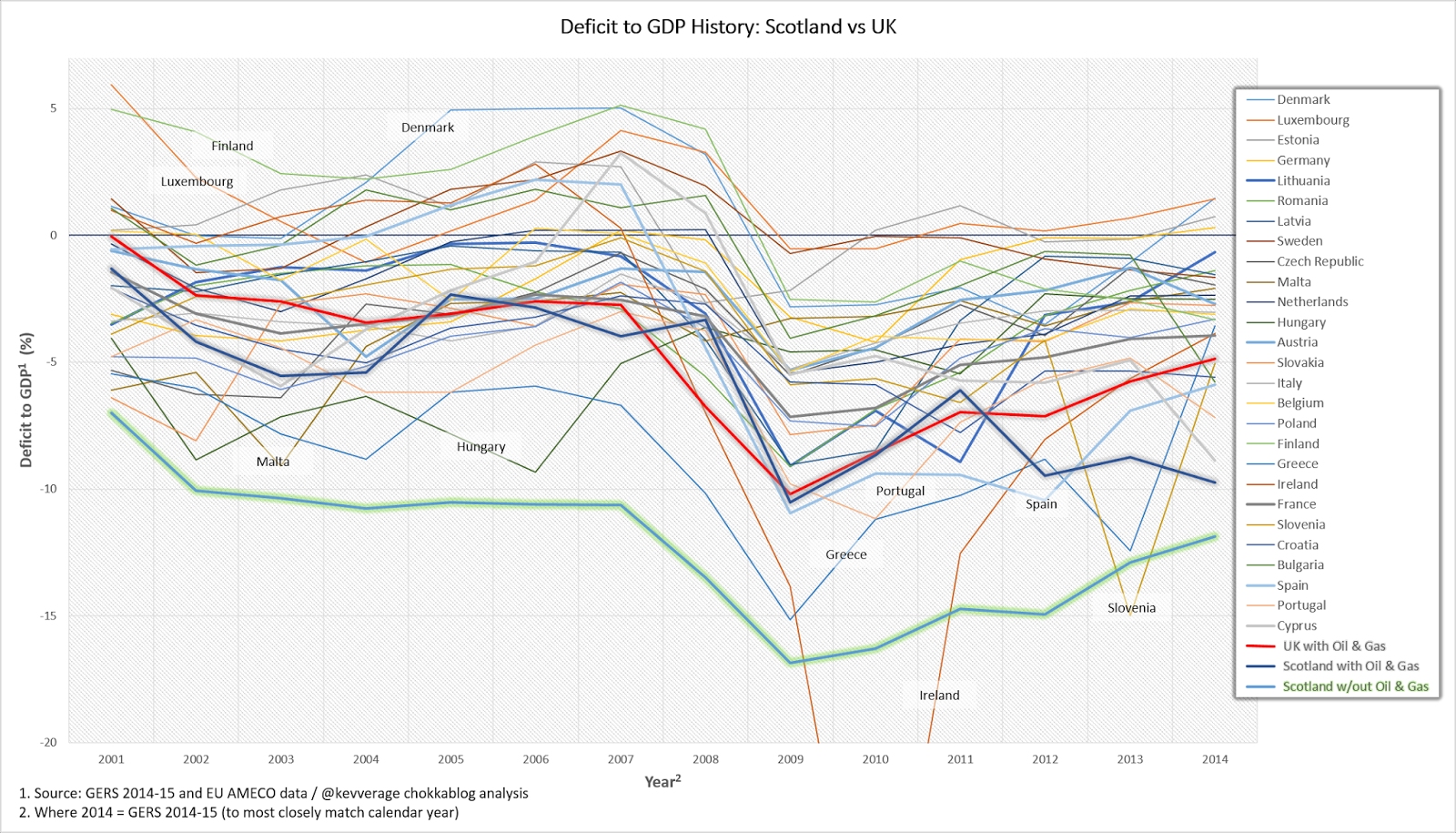
So let’s recap the truth about Scotland’s financial books. Because for all the complex arguments, mad graphs ludicrously pretending Scotland is a less viable nation than Greece or Latvia or Cyprus or Malta and endless arrays of incomprehensible charts and tables, there are (now) only six things you really need to know about GERS.
Read the rest of this entry →
Tags: black holetoo wee too poor too stupid
Category
analysis, debunks, europe, reference, scottish politics
The BBC’s most prominent politics presenter Andrew Neil, today:

There is, as there is so often, just one small problem.
Read the rest of this entry →
Tags: misinformation
Category
debunks, media, scottish politics
Today’s Sunday Times didn’t bother with any subtlety in its signalling of how people should expect the Scottish media to handle next week’s GERS figures.

So we’ll just leave these here:
The limitations of GERS
The five key facts about GERS
The wishful believers
Gazing into the black hole
There’ll be nothing but repeats of all last year’s articles in the papers, so there doesn’t seem to be much point in re-writing all the rebuttals. We’d advise readers not to expect to hear any of the facts or arguments in any of the above articles aired on TV or radio discussions of the new figures either. For the sake of your blood pressure, it’s probably best to stick to old QI repeats on Dave for the next eight days.
Read the rest of this entry →
Tags: misinformationtoo wee too poor too stupid
Category
debunks, media, scottish politics
For several years now this site has been drawing attention to the weird phenomenon of phantom news – stories presented by the media without even a shred of supporting evidence yet treated as unquestionable empirical fact. And recently there have been more phantoms around the Scottish press than an episode of Scooby Doo.

The thing Alan Roden – who prefers intimidating ordinary members of the public by doorstepping them and vilifying them in his paper – links to in that tweet is an article on the Herald website last night. And it’s a weird article, because it’s an extensive, quote-laden story about something that doesn’t appear to have happened at all.
Read the rest of this entry →
Tags: phantoms
Category
comment, debunks, disturbing, media, scottish politics
No, we’re not referring to the Spectator’s awful reheated whine from super-Unionist composer Sir James Macmillan, Knight Commander Of The Most Excellent Order Of The British Empire, in which he takes the audacious step of accusing some OTHER artistes of cravenly kowtowing to the establishment.
(A complaint he’s been levelling for several years in any publication that’ll listen, and which today’s piece hasn’t bothered to update with any post-2014 examples.)
We’re actually talking about this:

Because this one’s even older.
Read the rest of this entry →
Tags: misinformation
Category
comment, debunks, history, media, scottish politics
There’s a story in today’s Herald about yet another SNP disaster:

Backfires? What, the fares have gone UP?
Read the rest of this entry →
Tags: misinformation
Category
comment, debunks, media, scottish politics
There’s been a statistic released in Scotland, so obviously there’s a crisis.

Anarchy on the streets can only be moments away.
Read the rest of this entry →
Category
debunks, media, missing context, scottish politics
This week I published, through Common Weal, a discussion paper on the potential currency options for an independent Scotland in light of the material changes in circumstances caused by the Brexit vote.
This paper examines some of the options open to an independent Scotland and concludes that, on balance, the best option for Scotland would be a Scottish currency, initially pegged to Sterling but with the infrastructure and mechanisms in place to move, replace or remove that peg if and when it proves advantageous.
(As the UK did itself in the 1980’s when the pound was pegged first to the US dollar and then to the Deutschmark.)
One of the requirements of an independent currency is that Scotland would need its own foreign reserve fund which would act as a buffer against trade imbalances and would be used to counter movements in exchange rate (particularly if we were pegged our exchange rate to Sterling).

It was on this particular point that yesterday’s Scottish edition of the Daily Express chose to focus, in its characteristically measured, balanced and thoughtful manner.
Read the rest of this entry →
Category
analysis, debunks, media, scottish politics
A brief note on the current futility of political commentary.

Remember that? Well, let’s see how it really works.
Read the rest of this entry →
Category
comment, debunks, history, scottish politics, uk politics