We had a bit of a debate at the weekend with ITV’s generally pretty decent Scotland correspondent Peter Smith, after he tweeted this:
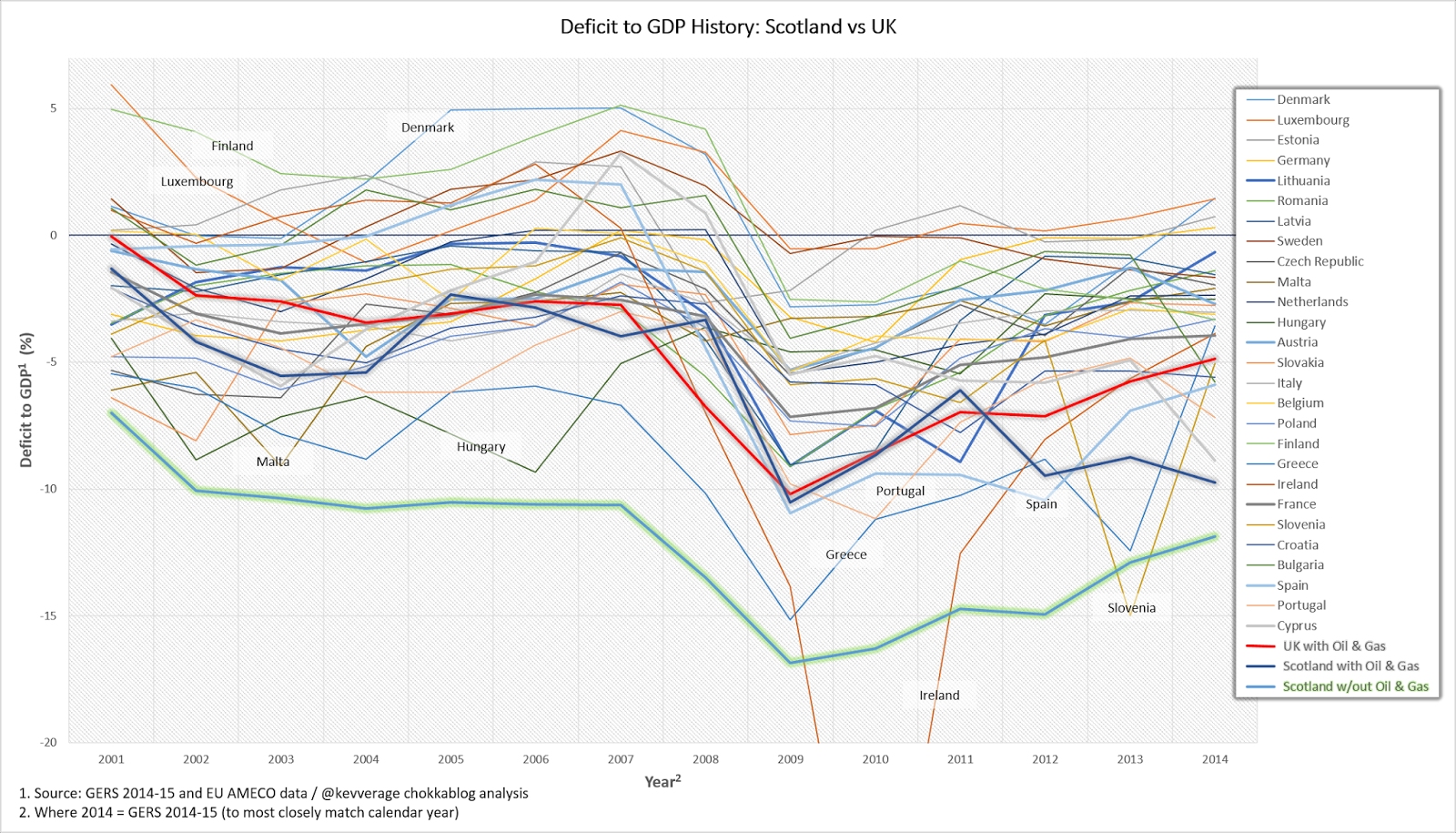
It wasn’t the curious choice of picture we objected to, nor the fact that the £14.8bn figure is a notional sum which is totally meaningless in the context of an independent Scotland (because it represents a vague estimate of the disaggregated finances of a Scotland that’s inside the UK and subject to UK government policy choices).
Nor was it even the implication that a £14.8bn “black hole” was an inherent permanent feature of the Scottish economy rather than an unusually bad year.
What chafed with us was the idea that it was somehow Nicola Sturgeon’s fault.
The starting pistol hasn’t actually been fired on the two-year Brexit process yet, but now we have a clear statement of when it will be: this morning on The Andrew Marr Show, the Prime Minister pledged that it would happen before the end of next March.
(We might end up broke, in other words, but at least we’ll be good old British broke, with none of those awful smelly foreign Euro-Johnnies around to see it.)
And nobody was getting a sick note.
And for supporters of independence, that’s about as good as news gets.
It’s long been a bone of contention for Scots – and not just nationalists – that the UK government, by common agreement, wasted the vast wealth windfall of the North Sea on funding Margaret Thatcher’s 1980s programme of deliberate de-industrialisation, mass unemployment, huge tax cuts for the wealthy and bribes to the working class in the form of Right To Buy.
It did so rather than investing the proceeds in a sovereign wealth fund, as demanded by the SNP (and some elements of Labour) and practiced in Norway, whose fund – only set up in 1990 – is now a literal embarrassment of riches.
But the reality is even worse than that. Because according to a 2015 report by the National Resource Governance Institute that’s just come to our attention, the truth is that if the UK had managed its North Sea treasure better, it could have done both.
Fear and lies work. Over many decades (and really for centuries) the Unionist parties and the media have succeeded in persuading a large percentage of Scots that they’re beggars, scroungers, vagrants and “subsidy junkies” dependent on the ever-generous charity of England to keep them from starvation.
And in terms of the facts, that hasn’t always been an easy sell.
More or less since the morning of 19 September 2014, the Unionist parties in Scotland have kept up an unceasing chorus of “You lost! Accept it!” directed at the entire Yes movement, but primarily the SNP (despite the SNP having never to date disputed the result or called for a re-run of the referendum).
Readers may not be entirely astonished to discover this morning that at least as far as Scottish Labour are concerned, that principle only applies to other people.
Because we’re pretty sure there’s already a name for when political parties set out an “alternative programme of government”.
Scottish Labour won a council by-election in Fife last night, held after the long-serving Communist Party/independent councillor Willie Clarke (who can be seen on the last page of our Charlie Hebdo feature here) stepped down due to ill health.
The successful candidate Mary Lockhart was understandably jubilant, but there were a couple of what seemed like pertinent facts missing from the local paper’s report.
We originally wrote this article in March, in response to the Government Expenditure and Revenue Scotland (better known as GERS) figures for 2014-15. We’ve updated it to take account of events since that time, of which there’s been one rather major one.
Today saw the publication (just five months after the 2014-15 GERS) of the 2015-16 stats, which are again triggering a convulsive orgy of “BLACK HOLE!” articles across the media, as every Unionist in the land falls over themselves to portray their own country as a useless scrounging subsidy junkie without actually using the exact words “too wee, too poor, too stupid”.
And once again, everywhere you look there’s a “Proud Scot” screaming about how the figures – showing an essentially unchanged “deficit” despite an almost £2bn fall in oil revenue – destroy a case for independence that those same people have spent most of the last four years stridently insisting never existed in the first place.
God knows, readers, there’s almost nothing we want to write about less than either David Torrance or the Scottish Six. Just to restate our own position for the record, we couldn’t care less either way about a dedicated teatime Scottish news programme on BBC Scotland – not because it’s a bad idea but because we have no confidence that in reality it’d end up any better than the embarrassment that is Reporting Scotland, far and away the regional station’s worst current-affairs broadcast.
(Certainly now that Scotland 2016’s had the chop.)
Nevertheless, the former’s article about the latter in today’s Herald is one of the most abysmally disingenuous and badly-argued things we’ve seen in the Scottish media for quite some time, and in the absence of any more diverting news in what now seems to have reasserted itself as the traditional summer slow season, we might as well take a methodical look at it.
This week I published, through Common Weal, a discussion paper on the potential currency options for an independent Scotland in light of the material changes in circumstances caused by the Brexit vote.
This paper examines some of the options open to an independent Scotland and concludes that, on balance, the best option for Scotland would be a Scottish currency, initially pegged to Sterling but with the infrastructure and mechanisms in place to move, replace or remove that peg if and when it proves advantageous.
(As the UK did itself in the 1980’s when the pound was pegged first to the US dollar and then to the Deutschmark.)
One of the requirements of an independent currency is that Scotland would need its own foreign reserve fund which would act as a buffer against trade imbalances and would be used to counter movements in exchange rate (particularly if we were pegged our exchange rate to Sterling).
It was on this particular point that yesterday’s Scottish edition of the Daily Express chose to focus, in its characteristically measured, balanced and thoughtful manner.
“Bias” is a word we hate. Other than in the article you’re about to read, you’ll almost never find it used on this site, for a string of reasons. It’s one of those words that – regardless of context or literal justification – simply makes people switch off instantly and dismiss your arguments. (See also: “Zionist”, “Quisling”, “fascist”, “Liebore”.)
It’s also largely irrelevant, because there are very few people or organisations who have any duty NOT to be biased. When it comes to Scottish independence we’re as biased as all heck, and there’s no legitimate reason to expect the Daily Record or Scotsman or Daily Mail to be any more impartial than we are. They’re privately-owned businesses and entitled to take any position they like.
(The difference, of course, is that unlike them we’re committed to still telling the truth when we’re being biased, and to always providing linked original sources so you can judge our biased interpretation of facts and events for yourself.)
You can’t throw a brick at the Scottish media at the moment – however much you’d like to – without hitting half a dozen articles all repeating the same mantra: that despite the post-Brexit surge in support for independence, a Yes vote would be more difficult to achieve because the economics are now harder than they were in 2014, due to the collapse in the oil price.
Weirdly, almost all of these articles simultaneously insist that any new White Paper for independence would have to abandon the Sterling currency union advocated by the Scottish Government the first time round (despite there being little to no concrete evidence that it was a significant factor in the No vote, other than the commentariat all loudly agreeing with each other that it was).
The problem is that those two claims – if for the sake of argument you take them both to be true – introduce a whacking great elephant to the room, which all the people making the arguments are pretending not to notice.
Fearghas MacFhionnlaigh on The quality of mercy: “Apologies. Correct spelling of host’s surname: FINKIELKRAUT” Apr 4, 14:53
Fearghas MacFhionnlaigh on The quality of mercy: “In relation to HANNAH ARENDT’s leaving of Germany for refuge in France in 1933, this radio podcast discusses questions of…” Apr 4, 14:39
Aidan on The quality of mercy: “Well done TH, it was very good of you to get up at 4am to write this thoughtful and considered…” Apr 4, 13:56
Mark Beggan on The quality of mercy: “Scotland needs regime change.” Apr 4, 12:38
TURABDIN on The quality of mercy: “As an inculturated province of the anglosphere Scotland might need to elaborate a sense of «Scotitude» as contrasted with the…” Apr 4, 12:37
Andrew scott on The quality of mercy: “What a brilliant article Salmond steered a steady ship -his successors ran it aground Simples” Apr 4, 11:54
Northcode on The quality of mercy: “Aye, Mrs Thatcher and Mrs Gourlay… twa sober women’s visiouns o Scotland us Scots kin dae withoot. We will see…” Apr 4, 11:45
Mark Beggan on The quality of mercy: “Well young skiver shouldn’t you be claiming benefits and ranting about the English? A rant a day keeps reality away.” Apr 4, 11:30
Cynicus on The quality of mercy: “agentx says: 3 April, 2026 at 7:19 pm “SNP and Greens join independence march ahead of Holyrood election” ======= Haud…” Apr 4, 10:56
diabloandco on The quality of mercy: “A friend of mine wrote a song some years ago and came across it recently, decided to see what could…” Apr 4, 10:52
Bilbo on The quality of mercy: “The streets of South East Asian countries are scrupulously clean. This is down to the authorities being strict with littering…” Apr 4, 10:39
Alf Baird on The quality of mercy: “My analysis of Storrar’s fine text on Scottish national identity, which is a critical aspect for any colonized people, was…” Apr 4, 09:43
Bilbo on The quality of mercy: ““I don’t think that the 50% of the population who support independence aren’t committed to it being delivered.” It’s all…” Apr 4, 09:41
Northcode on The quality of mercy: “The Scottish Liberation Movement should be about the freeing of Scotland and the Scots from the hoax Treaty of Union…” Apr 4, 09:08
Young Lochinvar on The quality of mercy: “TH @ 4.23 Well said! We have been betrayed by total w8ankers.. The younger generations are totally captured by it,…” Apr 4, 06:05
twathater on The quality of mercy: “Scotland will never be independent as long as we allow non Scots to vote for our independence , 2014 was…” Apr 4, 04:23
Young Lochinvar on The quality of mercy: “Beggars So you’re cool with the North Koreans, China, R, most South American countries, U, Poland and various African states…” Apr 4, 03:45
Mark Beggan on The quality of mercy: “The problem with the Western world is that they still think evil does the Goose Step.” Apr 4, 02:35
Fearghas MacFhionnlaigh on The quality of mercy: “Hopefully a better link: LIBERATION SCOTLAND UN UPDATE www.youtube.com/watch?v=wGn2SXcM7zw” Apr 4, 00:29
Fearghas MacFhionnlaigh on The quality of mercy: “LIBERATION SCOTLAND UN UPDATE (2 April 2026) « Peter Young (IndyScotNews) discusses with Alan McMahon, Craig Murray and Sara Salyers…” Apr 4, 00:07
Geri on The quality of mercy: ““Independence is not even in SNP voters’ top three priorities” Neither is the top two cause they’re completely out of…” Apr 3, 22:04
Fearghas MacFhionnlaigh on The quality of mercy: “The seminal (and still available) book by Will Storrar – SCOTTISH IDENTITY: A CHRISTIAN VISION was published by Handsel Press…” Apr 3, 22:02
Fearghas MacFhionnlaigh on The quality of mercy: “The joke was of course first cracked by Tom Nairn. You should watch (minister) Professor Will Storrar’s 10 minute tribute…” Apr 3, 21:20
Geri on The quality of mercy: “The problem is these independence marches used to be a collective of all different political parties or none at all.…” Apr 3, 21:16
Northcode on The quality of mercy: “” …the shift from an independence movement to a liberation movement…” Yes, indeed, Alf. I have, for some time now,…” Apr 3, 21:03
Geri on The quality of mercy: “Offshore/North Sea: Reserved to the UK Parliament under the Scotland Act 1998. The licensing, exploration, and exploitation of offshore oil…” Apr 3, 21:02
Karen on The quality of mercy: “Google “What was Graeme McCormick promised?” And it comes up with “Swinney committed to moving forward with the independence campaign…” Apr 3, 20:40
sarah on The quality of mercy: “O/T: naming no names but have you noticed the absence of certain prolific btl commenters? It is a bank holiday…” Apr 3, 20:18