We must confess ourselves perplexed by the Messianic awe in which much of the Scottish media appears to hold Douglas Alexander. The epitome of the modern career politician (as far as we’re aware he’s never had any sort of job outside politics), Alexander has risen without trace through the Labour ranks, and his Wikipedia profile is unable to attribute one noteworthy achievement to the former minister despite his having held some of the most senior offices of state.

We’re unable to recall a single instance of Alexander ever expressing a view on any subject that was anything other than 100% in line with the official orthodox party position, and in Scotland his name is perhaps most associated with the shambolic conduct of the 2007 Holyrood election.
Nevertheless, for some reason Scottish newspapers appear to regard him as some sort of intellectual powerhouse within Scottish Labour, and the fact that his speeches don’t consist exclusively of tangibly bitter, hate-filled attacks on the SNP also seems to have him marked down as the party’s great thinker.
Which means that roughly every two months we have to endure a vacuous torrent of middle-management duckspeak such as the one Scotland on Sunday has inexplicably chosen to make its front-page lead this morning.
Read the rest of this entry →
Category
analysis, comment, media, scottish politics
We all know there’s something strange about Britain. Germany and China have their factories, France and Japan their nuclear power plants. America has Google and Apple and the world’s largest navy. But how is it that Britain, a country that closed its mines and shuttered almost its entire manufacturing industry, is still a major world economy?

The answer is Britain’s best-kept economic secret. It links Grangemouth, the obscene cost of housing in London, the Royal Mail sell-off, Channel Island tax havens and George Osborne’s disregard for the poor, and explains why an incomprehensible financial crisis triggered by bad American mortgages led to the closure of municipal libraries and swimming pools across the UK and a programme of permanent austerity.
And more to the point, it explains why only London, not Scotland or Wales or Yorkshire or Wearside, matters to the British political class today.
Read the rest of this entry →
Tags: Alistair Davidson
Category
analysis, uk politics
Last night’s edition of Scotland Tonight saw a clearly nervous, rambling and seemingly well-refreshed ex-Labour spin doctor Simon Pia called upon to defend “Better Together” chairman Alistair Darling (“as good a frontman as I can imagine to save Britain”, said the Spectator’s Fraser Nelson in that extraordinary accent of his) from a series of attacks by his own side over his stewardship of the No campaign.

Pia played the usual cards that Labour types do when called upon to defend a man who is now distrusted by a majority of Labour voters. Darling was “substance not style”, a serious man with “cross-party appeal” (if you exclude Labour, the SNP and now seemingly a lot of Tories) who had “filleted” the White Paper (without reading it or understanding the one page he did look at) and saved the nation in 2008 “when we looked into the void”.
But not everyone shares Pia’s view of Darling’s integrity and competence.
Read the rest of this entry →
Category
analysis, disturbing, scottish politics, uk politics
When it comes to oil and gas, Scots are used to being treated like backwoods yokels by Westminster, deemed incapable of looking after this valuable resource and lied to about its value. Oil and gas is a priceless treasure to the UK, and Westminster is terrified of losing control of it.

That’s because not only are the billions of pounds in oil and gas tax receipts valuable in and of themselves, but they also halve the balance of payments deficit, thereby protecting the value of the pound.
But how exactly does Scotland turn oil and gas into money?
Read the rest of this entry →
Tags: Scott Minto
Category
analysis, scottish politics, uk politics
Today’s Sunday Herald has a rather low-key piece (it’s just the 7th-placed story in their “Referendum News” section) on the ramifications for a Yes vote of the 2015 UK general election. It comes the day after several papers carried vitriolic attacks from Unionist politicians on the SNP’s Angus Robertson for suggesting that the UK government ought to consider delaying the vote for a year to enable independence negotiations to be completed.

“This is yet another brazen stunt by the SNP to drive a wedge with Westminster”, raged the Scottish Conservatives’ Jackson Carlaw. “It is highly presumptuous of Angus Robertson, a man with clear delusions of grandeur, to be talking about postponing the next general election”, he continued, while Labour’s shadow Scottish Secretary Margaret Curran bleated about an extra year of Tories.
But it’s rationally almost impossible to make any other argument.
Read the rest of this entry →
Category
analysis, scottish politics, uk politics
This morning we’ve been double- and triple-checking our story from last night, because we were so sure we must have missed something. Even given the low esteem in which we hold the integrity of the hapless “Better Together” campaign, we felt that they surely couldn’t have made such an idiotic and fundamental error, and that instead we must have misinterpreted a word or a sentence somewhere along the way.

But no. We were wrong in that assumption. They really ARE that dim.
Read the rest of this entry →
Category
analysis, idiots, scottish politics, stats, stupidity
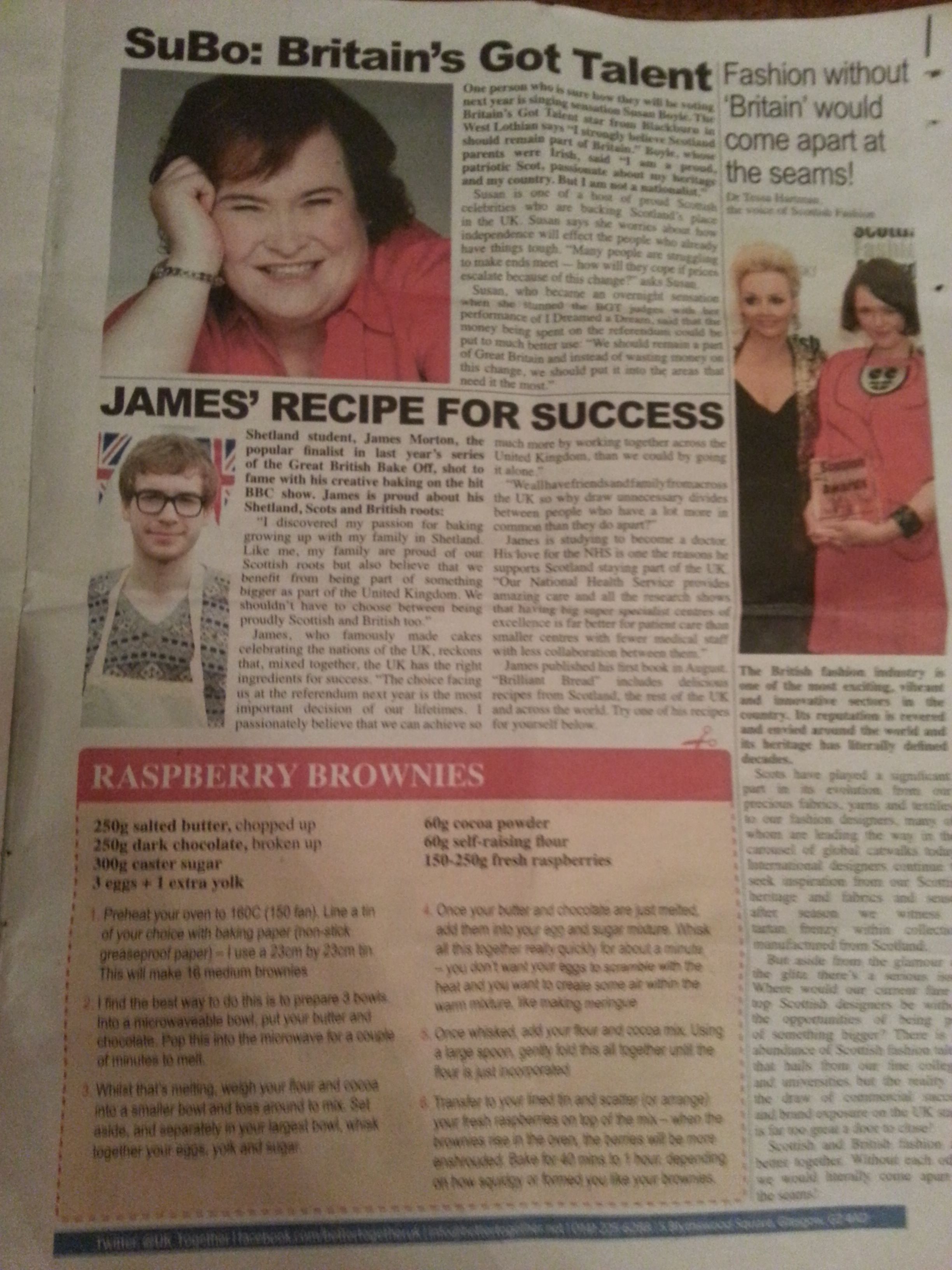
Alert commuters using Scotland’s railway stations may this week have received a “newspaper” from the official No campaign containing a splendid crossword and a recipe for raspberry brownies, amongst some political rubbish.

We haven’t tried it ourselves, but we hope the recipe was a bit less inaccurate than the political sections, or a lot of people might die of food poisoning.
Read the rest of this entry →
Tags: Douglas Daniel
Category
analysis, scottish politics
As a living embodiment of the posh, braying public-school Tory-boy stereotype, Fraser Nelson of the Spectator used to reside in our “Zany Comedy Relief” links bar until we kicked him out for rarely lowering himself to write about Scotland.

But his guest appearance in today’s Telegraph we enjoyed at least parts of.
Read the rest of this entry →
Category
analysis, comment, media, scottish politics
In “breaking news” during a dull ding-dong of a debate on Wednesday’s Newsnight Scotland, we were breathlessly told that Spanish Prime Minister Mariano Rajoy had made an important intervention in the debate about whether Scotland should keep paying for railway lines between London and Birmingham, weapons of mass destruction and Ian Davidson’s expenses. (We paraphrase.)

Stopping just short of a drum-roll or mariachi band (yes, those are Mexican, but are you telling us BBC Scotland would know the difference?), viewers were dramatically informed that in a major new development Mariano Rajoy had said… exactly what he’s been saying for most of the last two years.
Read the rest of this entry →
Category
analysis, comment, europe, scottish politics
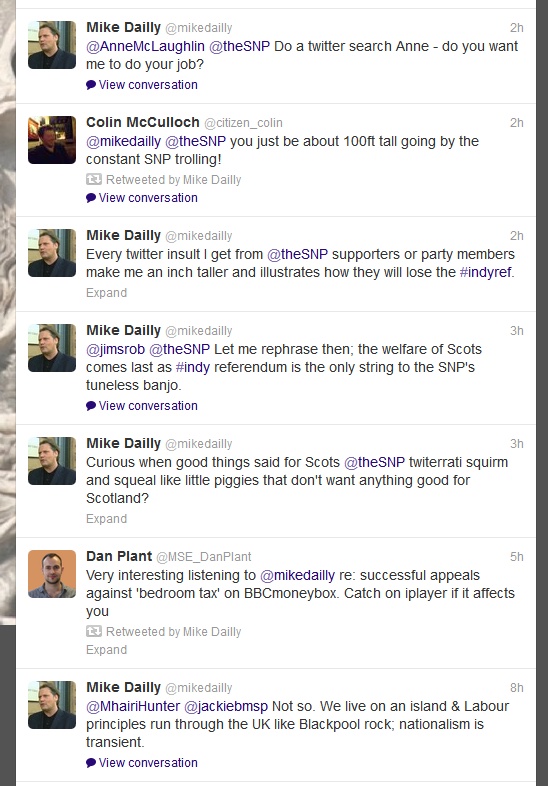
One of Labour’s key allies in Scotland is solicitor Mike Dailly of the Govan Law Centre. Best known for his attempts to force the Scottish Government to subsidise the bedroom tax by cutting services elsewhere, he’s a venomously anti-SNP figure who rarely passes up the chance for a bit of Nat-bashing.

(It would, we’re sure, be overly cynical to suggest that Mr Dailly wants the bedroom tax propped up because if it was abolished he’d suddenly be out of the public eye.)
Today he’s published a blog angrily contesting the claim made in yesterday’s White Paper that the UK is one of the most unequal countries in the developed world.
We thought we’d take a look.
Read the rest of this entry →
Category
analysis, idiots, scottish politics
We’re still dutifully ploughing through “Scotland’s Future”, but in truth we’re not really its target audience. We’re already convinced, and much of it is just like reading our own articles back except in rather blander language. What we can definitely say for certain is that it doesn’t lack detail – the composition of an independent Scotland’s armed forces, for example, is laid out almost down to the rifle.

Naturally, that didn’t stop the No camp from rushing onto the nation’s TV screens within minutes of the press launch ending with their considered, serious and thoughtful assessments of a document none of them had read.
Read the rest of this entry →
Category
analysis, comment, media, scottish politics