We weren’t going to post today, but we couldn’t let this one just sneak past under the cover of Christmas, because the way the story has evolved this week says so much about how the pro-Union media operates and what we’re up against.

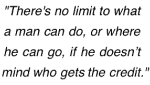
That’s the delightful Fraser Nelson, unfathomably-accented editor of right-wing commentary magazine The Spectator and the living embodiment of our own Sir Jock Finlay-Urquhart-Duncan in his youth. A couple of days ago Mr Nelson wrote the most extraordinary leader column for the magazine, and then things unfolded.
Read the rest of this entry →
Tags: flat-out liesmisinformation
Category
analysis, media, scottish politics
As a civil servant in London in the 1960s, and being part of the establishment, I always accepted the general view that an independent Scotland would not be able to survive on its own without financial help from the London Exchequer.
However, when in 1968 I was able to closely examine the UK’s “books” for myself in an official capacity, I was shocked to find that the position was exactly the opposite: that Scotland contributed far more to the UK economy than its other partners. And this, of course, was all before the oil boom.

I realised that the Treasury would wish to keep this a secret, as it might feed the then-fledgling nationalistic tendencies north of the border. I decided to keep an eye on the situation to see how long it would take for the true facts to emerge, which I felt would only be a short time. However, the machinery of Westminster, aided and abetted by the media, did an excellent job of keeping the myth about “subsidised” Scotland alive.
In fact it took another 30 years before the first chink in their armour appeared.
Read the rest of this entry →
Category
analysis, reference, scottish politics, stats, uk politics
As we’ve been poring over old opinion polls today, we thought we may as well share this with you. We make no suggestions that it proves anything about anything, it’s just fascinating. (It is to us, anyway, because the alternative is Strictly Come Dancing.)

It’s hopefully pretty self-explanatory. It charts the SNP’s lead (or, for much of the time, otherwise) in Holyrood opinion polling in the 16 months leading up to the 2011 Scottish election. And it’s interesting to ponder the timing of some of its peaks and troughs.
Read the rest of this entry →
Category
analysis, comment, psephology, scottish politics, stats
We’ve read a lot in the past few days about how referendum polling basically hasn’t moved at all this year. But we weren’t sure if that was really true. So with nine months to go, it seemed a reasonable idea to check the stats for the LAST nine months and see if any progress was being made.
Read the rest of this entry →
Category
analysis, comment, scottish politics, stats
The under-occupancy penalty more commonly known as the bedroom tax is a policy whose roots lie in London. Rents in the UK capital are so extortionate that keeping a roof over the heads of the unemployed, low-paid, disabled and vulnerable has become a dreadful burden on the taxes of City bankers, in the few cases where they pay any.

Readers might be forgiven for imagining, then, that the savage benefit reductions would be punishing Londoners harder than people in other regions of the UK. We’ve just been crunching the numbers, and you might be a little surprised at who it turns out are actually bearing the brunt more than most.
Read the rest of this entry →
Category
analysis, scottish politics, stats, uk politics
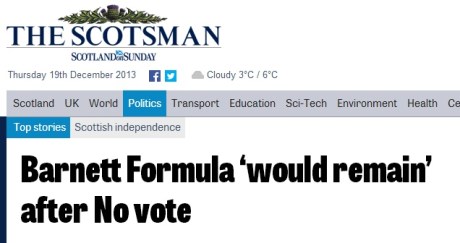
Ask anyone who knows about such things and they’ll tell you that not only is the headline the most important aspect of an article, but often it’s the only part of it that people read at all. It’s a fact worth bearing in mind when you scan the media coverage of the main Scottish politics story of today.
Read the rest of this entry →
Tags: misinformation
Category
analysis, media, scottish politics
Spain’s supposed threat to veto Scottish membership of the EU is like one of those serial killers on a student campus in a slash ‘n gore movie. No matter how many times the evil maniac is stabbed, hit over the head with bricks, shot 46 times through the lungs with a depleted-uranium blunderbuss, drowned in boiling acid or baked in a kiln with the pottery-class homework, he’s still stalking the heroine in the final scene.

Today the vampiric figure of a Spanish EU veto threat received yet another silver, garlic-coated stake through the heart. But we expect it to get up and walk again every other week until September 2014 regardless.
Read the rest of this entry →
Tags: project fear
Category
analysis, europe, scottish politics, uk politics
Today’s special referendum supplement in the Herald gives another run-out to the well-worn “women don’t like Alex Salmond” line much beloved of the Scottish press. It’s rare indeed that a month goes by without some mention somewhere of the fairer sex’s supposed dislike for the First Minister’s occasionally somewhat gallus nature, and today’s example is very much of its type.

“Yes campaign struggling to attract women voters” runs Magnus Gardham’s headline, and curiously notes of the paper’s poll findings that “the Scottish Labour leader Johann Lamont emerges as a potential asset in appealing to women”.
Why “curiously”? Well, let’s actually have a closer look at those stats.
Read the rest of this entry →
Category
analysis, media, scottish politics, uk politics
Rhodri Morgan, Labour former First Minister of Wales, 12 December 2013:
“No reform to the Barnett Formula until after the Scottish referendum.”
Alistair Carmichael, Lib Dem Secretary of State for Portsmouth, 17 December 2013:
“This government is not going to touch the Barnett Formula.”
Our emphasis both times. It’s not too tricky to read between the lines, is it?
Category
analysis, scottish politics, uk politics
Someone asked us yesterday for some facts and figures to help them with a debate, and it got us remembering one that we never see being brought up, perhaps because it’s buried in the archives of the Herald under Sport > SPL > Aberdeen (no, really).

It’s a piece that pre-dates the Scottish Parliament (and is written in a style that makes it seem older still), but it’s a complete mess of broken formatting, clearly the victim of numerous website redesigns, and painfully hard to read even when rescued from behind the paper’s paywall.
So we’re going to preserve it for posterity here in a cleaned-up, more user-friendly presentation, because it’s pretty much dynamite.
Read the rest of this entry →
Category
analysis, comment, history, media, reference, scottish politics, uk politics
There’s a rather strange article by Peter Kellner, CEO of polling company YouGov, in today’s Guardian. It makes a whole series of dubious claims, one of the most startling being the assertion that “Labour is the pro-welfare party-of-the-heart”, a view somewhat at odds with the party’s stated intent to be “tougher than the Tories on benefits”.
But perhaps most curious of all was the piece’s strapline.

Because the idea that Labour was winning any battle for the hearts and minds of the British public over public-sector cuts was quite dramatically contradicted the very same day by some data released by… YouGov.
Read the rest of this entry →
Category
analysis, stats, uk politics