It’s back (bacon), baby 5
Posted on
April 17, 2012 by
Wings Over Sealand
It's true, we are. This blog supports Scottish independence, and therefore usually finds itself at odds with the Scottish Labour Party and its elusive "leader" Johann Lamont. So when she was apparently released from the basement of John Smith House to speak at the launch of the Labour council-election campaign for Glasgow (though the evidence, supplied by Scottish Labour's own Twitter feed, was somewhat inconclusive), we didn't think it would be fair to report on the contents of her speech ourselves.

So instead, to ensure that Labour's positive policy prospectus for Scotland's biggest city gets impartial coverage, we're going to hand you over instead to the Scottish Political Editor of the Sunday Herald, the unimpeachably neutral Tom Gordon. Below is his full Twitter commentary on Lamont's speech as it happened. We have not edited Mr Gordon's tweetstream in any way. This is everything he said.
As we browsed the papers this morning, naturally our attention was captured by the implausible-sounding headline "Rennie Hails Breakthrough At Launch Of Poll Campaign". Coming the day after a YouGov poll suggested the Liberal Democrats had suffered the indignity of falling behind UKIP in nationwide voting intentions, we were intrigued at the notion of a positive turnaround in their fortunes.
The story wasn't quite as exciting as it sounded, referring as it did to a local-council by-election in Inverness that the Lib Dems had captured from Labour in November 2011 (quite why the Herald feels it to suddenly be front-page news in April 2012 we're not sure), beating the SNP by seven votes. But as we casually skimmed the piece we were startled into alertness by the revelation that the election had been brought about by the conviction of the previous Labour councillor for benefit fraud.
Attentive readers can't have failed to notice that the Unionist parties and media have been on something of a witch-hunt against the SNP recently, particularly the party's councillors and prospective councillors as – quite coincidentally, we're sure – crucial local-government elections loom.
The best-known example is of course that of MSP Bill Walker, which we've documented at some length before, and who has been the recipient of far more media and political opprobrium for violent crimes he's alleged to have committed 20 years ago as a private individual (but strenuously denies and has not been charged with, let alone found guilty) than Scottish Labour MP Eric Joyce, who pleaded guilty to a number of violent drunken assaults committed while a serving MP (indeed, committed in the House Of Commons) yet remains the elected representative of the people of Falkirk.
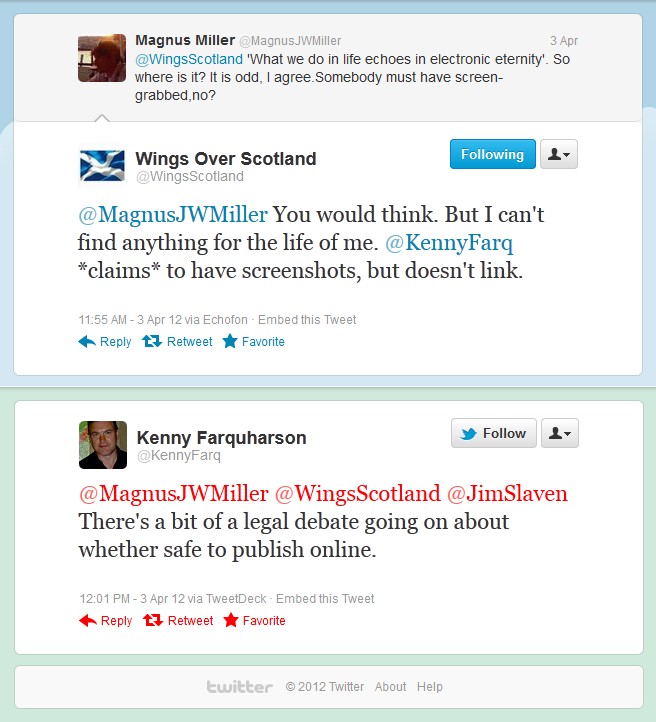
But we've also had the bizarre case of Lyall Duff, a man hounded out of the party under concerted and suspiciously-timed media pressure – most notably from the Telegraph, the Scotsman and the Herald – for some frank but fairly innocuous comments made weeks ago on a private Facebook page which appears to have been hacked in order to view them, leading to the curious situation where none of the newspapers involved have actually printed any images of Duff's alleged comments, citing possible legal issues.
(It's curious because if the information was obtained lawfully, there can be no possible grounds to fear publishing it. If Mr Duff expressed his views in public, they're fair game to reproduce. If he didn't, the newspapers concerned are guilty of intercepting someone's private communications, which is a criminal offence.)
Yesterday the Scotsman whipped up another smear about an SNP councillor, this time a non-story about a non-existent conflict of interest with a company in administration, and today the lead story – that's the lead story – in its Politics section is an absurd and hysterical piece based around an article openly written by an SNP MSP in a newsletter and illustrated with a picture of her, but which (in addition to spelling her name wrongly) attributes her academic history to the wrong university. This error leads the Scotsman to bewilderingly describe the entire newsletter as a "fake leaflet".
Earlier this month the same paper prominently reported some rather feeble allegations of "ballot-rigging" by SNP members (in an internal candidate-selection process), and also ran with a story of another SNP councillor who'd apologised for making a tasteless joke. Attentive readers will note that the media rarely fails to include the word "SNP" in the headlines of articles like the ones we've listed in this piece.
But oddly, even though it only happened a few months ago, we couldn't remember reading of any Labour councillor being convicted of benefit fraud, which seemed strange as you'd imagine it was a bigger story than a badly-subbed newsletter or some sour grapes from an unselected council candidate. So we got our Googling hats on.
The nationalist blogosphere is alive this weekend with talk of the recent BBC briefing at which several senior figures addressed an audience of the Corporation’s up-and-coming young journalists. The consensus view is that the recordings of the seminar reveal the BBC’s ingrained anti-independence bias – and indeed they do just that. But they do so in a way that’s both much less obvious and far more fundamental than most of the SNP supporters who’ve commented on them would have you believe.
You can watch the entire compiled recording above (the four individual sections with no syncing issues can be found here) and make your own mind up about what it demonstrates. But as our interpretation is rather at odds with that of most nationalists we’ve seen, we’re going to humbly offer it up for your consideration too.
We’re probably all sick of the “Skintland” furore already. The sneering, condescending front cover of the Economist (coupled with a truly dreadful Photoshopped image of Alex Salmond inside which was oddly reminiscent of one on a campaign leaflet the Lib Dems had to apologise for and withdraw last year) achieved its aim of provocation, while the feature it purportedly advertised was an altogether more innoffensive beast, cobbling together some fairly bog-standard Unionist innuendo, supposition and misrepresentation amounting to nothing much that we haven’t heard a hundred times before, and which was excellently dismantled by Gerry Hassan.
The most interesting thing about the article was that it started with a preamble about the Darien Scheme, a 17th-century business venture which went horribly wrong and which anti-independence activists are very fond of bringing up as a stick to beat Scottish nationalists. This very week, for example, saw the publication (given much prominence by the Unionist media) of a report by Professor Malcolm Chalmers on the future of Scottish defence, in which the learned academic also felt it bafflingly necessary to cite the three-centuries-old events of the Darien adventure.
The Chalmers report was noteworthy not just for its politically-motivated conclusions, but also the emotive language and narrative of British nationalism running through it. We’ll deal with the report itself in more detail soon, but for this weekend’s in-depth feature we’re going to look at the theme of BritNat mythology, and in particular the re-writing of the story of the Darien Scheme to that end. Trust me, it’ll be fun.
From the Scottish Football Association rules on Club Licensing (specifically Part 3, Section 03 – The Club as Licence Applicant and the UEFA Licence). Emphasis ours.
"3.1.1 The Licence Applicant may only be a football club, that is the legal entity fully responsible for the football team participating in national and international competitions and which is the legal entity member of the Scottish Football Association (Full or Associate Member). The licence applicant is responsible for the fulfillment of the club licensing criteria. This membership must have been in place at the start of the licence season for a minimum period of three consecutive years.
[…]
3.3.1 UEFA Licence Awards for Scottish Premier League Clubs (SPL)
A Licence cannot be transferred from one legal entity to another."
NB: "UEFA Licence" does not denote a licence to compete in UEFA competitions, which are governed by an entirely different set of criteria. As the SFA website explains:
"National Club Licensing applies to Scottish FA member clubs and UEFA Club Licensing applies to Scottish Premier League clubs."
In other words, to play in the SPL you must have a UEFA Club Licence, regardless of whether you actually compete in UEFA competitions or not. (SFL clubs, who in normal circumstances wouldn't be expected to qualify for European tournaments, are dealt with separately via an "extraordinary procedure" in the event that they do.)
So, should Rangers FC be subject to liquidation and then reborn as a "newco", the new company would NOT be eligible for the licence required to play in the SPL, for at least three years. Furthermore, it is plainly and explicitly forbidden under SFA rules for such a licence to be transferred from one legal entity (Rangers FC) to another (New Rangers FC 2012). Well, that's that all sorted out, then. As you were.
…
[Edited for clarity and latest versions of documentation, 13-4-2012]
[EDIT 17-4-2012: We rang the SFA yesterday, and they confirmed our interpretation of the rules above. Half an hour later they rang us back, sounding very nervous, and changed their line, stating that the UEFA Club Licence DID only apply to UEFA competitions, and only a National Club Licence was required to play in the SPL. Later that evening it was revealed that the Association is considering disbanding the SPL and SFL entirely and replacing them with a new National Football League. The SFA did not comment on the possible position of a newco Rangers in such a league.]
Picture special!

The world of Scottish soccer is in a ferment this week, and we use the word "soccer" quite deliberately. The two-part compound word "football" sticks in our throat, because the Scottish game has plenty of the first part but absolutely none of the second.
The reason for the sudden outbreak of sound and fury, which will ultimately signify nothing, is the revelation by the SPL of what the blogosphere is already calling the "Cheat's Charter". In itself it's actually a fairly innocuous document, and indeed could be portrayed as a crackdown. It proposes a raft of new penalties for teams going into administration or liquidation, with sanctions both on and off the field – a 75% reduction in monies paid by the League to the offending team for three years, and a 10-point deduction for two additional years following administration.
Since none of these punishments are currently part of SPL rules, one could not entirely unreasonably depict the changes (should they be agreed by the clubs in the meeting at the end of April) as a tightening-up of procedures. But equally rationally, the supporters of 11 out of the 12 SPL clubs are seeing them as something else entirely. Because what the proposed new rules do is explicitly lay down the route to a possibility which until now was only implicit – the return of a post-liquidation Rangers Football Club directly into the top flight of the Scottish game.
We were going to write about something else today, but we have a touch of the flu and we're not quite up to a hefty post. As we bravely ploughed through some research, though, we stumbled across another example of something we've noted before on this blog – Labour's curious (some might say outright untruthful) habit of presenting the SNP's position on things as the precise opposite of what they actually are. The latest accidental misunderstanding came from Johann Lamont's speech to the Scottish Labour conference last month. Here's what Johann claims the SNP say:
Here, on the other hand, is what the SNP actually say, from two months earlier:
"Scotland is not oppressed and we have no need to be liberated."
How odd. In the interests of fair and honest political discourse, should we all perhaps club together and offer to buy the leader of Scotland's opposition some new batteries? We'll throw in 50p to get things started. Pledge the amount of your support in the comments below and let's see if we can make the world a better place.
RUNNING TOTAL: £0.50
Last week saw another deployment of Labour's secret weapon in the fight against the SNP and their dastardly independence plans. The device is a WMD (Weapon of MisDirection) which the party has unleashed several times. But the weapon has a persistent teething problem – it has a tendency to come straight back and hit the user in the rear when they least expect it, while rarely managing even a glancing blow off the intended target. (Which in this case is of course the SNP.)

We've seen the patented Attack Boomerang in action on many occasions (the most recent being the bizarrely ill-judged attack on the SNP's referendum consultation which rebounded particularly badly on the party's "deputy" Scottish leader Anas Sarwar, and forced even the BBC to reluctantly acknowledge Labour's embarrassment), but one of the strangest was Labour's bitter criticism of the SNP over the fact that it had persuaded Amazon, the internet retailing giant, to recently open a large centre in the Dunfermline area and provide thousands of new jobs.
We couldn't help but note the Bill Walker story floating back to the top of the media agenda again this weekend like – well, you can finish that metaphor for yourself.
After an embarrassing week in which Labour had scoured Twitter and Facebook with a fine tooth comb trying to find obscure SNP councillors/candidates saying anything mildly contentious that they could fake some pious outrage about (of which this surely represented the pitiful, embarrassing nadir, as a fully-grown man tried pathetically to manufacture some kind of offence at a handful of primary-school-playground jokes that wouldn't have upset even the primmest Victorian maiden aunt), the beleagured party and its increasingly-desperate activists went back to some safer ground.
*Wings over Scotland is very pleased to be able to bring its readers another terrific guest post from Andrew Page of A Scottish Liberal. We spoil you, really we do.
This past Friday, the 6th of April, saw the anniversary of one of the most significant events in Scottish history – the signing of the Declaration of Arbroath.
It was a truly inspirational and courageous statement on many levels, and it is unsurprising that almost eight hundred years later it continues to have an impact on our understanding of nationhood and Scottish identity. That it was an expression of Scottish nationalism cannot be doubted: indeed, it is one of the most articulate, eloquent and heartfelt expressions of Scottish nationhood ever written.
But it is so much more than that, and at its heart was more than mere nationalistic aspiration, but a passionate cry for freedom and liberty. It was also, at its most basic level, a challenge to religious authority centuries ahead of its time in addition to arguably being a stimulus for far-reaching changes in European constitutional thinking.
In appealing to the Pope the signatories to the declaration make clear their commitment not merely to Scotland’s independence but also to its nationhood. In a curiously selective recollection of Scottish history, they point to how the Scots “came, twelve hundred years after the people of Israel crossed the Red Sea, to their home in the west where they still live today”, thereafter “[holding] it free of all bondage ever since” while “in their kingdom there have reigned one hundred and thirteen kings of their own royal stock, the line unbroken [by] a single foreigner.”
While these “facts” are more the product of cultural sensitivities rather than historical understanding, there can be no escaping the sense of belonging to a proud nation – one of “freedom and peace” in which “our people harbour no malice or treachery and [are] unused to wars or invasions.” A fine vision, indeed.
In some respects, it is easy to detect a more than faint romanticism in these claims as is generally true with most nationalist thinking. Perhaps, while many today identify Scotland in terms of Celtic mysticism, the tartan and bagpipes culture of the White Heather Club, haggis and shortbread tin landscapes the signatories of the Arbroath declaration were equally in love with an artificial view of Scotland, based itself on false assumptions about the nation’s history, its potential and its individual nature.
Such assumptions perhaps contain a grain of truth, but are in fact quite dangerous and are themselves usually based on modern hostility to Scottish nationalism. Certainly, the myth of ethnic origin apparently expressed within the Declaration can be easily debunked, but it’s also clear that Scottish nationhood was not defined by such fiction. The explanation of Scotland’s establishment was designed to persuade the Pope of their cause rather than an exercise in writing accurate history.
What is immediately obvious is that the nature of nationhood itself, as expressed in the Declaration of Arbroath, is far different from that often associated with the romanticised view of Scotland that appeals far more to foreign visitors than it rings true to most contemporary Scots. At the root of the nationalists’ cause in 1320 were core values, not determined by lines on maps or even historic achievements but a right to self-determination, for recognition, for an end to oppression and the subservient status apropos England. Put in modern terms, it was a desire on the part of Scots to take control of their own political destiny.
Wings Over Scotland is a thing that exists.