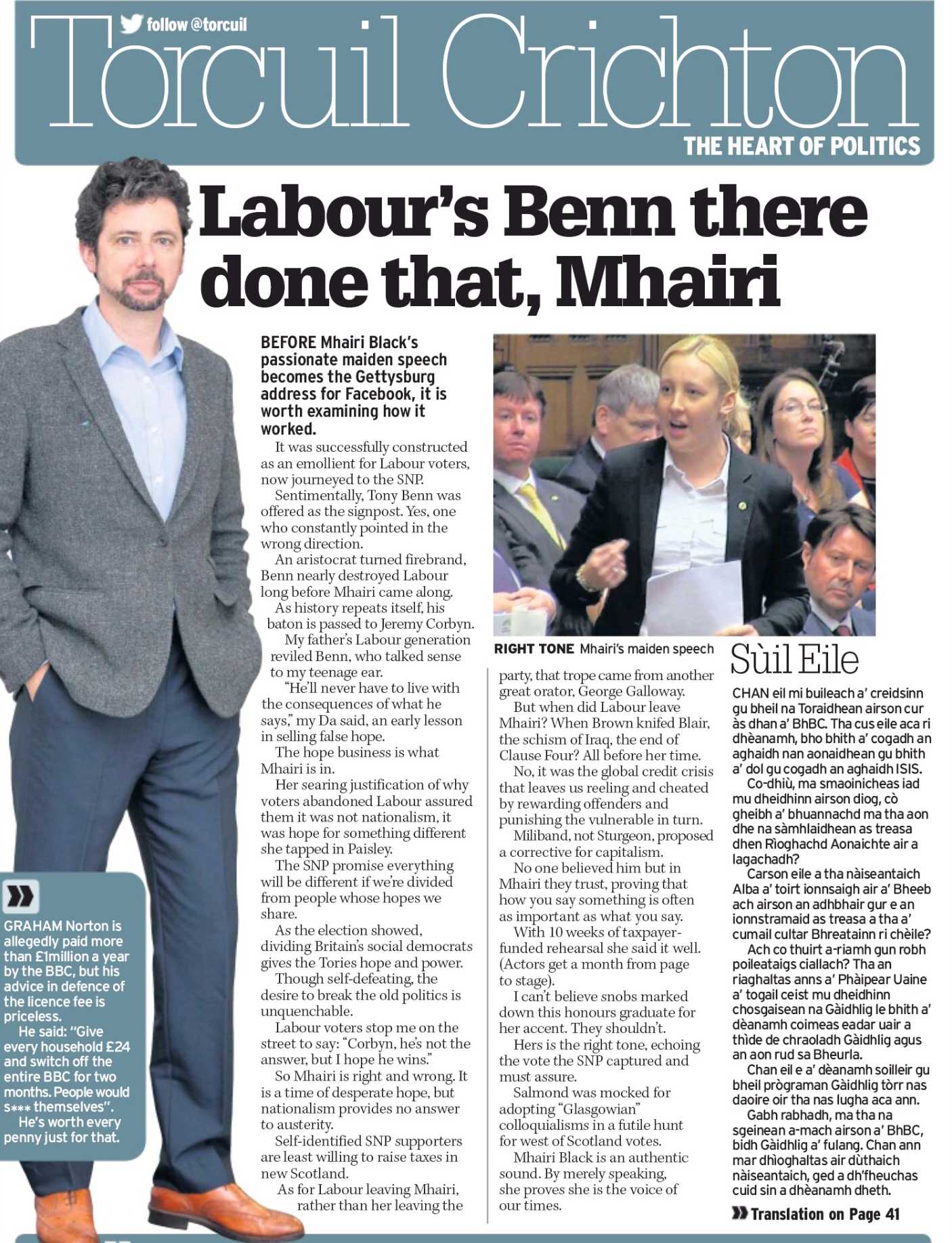
These pages from the 14 March 1998 issue of NME (just 10 months after the election of Tony Blair’s first Labour government) are a fascinating historical document.
They needed saving. So we found them and we saved them.
Alert readers may have noticed something of a glut of articles in the press recently by right-wing commentators angrily challenging the SNP to prove its left-wing credentials if and when the new Scotland Bill ever becomes law and grants Holyrood more powers over taxation, some minor aspects of welfare and – of course – road signs.
The zenith of the phenomenon must surely be today’s eye-rubbingly bizarre Scotsman story in which the Scottish Tories urge the SNP to increase tax in order to reverse, er, Tory cuts. But there’s method behind the seeming madness.
The battle-cry of right-wing Labour apologists all this week has been “realism”. It’s all very well people like Jeremy Corbyn having crazy old principles about what Labour is supposed to stand for, runs the argument, but you can’t argue with public opinion and public opinion is desperate for Labour to become Tories with a slightly softer edge.
We’re sorry to keep going on about this, readers, but we’ve been going over and over it in our heads and we just can’t get it to make sense.
Below is the failed Labour amendment to the Welfare Reform And Work Bill:
As you can see, its sole intended purpose was to refuse a second reading to the Bill. Labour voted for their own amendment (an achievement, we suppose), which means they didn’t want to see the bill get a second reading.
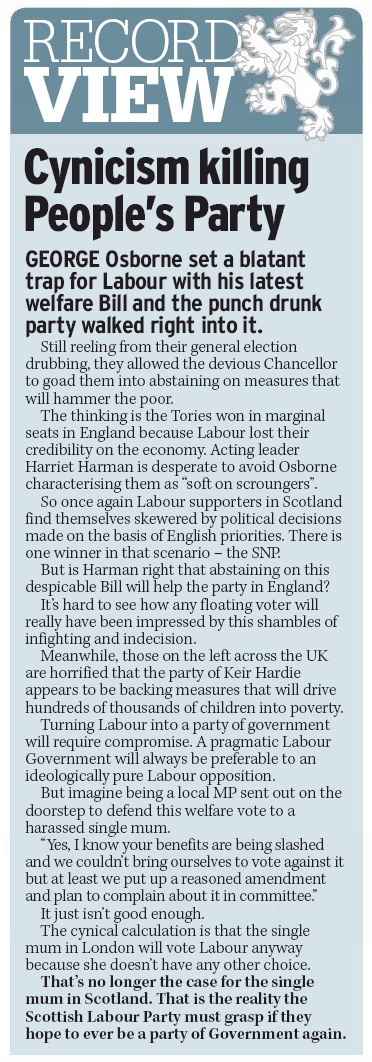
After last night’s debacle in the House Of Commons, various Labour activists and cheerleaders have been scrambled on social and print media to firefight the appalled reaction from voters on the left to the party’s abstention on the Tory welfare bill.
The government’s brutal, monstrous welfare reform bill passed its second reading in the Commons tonight by 308 votes to 124, meaning that somewhere in the region of 80% of Labour MPs abstained on it.
Hatey McHateface on Response Level Upgrade: “I have a crisp tenner that says calling somebody a pygmy – a derogatory term with racist overtones – is…” Jun 16, 23:27
Hatey McHateface on Response Level Upgrade: “You don’t get it, Marie. Again. An immigrant ceases to be an immigrant when she loves her adopted country. Then…” Jun 16, 23:17
Hatey McHateface on Response Level Upgrade: “Then I’d have to create yet more identities! Have a heart, Bob. I’m struggling to keep track of even the…” Jun 16, 23:08
robertkknight on Response Level Upgrade: “This place should be renamed “Hatey McHateface Over Wings”. Rev… Any chance of limiting BTL comments to 5 per person…” Jun 16, 22:55
Oneliner on Response Level Upgrade: “He called the Donald a ‘war criminal’” Jun 16, 22:21
Marie on Response Level Upgrade: “Americans are generally thought of as patriots who love their flag and their country and put their hands on their…” Jun 16, 21:48
sam on Response Level Upgrade: “Pygmies, literally and figuratively, fail to recognise words of the inaugural speech of Jimmy Reid as Rector of Glasgow University.” Jun 16, 21:29
Hatey McHateface on Response Level Upgrade: “MSM reporting that two petitions calling for FIFA to review the refereeing of the Scotland-Haiti match have now reached 155,000…” Jun 16, 21:21
Mark Beggan on Response Level Upgrade: “A Leftist is someone who wants the immigrant and all his mates to come to their country so they can…” Jun 16, 20:41
Mark Beggan on Response Level Upgrade: “A patriot is someone who wants the immigrant to go back to their own country ASAP by the fastest route.” Jun 16, 20:32
Aidan on Response Level Upgrade: “And of course using that definition Alf, every region and county within the U.K. would similarly be a colony, lacking…” Jun 16, 20:31
Southernbystander on Response Level Upgrade: “I know James, and I am, after all, just a ‘wanker’, though I draw the line at ‘effete arsehole’ as…” Jun 16, 20:28
Hatey McHateface on Response Level Upgrade: “An immigrant is somebody who hates their adopted country. Discuss.” Jun 16, 20:10
Hatey McHateface on Response Level Upgrade: ““distributes funds necessary to keep […] much of the native proletariat on side, being ‘the most favoured section of the…” Jun 16, 20:07
Alf Baird on Response Level Upgrade: ““the book” This may be the correct term given that I assume you are referring to the only research-based book…” Jun 16, 20:05
Mark Beggan on Response Level Upgrade: “‘A patriot is someone who loves their country. A nationalist is someone who hates everybody else’s country’” Jun 16, 19:59
Hatey McHateface on Response Level Upgrade: “Can I just say, Marie, that in the Land Of The Stupid Comments, the writer of the Most Stupid Comment…” Jun 16, 19:58
Alf Baird on Response Level Upgrade: ““Public life in Scotland is dominated by fake-nats, bourgeois leftists, anglos, and every variety of grifter and opportunist” Excellent synopsis,…” Jun 16, 18:22
Mark Beggan on Response Level Upgrade: ““Only have to look at the manner in which opposite sides on political debates dehumanize each other for daring to…” Jun 16, 17:48
Mark Beggan on Response Level Upgrade: “Well done American Homeland Security. I wouldn’t let a baldy grifter who doesn’t know the difference between a man and…” Jun 16, 16:18
Aidan on Response Level Upgrade: “Do you honestly think the British state would pay three people to entertain an irrelevant idiot like you James? If…” Jun 16, 16:18
Hatey McHateface on Response Level Upgrade: “Havers, sam. It’s all the fault of colonialism.” Jun 16, 16:08
Hatey McHateface on Response Level Upgrade: ““hundreds of Scotland fans who had previously been granted an ESTA had had their travel permits withdrawn at the last…” Jun 16, 15:56
Spartan 117 on Response Level Upgrade: “Interesting quotes with much food for thought. Only have to look at the manner in which opposite sides on political…” Jun 16, 15:48
Hatey McHateface on Response Level Upgrade: “It might be a very subtle witticism, Northy. Chas might be hinting at how the reflection in the mirror connects…” Jun 16, 15:47