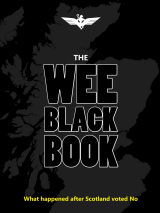
This guy’s on your team. Congratulations on that.

(We’re particularly impressed by the attack on Nicola Sturgeon, just days after a poll found her to be the most popular politician in Scotland, and probably Britain. Genius.)
At the last Scottish Parliament election, UKIP secured 0.52% of the vote, a little over half the share achieved by the Scottish Senior Citizens Unity Party. We’re not sure why the press doesn’t give their leader, whoever it is, more front covers.
Tags: britnatslight-hearted banterunionist of the day
Category
comment, europe, pictures, uk politics
In this site’s view, the single most important truth that YesScotland will need to convey to the Scottish electorate if it wants to win the 2014 independence referendum is the reality of what a No vote will mean for devolution. It’s a theme we’ve covered extensively, and will continue to highlight because it’s the core thing the Unionist campaign don’t want people to know.

All three London-run parties are engaged in the pretence that if Scots reject full control of their own affairs they’ll be showered with new powers by Westminster, despite that premise collapsing under the slightest scrutiny. But today an alert reader pointed us towards something that reveals a much more convincing reality.
Read the rest of this entry →
Category
comment, disturbing, scottish politics, scum, uk politics
Unionists never miss a chance to sneer at “Braveheart”, a film which won five Oscars and tells a true story (very heavily embellished by Hollywood) about a people’s fight for self-determination. Only last night, Scotland Tonight retweeted one eager young No voter using it as an explanation for the increase in support for independence among the 18-24 demographic, even though the film came out almost 20 years ago.
This sort of thing, though, is fine:

That’s because nationalism is great, so long as it’s British.
Read the rest of this entry →
Tags: braveheart klaxonbritnats
Category
comment, culture, pictures, uk politics
There’s a faintly astonishing story in today’s Scotsman. As if belatedly realising the damage that they’d done to the No campaign by detailing Labour’s toys-out-of-pram tantrum in the House Of Commons this week, the paper runs a firefighting exercise of a follow-up piece which reveals no new information, but gives the party a helpful platform from which to try to winch itself out of the hole.

(A “senior party source” duly obliged with the comically-absurd assertion that “the party’s main concern was that without a reference to independence, an MP could be stopped from speaking for going off the subject.”)
That’s not the astonishing part, of course – giving Unionist parties a platform is what the Scotsman exists for. The amazing thing is the size of the gulf between what the story reports as the reason for the debate’s cancellation and what the person whose debate it was had already said in public a full day earlier.
Read the rest of this entry →
Category
analysis, comment, media, scottish politics, uk politics
We’ve spoken before on this site about a couple of political concepts based around different ways of winning votes by bombarding the electorate with untruths so relentlessly that they come to be accepted as fact.
One of them, the “Big Lie”, was a term infamously coined by Hitler to describe a strategy regularly deployed by the Nazis in which a falsehood would be perpetrated which was so diametrically and spectacularly at odds with the reality, people would instinctively reject the thought that anyone would have the bare-faced audacity to say it if it wasn’t true, and therefore it must be.

Language needs some kind of brand new term, though, to accurately encapsulate the magnitude of what Scottish Labour have just tried to pull off.
Read the rest of this entry →
Tags: flat-out lieshatstand
Category
comment, scottish politics, uk politics
In an intervention that could in time-worn political terms be described as “brave”, the Secretary of State for Scotland insisted yesterday that recent legal advice to the UK government means an independent Scotland would not inherit the UK’s existing international treaties but would still nonetheless inherit a share of the UK national debt.
The UK Government’s understanding of new legal analysis on the implications of Scottish independence is in their view proof that the most likely outcome of Scottish independence would be the continuation of the UK as the existing state under international law and the creation of a new state of Scotland.

However, the report’s authors declined to rule out the creation of two completely new states or the resurrection of the Scottish state that existed prior to 1707 – although both outcomes were deemed unlikely by Westminster. But just in case anyone wasn’t yet adequately confused, the report’s authors went on to say this (our emphasis):
“Assuming that Scotland would be recognised as a new state, albeit a successor state to the UK, it is difficult to see how Scotland could evade the accession process for new states in the EU treaties.”
So this new “definitive” legal advice doesn’t in fact rule out any of the only three options available, and in fact defines Scotland as both a “new” and a “successor” state, seemingly contradictorily. But what does all this mean? To try to shed some light, let’s look at what international law says on the subject of borders, treaties and debts.
Read the rest of this entry →
Tags: one nationScott Minto
Category
analysis, scottish politics, uk politics
Observed – so far as we’re aware – by nobody, today’s UK government paper also torpedoes another core argument hitherto beloved of Unionists in the independence debate. That argument runs “Scotland and England would not be entitled to equal successor-state status, because Scottish independence would NOT in fact be a dissolution of the Union, because the current UK was formed not by the 1707 Acts of Union but by the 1800 treaty incorporating Ireland.”
The document, however, expressly blows that contention out of the water:
“36. We note that the incorporation of Wales under laws culminating in the Laws in Wales Act 1536 (England) and of Ireland, previously a colony, under the Union with Ireland Act 1801 (GB) and the Act of Union 1800 (Ireland) did not affect state continuity. Despite its similarity to the union of 1707, Scottish and English writers unite in seeing the incorporation of Ireland not as the creation of a new state but as an accretion without any consequences in international law.“
File this one for future reference, readers.
Category
analysis, scottish politics, uk politics
The devil, they say, is in the detail, and that certainly seems to apply to the UK Government’s first paper on the consequences of Scottish independence. With remarkably little fanfare, the coalition appears to have dropped an atomic bomb into the heart of the constitutional debate, and not even realised it.

The core premise of the document appears to be the counter-intuitive idea that the UK can have it both ways – it can insist that an independent Scotland would be a brand-new nation with no rights to any of the shared property of the UK, but that it would somehow simultaneously be responsible for its full share of the UK’s liabilities. Michael Moore is quoted saying precisely that in today’s Herald.
The justification for this outwardly-absurd claim rests on an astonishing assertion lurking unassumingly in a series of paragraphs in the middle of the paper. We’ve copied it below and highlighted a couple of the relevant phrases.
Read the rest of this entry →
Category
analysis, apocalypse, history, scottish politics, uk politics
There will be uncountable acres of newsprint expended on analysing the UK Government’s paper released today on the implications of Scottish independence for EU membership. If you’re in a hurry, though, the entire document is comprehensively and accurately summed up in these two paragraphs from Part V, Section (3):

Even shorter version: if the EU wants us in automatically (something which is plainly in absolutely everyone’s interests, including the rUK’s), then we’ll be in automatically, no matter what the small print says. And that’s that.
Read the rest of this entry →
Category
analysis, europe, scottish politics, uk politics
It sometimes feel as though the jagged, jittery line stretching from Gretna to Berwick isn’t so much a border as a fracture in a mirror, through which things look different according to which side of it you’re standing on.

On its south side, Labour decry a Tory government as the worst thing that can possibly happen. To the north, it’s an inconvenience Scots must bear for six or seven years out of every ten despite always rejecting the Conservatives at the ballot box, because to cast them out decisively would be selfish, childish “narrow nationalism”.
Scottish Labour MSPs abstain from voting for the replacement of Trident nuclear weapons, presenting a transparent lie of opposition to the weapons of global destruction. But something about the short train journey to London persuades Scottish Labour’s MPs to advocate Trident replacement enthusiastically, demanding only to know what else can be cut to ensure there’s enough money for it.
When in Scotland, the Tories and Lib Dems in the coalition government issue dire warnings that an independent Scotland would be cast out of the European Union and into international isolation. Safely back home in England, the Prime Minister promises UK voters a referendum that (according to polls) will achieve that very end.
The Huffington Post quotes the PM today on the subject of Scottish independence.
“He questioned why people should be made to choose between Scotland or Britain when they could be part of both, adding: “Britain works. Britain works well. Why break it?”“
But hang on. “Britain ain’t broke, don’t fix it” wasn’t Mr Cameron’s previous view.
Read the rest of this entry →
Tags: vortex
Category
comment, scottish politics, uk politics
Remember when some of us made a bit of a fuss about the epically tasteless plans for the 100th anniversary of the start of World War 1, and were angrily told by various indignant British nationalists that the planned events were a “commemoration, not a celebration”? Turns out you can’t keep the truth down for long.

Astonishingly, the government even wheeled out some unbelievable numbnuts of a defence minister who offered up the following quote to describe this great sporting showpiece in which we will again be encouraged to see the Germans as our enemies:
“A no-brainer in terms of an event that is going to reach part of the community that perhaps might not get terribly entrenched into this”
Yep. He really said “entrenched”. Still, we agree with the first three words.
Tags: britnats
Category
comment, disturbing, football, idiots, uk politics
For those who haven’t already seen it on Twitter, we’ve been trying to follow up a recent comment made by James Kelly of the splendid Scot Goes Pop! blog, and we’ve drawn a blank. So: does anyone know when the UK Labour Party gave up its full membership of the Socialist International?
The party’s website still claims to be a member, and the Wikipedia entry concurs, so the change of status is likely quite recent*. But the SI’s own site is clear that the party is no longer a participating member, merely an observer. Yet we’ve turned Google upside down searching for any sort of news story about it anywhere.
(And since UK Labour has been an active member for the entire period of the international group’s existence – joining it when it took its present form in 1951 – you’d think someone somewhere would have seen fit to mention an event as significant as it leaving “the worldwide organisation of social democratic, socialist and labour parties”.)
Anyone?
.
*[EDIT @ 13.12: An alert reader uncovers an entry on archive.org still listing the party as a full member as recently as December 27th of last year.)
Category
uk politics