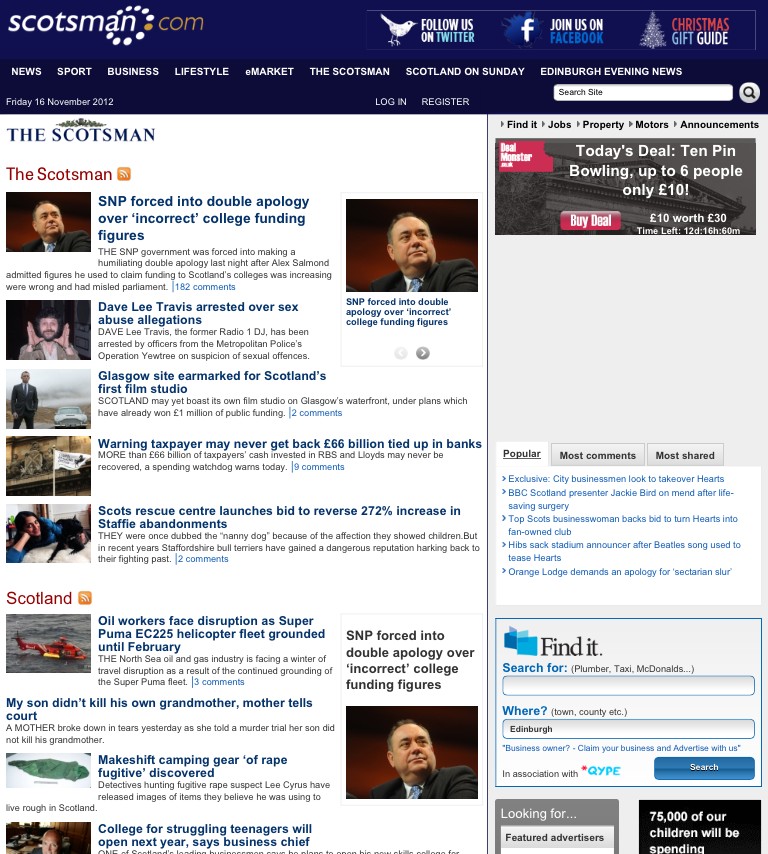
Alex Salmond, rumoured to have a fiery temper, must be hopping mad today. Johann Lamont wasted her time on a speculative exercise at First Minister’s Questions, aiming (as is her wont) for nothing more than a petty point of snark, and instead a clumsy piece of SNP briefing allowed her to extract an embarrassing retraction and apology to the chamber, which the Unionist press has of course seized on gleefully.
(The Scotsman has emblazoned no fewer than THREE links to the same article across this morning’s front page to make sure none of its remaining readers miss it. The Herald, meanwhile, had Magnus Gardham write a frothing piece entitled “Salmond apologises for misleading MSPs at Holyrood”, only to bizarrely pull it – and all its comments – and replace it with an almost-identical one in order to change the headline to “Salmond says sorry for misleading MSPs again“. The original has been deleted from the Herald’s search facility, but can still be found on the server.)
In fact, rather than being increased by 0.18% as Salmond claimed at FMQs, the budget for Further Education colleges has been reduced by 1.7%. Given the austerity measures being inflicted on the Scottish Government by Westminster, that’s actually a near-miraculous protection of funding, particularly given the other investments being made in education, and a properly-briefed Salmond could have calmly and effectively pointed that out. He might also have noted that Lamont had no genuine interest in FE funding and nothing constructive to say on the subject – such as where Labour would make the savings necessary to maintain/increase it.
The Labour “leader” sought only to make party-political hay out of semantics, at Mike Russell’s expense, to give her hapless back-benchers something to cheer, but in her flailing landed herself an unexpected hit on the First Minister himself. Someone somewhere in a dark corner of SNP headquarters will be nursing a severely chewed ear this morning, and deservedly so.
Labour, meanwhile, will crow delightedly about the Nats’ own-goal. But at the end of the day, we suspect the electorate will remember who it is who wants to impose crippling tuition fees on students, and who wants to end free personal care and bus travel for the elderly, and free prescriptions for the sick, and increase Council Tax, and use the money to pay for nuclear weapons so that Westminster politicians can strut around on the world stage. We know we will.
Category
analysis, media, scottish politics
Below is a picture of the headline and opening paragraph of a David Maddox-penned story that appeared on the Scotsman website last night.

It is, as you can see, an essentially positive story, noting that independence per se represents no threat to RBS staying in Scotland. Those readers wondering if that was perhaps a little at odds with the Scotsman’s normal editorial position on the issue would be reassured, then, to see how the story looks this afternoon.
Read the rest of this entry →
Category
disturbing, media, scottish politics
As attentive readers will know, I currently live in the leafy Georgian city of Bath. Just a few miles down the road is a small town called Frome, where interesting things have been happening over the last 18 months or so. Today’s edition of the Independent has a pretty decent one-stop guide to them, which is well worth a read in full.

By way of a trailer, though, we’ll pick out a few soundbite snippets for you.
“united in being fed up with their town council’s institutional wrangling and party-political self-interest”
“set about making their town a better place to live”
“it’s the people who live in Frome that know what’s best for the area”
“hostility, stonewalling and outright non-cooperation from the established parties”
“an incredible 75% increase in voter turnout”
“In Westminster… elected officials toe their party line and avoid contentious issues; maintaining the status quo to the detriment of progressive debate… always eager to discredit their opponents, but much more reticent when it comes to their own ideas… the sole aim of the main political parties is not public service, but to get power, and once they have it to cling on at all costs“
“In contrast to this partisan deadlock, the [Frome] councilors are proud to point out that… they have not yet once failed to reach a democratic consensus on any issue.”
Running your own affairs sounds pretty good, doesn’t it?
Category
media, uk politics
A press release on the always-positive Scottish Labour website this morning blares a wake-up call to the reckless and irresponsible Scottish Government. “IPPR Report Shows SNP Economic Policy Is Financially Illiterate”, it rages, going on to quote the party’s finance spokesman Ken Macintosh:
“This report shows that the SNP’s economic policy is financially illiterate. Not only do we get more spending than we raise as a result of being in the Union, but the SNP’s commitment to turn Scotland into a low-tax corner of Europe would see revenues plummet and public spending slashed to the bone. Scotland would be crippled by what could only be described as economic suicide.”
Oof. Strong words for sure. Hang on, though – which SNP economic policy are we actually talking about here? The preamble to Macintosh’s furious blast references “the SNP’s plans to cut Corporation Tax to 12.5%”. But the only problem with that is that the SNP doesn’t appear to have any such plans.
Read the rest of this entry →
Tags: flat-out liesthe positive case for the union
Category
analysis, media, scottish politics, uk politics
Some alert listeners picked up a curious story on today’s edition of Good Morning Scotland, which was reported on the Tattie Scones blog and which we immediately set about investigating further. It was another outing for the “Scotland could be partitioned after the independence referendum” nonsense first peddled by a Tory peer back in January of this year, and picked up by unhinged Scotsman columnist Michael Kelly in August, but the latest advocate of slicing Scotland into countless separate parts that could require you to cross international borders a dozen times on a drive from Dumfries to Dingwall was our old pal Ian Davidson.
The Glasgow MP, who to the astonishment of alien observers from far-off galaxies has been placed in charge of the Scottish Affairs Select Committee in order to conduct a fully impartial analysis of Scottish “separation”, apparently made the suggestion sometime this week, but GMS curiously failed to include either an interview or a quote in its 69-second news report, which you can hear in its entirety by clicking on this link.
The piece also suggested that some of Davidson’s own colleagues were among those pouring scorn on the ludicrous notion, but declined to identify any of them. It wasn’t repeated in the rest of the programme, and we’re still none the wiser as to when and where the comments were made. (Although we know when it wasn’t.)
If any reader can enlighten us, please feel free.
Category
audio, disturbing, idiots, media, scottish politics, uk politics
The Daily Record carries the results of an interesting poll today. Carried out by the paper itself among its own readers, it shows conclusive support for a range of SNP policies. For example, 79% of Record readers want to retain Sterling should Scotland become independent, in line with the Nats’ position. They want Scotland to remain a member of the EU by a ratio of almost two to one (55% to 29%). They want to stay in NATO by an overwhelming margin of 68% to 13%. And abolishing Trident is backed by more than three-to-two (47% vs 31%) among the poll’s respondents.
You’d imagine that Scotland’s second-biggest-selling newspaper might be pleased that the country’s government so comprehensively reflects the desires of its own readers, wouldn’t you? And yet unaccountably, the Record appears to be furious about it.

“Our poll shows voters back the SNP’s blueprint for independence – and that’s exactly how Alex Salmond planned it”, the Record froths, as if putting forward a manifesto that people like and support was some kind of dishonourable, underhand tactic. “The SNP have thrown political beliefs out of their window in a desperate attempt to convince Scots to put a cross beside the Yes box in 2014”, it continues, seemingly in the belief that listening to the electorate is the most dastardly crime in the government playbook.
Much of the piece is of course given over to angry reactions from Labour and Unionist spokespersons, who we commend the Record on getting to actually turn up. And it ends rather abruptly, as if the Record’s exasperation at the sheer effrontery of the SNP in continuing to be popular has rendered it speechless. But ultimately, even Labour’s most loyal propaganda organ reluctantly faces the basic fact that the SNP can legitimately claim to be speaking for the people of Scotland, while Scottish Labour can’t even speak for itself. We suspect the Record has more such dark days ahead.
Category
analysis, media, scottish politics
There was a shock admission from Anas Sarwar, “deputy” leader of Scottish Labour, when speaking about the referendum on BBC Scotland’s “The Big Debate” last night:
“This will be the biggest decision that any of you will make in your lifetime, and what we need actually is Yes.”

It’s not every day we agree with the often factually-challenged MP for Glasgow Central, but this time we think he’s hit the nail square on the head.
(Because it’s fine to just cut people’s quotes short to suit your own purposes, right?)
Category
audio, comment, media, scottish politics, uk politics
After ten days, we have an answer, of sorts.
“Dear Rev Campbell
Reference CAS-1714825-RP7R5W
Thank you for your e-mail. Your comments were passed to the Editor of Newsnight Scotland, who has asked that I forward his response as follows:
“Thank you for getting in touch with us about the Newsnight Scotland interview with Nicola Sturgeon on 23rd October.
We have received a number of complaints about this item, most of them concerning the sound quality of the interview and a number alleging politically-motived bias.
To take each in turn:
I accept that the sound quality of this item fell short of the standards we would expect and apologise if this detracted from your enjoyment of the interview. However, I do not believe that the editorial sense of that interview was compromised by the technical problems. I have investigated what went wrong in this instance and have taken appropriate steps to ensure that something similar does not occur in future.
Some have suggested that the BBC in some way deliberately ‘doctored’ the interview for reasons of political bias; others suggested that it was not a technical fault but a deliberate attempt to suppress the words of the Deputy First Minister. Either suggestion implies that we were happy to be grossly unprofessional and, thereby, seriously to breach all of the journalistic standards which the BBC has striven for so many years to achieve and which are encapsulated in the BBC’s Editorial Guidelines. I can only repeat – this was an unfortunate technical matter for which I again apologise.
Thank you again for taking the time and the trouble to be in touch about the programme.”
Details of the BBC complaints process are available online at http://www.bbc.co.uk/complaints/handle.shtml
Kind Regards
Patrick McManus
BBC Complaints”
As often tends to be the case with BBC responses, it produces more questions than answers. The nature of the “technical fault” is not clarified, there’s nothing on how it managed to get past the producer without the failure being noticed and be broadcast, and nor – more tellingly – is there any explanation of why there was no apology broadcast on either that night’s show or the following evening’s. Even if we take the reply at face value with regard to the incident itself, we all pay a significant (and mandatory) fee for the BBC and we deserve more respect than that.
But most curiously of all, if you read it closely the reply doesn’t in fact deny the suggestions of bias. It merely says, if we might paraphrase, “If you believe we’d do such a thing, then you must be prepared to believe that we’re biased.” It rather conspicuously doesn’t go on to add “But we’re not”, instead merely leaving the reader to infer it without it actually being said.
We feel compelled to note once again that in the event of a vote for independence, everyone at BBC Scotland would be out of a job. We’re not sure how conducive to impartiality that is, and we suspect it could certainly stretch to turning a blind eye to an initially non-deliberate gremlin in the works. We will, as ever, continue to monitor.
Category
comment, media
Poor old The Herald. The paper’s political editor Magnus Gardham must have felt today was a safe day to keep piling attacks on the SNP about an independent Scotland’s status within the EU. So he went ahead and penned “Further Blow For Salmond Over Europe”, a front-page lead concocted out of comments from an obscure European politician about Catalonia, which observant readers may be aware is not Scotland.
Yet even as Gardham (and colleague David Leask) thundered about how a mandarin from Luxembourg’s personal opinion about a situation almost entirely incomparable with that of the United Kingdom could nevertheless be extrapolated to dire consequences for Scotland (with a Yes vote in the referendum leading to Scots being ejected from the EU and forced to apply for membership as a new nation), a document published by the UK’s own Parliament came to light offering exactly the opposite view.
The document, dated 24th September and 17th October this year, is a submission to the Foreign Affairs Select Committee by Graham Avery, who is identified as a “Senior Member of St. Antony’s College, Oxford, Senior Adviser at the European Policy Centre, Brussels, and Honorary Director-General of the European Commission”, and whose CV notes that he spent “40 years as a senior official in Whitehall and Brussels, and took part in successive negotiations for EU enlargement”. Sounds like a chap who might know what he was talking about in this field.
You can read the whole thing here. But a few passages leap out. (Our emphasis.)
Read the rest of this entry →
Category
analysis, media, uk politics
The quotes below come from an April 2007 piece entitled "And The Winner Is", concerning the inaugural Games Media Awards of later that year, written by Kyle Orland for GameDaily.com. The site no longer exists, but you can still read the article via the ever-handy Internet Wayback Machine.
""We actually found a lot of people in the games media don't feel well recognized by the industry they served," said Stuart Dinsey, Managing Director for Intent Media and the brains behind the awards show. "We felt this was a good way to give them some of that recognition and have a great party for everyone to get together at the same time."
"As for the all-important judging itself, Dinsey said the exact process was still being tweaked. Dinsey added that he'd like to get votes from "all the leading companies" in the games industry, probably by asking PR representatives to consult with their colleagues and place a vote to represent the company as a whole. Dinsey said the exact makeup of the judging panel will be kept secret until after the voting is done, to prevent any quid pro quo situations from developing."
But the mere specter of industry voting was enough to give some members of the press pause about the awards. "The games industry are the last people who should be voting for awards in games journalism," said British game freelancer Kieron Gillen. "It's a bit like the prisoners voting for who's their favourite prison guard." Gillen said he worries that the industry voting will make the award one "you wouldn't want to win…. because it's basically shorthand for 'Lapdog Of The Year award'.""

(Despite these comments, Gillen accepted a GMA that very year, and this month pocketed the "Games Media Legend" prize to bookend it with. He attempted to justify his instant U-turn the day after the 2007 award by saying "The awards don’t really matter. PRs are fine. They’re just people." In a fine twist of irony he now pontificates at highbrow public events about how independent games journalism is of PR, and is also a judge in the "Games Journalism Prizes" awards, along with a number of other "concerned games industry types", several of whom are also GMA winners.)
Now the owner of the PR-driven GMAs uses their power to censor journalists with legal threats for expressing honest opinions and accurately quoting people's own public comments to illustrate a valid and fair point. Now maybe we're just old and bitter (well, there's no "maybe" about it), but it seems a pretty odd way of "recognising" games journalism to us. Unless, that is, you ponder who voted on the first GMAs (and still vote on them now), and start wondering to yourself exactly which industry it was that Stuart Dinsey meant when he said "recognised by the industry they serve".
Category
analysis, disturbing, media, videogames
Well, that was exciting. The entire English-speaking world of videogames journalism just about convulsed itself into a coma yesterday because someone did that rarest of things in the English-speaking world of videogames journalism – spoke openly, frankly and truthfully about something. If you've been having trouble keeping up with the dizzying pace of developments, allow us to lead you gently through the most concise and accurate timeline we can manage.
Read the rest of this entry →
Category
disturbing, idiots, investigative journalism, media, videogames
Below is the originally-published version of an article entitled "A Table Of Doritos", which appeared on Eurogamer this week, before being censored by the site following a complaint from Lauren Wainwright, who was mentioned in the piece. Lauren Wainwright is a journalist whose entry on Journalisted includes Tomb Raider publisher Square-Enix in the roster of her "current" employers.

WoSland republishes the article here, without the permission or knowledge of either Eurogamer or the article's author Robert Florence, in the interests of news reporting. It is unedited save for the fact that we've highlighted in bold the passage that Eurogamer removed. If it's libellous, as Lauren Wainwright claims, we invite her to sue us.
Read the rest of this entry →
Category
disturbing, investigative journalism, media, ps3, rage, wrongness