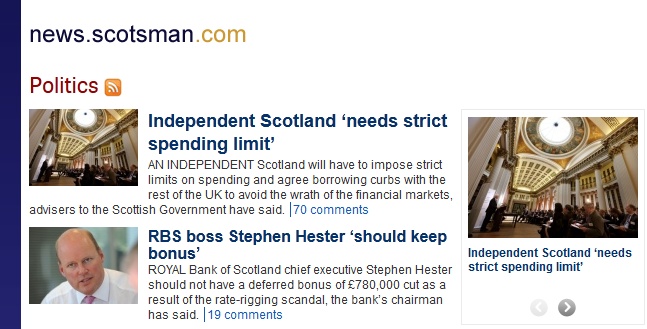
The passage below comes from the lead story in the Scotsman’s politics section today. We’ve highlighted a few of the more interesting bullet points.
“An independent Scotland will have to impose strict limits on spending and agree borrowing curbs with the rest of the UK to avoid the wrath of the financial markets, advisers to the Scottish Government have said. The advice also states that austerity will continue to bite “irrespective” of whether the country votes Yes or No next year.
However, the Fiscal Commission, set up by the SNP government last year to study the economics of independence, said the restrictions would be outweighed by the “flexibility” of independence, which would allow Scottish ministers to pick a way through the financial crisis facing western countries.
The 221-page document, commissioned by the Scottish Government, recommended that an independent Scotland should keep the pound and the Bank of England, and sign a pact with the UK on financial stability. Such policies would provide a mix of “autonomy, cohesion and continuity”, chairman Crawford Beveridge said yesterday. The pro-independence former Scottish Enterprise chief insisted: “Scotland has the clear potential to be a successful independent nation.”“
So here’s the quiz: guess which one formed the headline.
Category
media, scottish politics
In an intervention that could in time-worn political terms be described as “brave”, the Secretary of State for Scotland insisted yesterday that recent legal advice to the UK government means an independent Scotland would not inherit the UK’s existing international treaties but would still nonetheless inherit a share of the UK national debt.
The UK Government’s understanding of new legal analysis on the implications of Scottish independence is in their view proof that the most likely outcome of Scottish independence would be the continuation of the UK as the existing state under international law and the creation of a new state of Scotland.

However, the report’s authors declined to rule out the creation of two completely new states or the resurrection of the Scottish state that existed prior to 1707 – although both outcomes were deemed unlikely by Westminster. But just in case anyone wasn’t yet adequately confused, the report’s authors went on to say this (our emphasis):
“Assuming that Scotland would be recognised as a new state, albeit a successor state to the UK, it is difficult to see how Scotland could evade the accession process for new states in the EU treaties.”
So this new “definitive” legal advice doesn’t in fact rule out any of the only three options available, and in fact defines Scotland as both a “new” and a “successor” state, seemingly contradictorily. But what does all this mean? To try to shed some light, let’s look at what international law says on the subject of borders, treaties and debts.
Read the rest of this entry →
Tags: one nation, Scott Minto
Category
analysis, scottish politics, uk politics
As a new week of Newsnight Scotland looms, this should work most days.

Tags: and finally
Category
media
Observed – so far as we’re aware – by nobody, today’s UK government paper also torpedoes another core argument hitherto beloved of Unionists in the independence debate. That argument runs “Scotland and England would not be entitled to equal successor-state status, because Scottish independence would NOT in fact be a dissolution of the Union, because the current UK was formed not by the 1707 Acts of Union but by the 1800 treaty incorporating Ireland.”
The document, however, expressly blows that contention out of the water:
“36. We note that the incorporation of Wales under laws culminating in the Laws in Wales Act 1536 (England) and of Ireland, previously a colony, under the Union with Ireland Act 1801 (GB) and the Act of Union 1800 (Ireland) did not affect state continuity. Despite its similarity to the union of 1707, Scottish and English writers unite in seeing the incorporation of Ireland not as the creation of a new state but as an accretion without any consequences in international law.“
File this one for future reference, readers.
Category
analysis, scottish politics, uk politics
The devil, they say, is in the detail, and that certainly seems to apply to the UK Government’s first paper on the consequences of Scottish independence. With remarkably little fanfare, the coalition appears to have dropped an atomic bomb into the heart of the constitutional debate, and not even realised it.

The core premise of the document appears to be the counter-intuitive idea that the UK can have it both ways – it can insist that an independent Scotland would be a brand-new nation with no rights to any of the shared property of the UK, but that it would somehow simultaneously be responsible for its full share of the UK’s liabilities. Michael Moore is quoted saying precisely that in today’s Herald.
The justification for this outwardly-absurd claim rests on an astonishing assertion lurking unassumingly in a series of paragraphs in the middle of the paper. We’ve copied it below and highlighted a couple of the relevant phrases.
Read the rest of this entry →
Category
analysis, apocalypse, history, scottish politics, uk politics
There will be uncountable acres of newsprint expended on analysing the UK Government’s paper released today on the implications of Scottish independence for EU membership. If you’re in a hurry, though, the entire document is comprehensively and accurately summed up in these two paragraphs from Part V, Section (3):

Even shorter version: if the EU wants us in automatically (something which is plainly in absolutely everyone’s interests, including the rUK’s), then we’ll be in automatically, no matter what the small print says. And that’s that.
Read the rest of this entry →
Category
analysis, europe, scottish politics, uk politics
Recently we’ve mentioned a concept we called the “invisible hypothetical”. It refers to a form of media bias characterised by omission, and which is therefore hard to prove. This morning’s edition of the Scotsman carries a conveniently striking example.

Taken solely on its own merits, the article below the headline is impossible to fault. It notes the figure claimed today by the UK Government for the number of treaties an independent Scotland would be required to (at least theoretically) renegotiate, and even refers – obliquely and neutrally – to the previously-cited figure of 14,000.
In that oblique neutrality, of course, lies the rub.
Read the rest of this entry →
Category
analysis, media, scottish politics
For all the staggeringly impressive total to date, fewer than 500 of our 30,000+ readers have currently donated even a single £1 to our fundraising campaign. If you’re one of the other 29,500 – and statistically you almost certainly are – there’s a certain lion who wants a wee word with you this morning.

Tags: hamish
Category
admin
EXCLUSIVE! Wings Over Scotland discovers that after studying a number of secret UK Government documents the BBC is resigned to a Yes vote, has already removed Scotland from all its maps of the “United Kingdom”, and is preparing to replace the whole of BBC Scotland with Jeremy Clarkson after independence.

Eggheads is going to be a bit different.
Tags: and finally
Category
europe, pictures
Unionists can often be heard protesting that the phrase “too wee, too poor, too stupid” is a dreadful Nat calumny which nobody on the No side has ever actually uttered. And of course they’re technically right – not even “Better Together” is quite stupid enough (and certainly not honest enough) to come out and use the phrase in its overt form.
A Coalition source said the report would highlight the weakness of Scotland’s negotiating position with the EU if it was to leave the UK, given the size of its population and economy, which would relegate the Scots to Europe’s minor leagues.
“At these European summits, you see all the key players moving around, the French, the Germans and the British. But where are the Danish? They’re nowhere. It’s not that Denmark is not significant, but it’s not as important as these other nations, simply because of its size.”
That quote, taken from a story in today’s Sunday Herald, seems to be pretty closely related to the first two of the unholy trinity, though.
Read the rest of this entry →
Tags: too wee too poor too stupid
Category
comment
Finally overcome with embarrassment as the entire internet and the rest of the media laughed at it, Scotland on Sunday has pulled its lead story from today’s edition and replaced it with an completely new piece which the old links now redirect to.
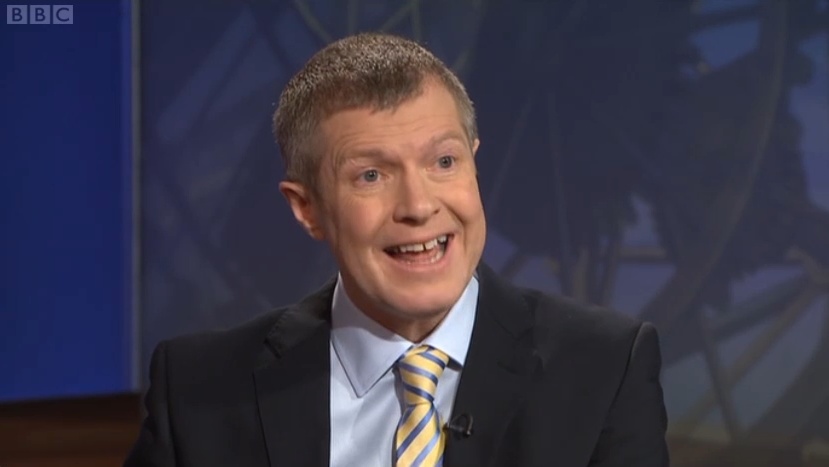
The replacement article, written by a “Julia Horton” rather than the previous two-man team of Tom Peterkin and Brian Ferguson, relegates the absurd opposition attack on food standards minister Richard Lochhead to a footnote, and entirely removes the quotes from Labour’s Claire Baker and Lib Dem leader Willie Rennie (below).

As ever, the paper’s attempts to cover its tracks are futile. You can still find a cached version of the original, but in case it vanishes we’ve copied the entire piece here.
Read the rest of this entry →
Tags: memory hole, snp accused
Category
media, scottish politics
The Telegraph’s crotchety old relic Alan Cochrane is usually a figure of comic fun for independence supporters. But now and again the Tory dinosaur’s prehistoric polemic conceals something more dangerous. In a misguided attempt to add hard numbers to a piece yesterday reporting Teresa May’s speech about spies, Cochrane seems to have used Wikipedia for some information on Swedish and Danish domestic intelligence services and come up with this:
“For instance, the Danish Security and Intelligence Service, which is part of the country’s police force, has 650 officers. Sweden, which is not a member of Nato, has over 1,000 officers in its security, counter terrorism and intelligence service – SAPO – which has an annual budget, according to one estimate, of £800 million.”
“According to one estimate”? That’s an interesting choice of words. Unfortunately someone wasn’t reading closely enough. Wikipedia’s English-language page on Säpo does indeed say that it had a budget of around 800m in 2008. Except it wasn’t £800m, but 800 million Swedish Kronor. At today’s exchange rate that’s around £80 million. Mr Cochrane has, in his fury, overstated Sweden’s intelligence budget by 1,000%. Oops.
Read the rest of this entry →
Tags: Angus McLellan, flat-out lies
Category
analysis, stats