Considering we’re only eleven days from a general election, there’s remarkably little politics coverage in the Sunday papers today. Most of what there is is in the Sunday Herald, which has a substantial (and quite entertaining) interview with Kezia Dugdale and another two pages devoted to what’s essentially spluttering attempted justification of its shambolic front-page lead from last week.

We’re not going to go into it in depth, as James Kelly on Scot Goes Pop! has already had a close look and made a pretty fair assessment. But for want of anything more interesting to talk about, and in the wake of some depressing Twitter conversations with people who apparently STILL don’t understand either the Holyrood electoral system or basic arithmetic, we’re going to have one more wade in the list-vote debate.
You might want to see if there’s football on or something.
Read the rest of this entry →
Category
analysis, debunks, psephology, scottish politics, stats
Last weekend’s edition of the Sunday Times gave an article to a Green activist and party worker – not billed as such, even though until last month he was on the party’s regional candidate list for Lothian – to predict that the Greens would get 10 seats at next month’s election.
Much campaigning by the various fringe parties for the Holyrood contest has been based on “seat predictors” like the one deployed to produce the figures in the piece, purporting to show that a tactical-voting strategy on the list can deliver a large gain in numbers of pro-independence MSPs compared to using both votes for the SNP.

We’ve examined that argument in considerable depth already, both theoretical and practical. But its also worth noting that so-called “seat predictors” are a rather shaky basis for making such bold forecasts.
Let’s illustrate that assertion.
Read the rest of this entry →
Tags: misinformation
Category
analysis, debunks, investigation, psephology, scottish politics, stats
SNP tax plans simultaneously raise £300m and lose £900m:

The Guardian’s daily sale in Scotland: 8,700 copies and falling.
Tags: misinformationticktock
Category
media, scottish politics, stats, wtf
A reader directed us today to a tweet by one of the most consistently abusive Tory trolls on social media, slightly concerned about whether his gleeful assertion of a 12% drop in SNP support had any grain of truth to it.

If you’re in a hurry, the short answer is “No”.
Read the rest of this entry →
Category
debunks, scottish politics, stats
When we ran this story on Monday, some of the press got rather upset with us. Even though we’d linked to the full data tables published on the ComRes site, Scottish Daily Mail political editor Alan Roden, for example, huffily tweeted a link to a cropped table suggesting that the real sample size was higher.

And as it turned out, it was.
Read the rest of this entry →
Tags: misinformation
Category
analysis, media, scottish politics, stats
Even by the low, low normal arithmetical standards of the Scottish media, yesterday’s Scottish Sunday Express humiliated itself with the most stupendously factually wrong articles we’ve seen in a newspaper for some time.

James Kelly on Scot Goes Pop! has already eviscerated its comically inept bumbling in detail, but we thought we’d just quickly give you a visual version.
Read the rest of this entry →
Tags: arithmetic failflat-out liesmisinformation
Category
analysis, comment, debunks, idiots, media, scottish politics, stats, wtf
The Scottish Daily Mail has been working itself into a froth this week over the idea that the Scottish Government doesn’t intend to match George Osborne’s increase in the upper-rate income tax threshold from £42,000 to £45,000.

Central to the complaint is that rejecting the increase will hurt what the Mail calls “the squeezed middle” and “middle earners”, including “nurses, teachers and police”.
There are, of course, several ways of defining “middle”.
Read the rest of this entry →
Tags: misinformation
Category
analysis, scottish politics, stats
Economics: The art of explaining why all of your models fail to accurately predict either the future or the past.
It’s the time of year again when everyone glances at the first page of a dense booklet of complex economic data and immediately starts using it to make wild forecasts and proclamations despite the long-known problems with doing so.

So it’s also, once again, time to try looking a little further to tease out some details that others might have – let’s be generous here – accidentally missed.
Read the rest of this entry →
Tags: black holeDr Craig Dalzelltoo wee too poor too stupid
Category
analysis, scottish politics, stats

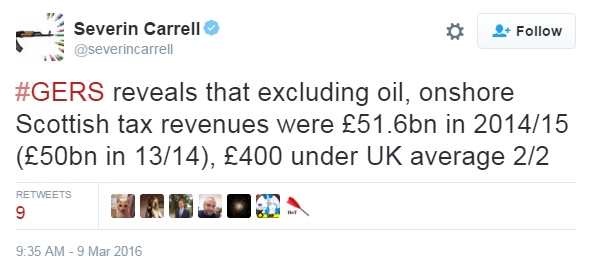
(The GERS figures actually showed Scotland’s revenues in 2014/15 dropping by ONE PERCENT as a result of the oil price collapse. Non-oil revenues were UP by 3.2%.)
Category
comment, media, stats, wtf
Without a doubt our new favourite Unionist website is this one:

And it’s not just for the snazzy badges.
Read the rest of this entry →
Tags: flat-out liesmisinformation
Category
comment, media, scottish politics, stats, wtf
Barely a week – indeed, barely a day – has gone by over the last year or so without some angry, confused and hurt-sounding Unionist pundit or politician churning out yet another article on the theme of “WHY AREN’T YOU GRATEFUL THAT WE SAVED YOU FROM INDEPENDENCE, YOU APPALLING PLEBS?”

As far as the No side are concerned, the oil-price slump is a slam-dunk game-ender which finally conclusively proves that Scotland is too wee and too poor to run its own affairs, and their uncomprehending bewilderment as support for a Yes vote not only fails to disintegrate but keeps increasing even as the oil price sinks lower and lower has been quite a phenomenon to behold.
So we were interested to see today’s Sunday Times report a YouGov poll done for the comedy grumpy-old-white-guys support group (and spectacularly unsuccessful tactical voting enthusiasts) Scotland In Union, and somewhat miss the point of the results.
Read the rest of this entry →
Category
analysis, comment, media, scottish politics, stats