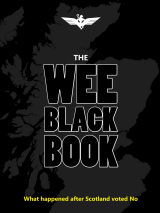
“Sod it”, we thought, “let’s compile a list after all“.

Clearly we’re not impartial judges of how the No campaign is being conducted. To assess its performance with any degree of fairness, we must instead take the widest possible sample of opinion from those on its own side. Here goes, then.
Read the rest of this entry →
Tags: the positive case for the union
Category
comment, media, reference, scottish politics
Remember, readers, how last year “Better Together” tried to ridicule the fact that we’d put a satirical line about “space monsters” into one of the questions in our first Panelbase poll? Remember how it was the most absurd, stupid thing imaginable?

That was the UK Secretary of State for Defence, yesterday.
Read the rest of this entry →
Category
comment, scottish politics, wtf
We honestly don’t understand how anyone with electricity in their house or a newsagent anywhere within a 30-mile radius can possibly come to say things like this:
“[Independence] is a view not shared by IT teacher Elaine Coates, originally from Glasgow but now in Tettenhall. The mother of three has lived in England for 30 years but has no strong views on independence.
‘I just don’t see how it will work, I think Scotland would be crazy to do this,’ she says. ‘It doesn’t have any oil so how is it going to get its income? Whisky and tourism, probably, but that’s it.'”
Firstly, Elaine, we’d have to say that “it would be crazy” DOES actually sound like quite a strong view on independence to us. But in all seriousness, leaving all snark and sarcasm aside, how on Earth does a human being living in the UK in 2014, seemingly not inside any sort of secure institution, come to believe something like that?
Ms Coates isn’t some lone madwoman. Other people, also not resident in mental hospitals, say the same thing. And we get that lots of people aren’t into politics. But when it comes to ignorance about your own nation, being unaware that Scotland has oil is somewhere on a par with not knowing that Great Britain is an island. How in the world do you go through decades of adult life without ever picking up on that fact?
It’s not a rhetorical question. Can someone actually explain it to us?
Tags: unionist of the day
Category
comment, investigation, scottish politics, wtf
We’ve just been watching the latest of the BBC’s big independence referendum debates, and we’d like the hour of our life we wasted back, please.

It wasn’t as though it was the worst we’ve seen by a long chalk. It was, if nothing else, relatively even-tempered, helped by some firm moderation by James Cook. Lesley Riddoch was as reliable, sensible and on top of the facts as she always is (although even we’re starting to get fed up of hearing her go on about Norway all the time). And while Brian Wilson is a dishonest and bilious wee nyaff, he does have the one huge saving grace that he isn’t Anas Sarwar.
But tell us this, readers – what was the point of it all?
Read the rest of this entry →
Tags: debates
Category
comment, media, scottish politics
The chief executive of the Scottish Fishermen’s Federation, Bertie Armstrong, was reported in yesterday’s Press & Journal as saying that a vote for independence would leave Scotland with a weaker voice in the EU, as it would only have seven votes in the Council of EU Ministers, compared to the UK’s 29 votes.

(Which it would likely retain even in the event of losing 5.3 million of its citizens, due to the Treaty of Nice favouring the six largest countries: Germany, France, Italy and the UK all have 29 votes, while Spain and Poland have 27 each; the next largest is the Netherlands with only 13, even though the difference between their population size and Poland’s is exactly the same as that between Poland’s and the UK’s).
But Mr Armstrong seems to be having a problem with his arithmetic.
Read the rest of this entry →
Tags: arithmetic failDouglas Danielmisinformation
Category
analysis, scottish politics
It’s one of the more striking aspects of the No campaign that no matter how many panicky editorials appear in right-wing papers bemoaning the fact that their neverending litany of negativity and scaremongering is proving counter-productive (we don’t even bother linking to them any more, there are so many), and no matter how many kickings “Better Together” takes from its own side (the firmly anti-independence Independent columnist Katie Grant was especially scathing on “Headlines” last weekend), the negativity just keeps pouring out.

So of necessity, we try to keep things brief in order to keep up. With that in mind, let’s see how quickly we can deal with today’s media orgy on the subject of defence.
Read the rest of this entry →
Category
analysis, scottish politics, uk politics, world
Alert readers can’t have failed to notice a certain reticence on the part of Scottish Labour to clarify key aspects of their shambolic proposals for further devolution in the event of a No vote.
(In response to our latest enquiries, genetically-programmed Central Scotland list MSP Siobhan McMahon sent a Wings reader a letter at the weekend directing them to the “Devo Nano” report – which doesn’t address any of the issues that were actually raised by her constituent – and saying “I believe that I have now adequately responded to your queries and have nothing further to add.”)

But it turns out there ARE people they’re prepared to tell the truth to.
Read the rest of this entry →
Tags: Devo Nanovote no get nothing
Category
analysis, scottish politics
Readers who may have been alarmed that the Scotsman hadn’t run any Michael Kelly columns for a while can breathe a sigh of relief this morning, as the role of “clueless idiot blithely spouting inflammatory and wrong-headed drivel about sectarianism and independence” is clearly in safe hands.

Read the rest of this entry →
Category
comment, disturbing, idiots, media, scottish politics
The top five most-read stories on Wings Over Scotland in the last seven days.
1. Playing with fire
The No campaign turns ugly. Okay, more ugly.
2. Neither national nor collective
Some particularly audacious “Better Together” lies about the NHS.
3. People are strange
The most curious results from our third Panelbase poll.
4. Fine-tuning the news
The Scotsman edits itself into a bit of a pickle.
5. The mushroom farm
The story of the Queen’s Scottish coronation that never was.
This week’s theme: rewriting history.
Category
scottish politics, stats
One of the great things about this site’s sky-high viewing figures is that on the rare occasions when we might be, for example, out having a walk in the park to get over the crushing disappointment of somehow losing yet another Scottish Cup semi-final, our ever-vigilant readers will remain alert.
Otherwise, we might have missed this.
Read the rest of this entry →
Category
comment, disturbing, scottish politics, uk politics, video, wtf