There’s a curious column in today’s Scottish Sun on the subject of the Smith Commission. We’re going to have to quote quite a large chunk of it to make our point.
Read the rest of this entry →
Category
analysis, comment, media, scottish politics
This is a headline from Thursday’s Guardian:

You all know how it works by now, right?
Read the rest of this entry →
Tags: misinformation
Category
analysis, media
The coverage of the Smith Commission findings in today’s press is woeful pretty much across the board, regardless of where each paper’s allegiances sit. Right-wing Tory papers fume about the poor suffering English (without ever quite pinning down how England would lose out from the proposals) and rage bitterly at what they bizarrely interpret as hypocrisy on the part of the SNP for signing off on the report but then criticising it as inadequate.
(If it helps, chaps, try picturing yourselves as creditors of a bankrupt business being offered a CVA settlement of 10p in each pound owed. It’s better than getting nothing at all and you’d accept the offer, but you’d still be pretty unhappy, right?)

Meanwhile, the Daily Record continues its blitzkrieg bombardment of breathtakingly barefaced bullshot, attempting to simply overwhelm gullible readers by virtue of the sheer volume (in both senses of the word) of its spin and flat-out lies.
Read the rest of this entry →
Category
analysis, comment, scottish politics
You have to hand it to David Cameron – he doesn’t hang about. Barely two hours had passed after the declaration of the result of the independence referendum when he started tying new devolved powers into legislation on “English votes for English laws”, in a slick knifing of his unsuspecting hitherto-allies in Labour.

And just as hot on the heels of the Smith Commission’s final report, he’s at it again.
Read the rest of this entry →
Category
analysis, comment, scottish politics, uk politics
It’ll be a brave Yes voter who buys a newspaper (other than The National) or switches on their TV or radio today, because Scotland is already enduring an outpouring of concentrated spin and outright deception that perhaps even exceeds that seen in the last few weeks before the independence referendum.

Blood pressures will be soaring across the land as people are told things about the final report of the Smith Commission that are flatly at odds with the reality, by journalists and broadcasters who either know perfectly well that what they’re saying is false or haven’t bothered to try to find out.
Below, you’ll find the facts.
Read the rest of this entry →
Category
analysis, scottish politics
Two interesting comments from last night’s Scotland Tonight.
So that’s good to know.
Read the rest of this entry →
Tags: Devo Nano
Category
analysis, scottish politics
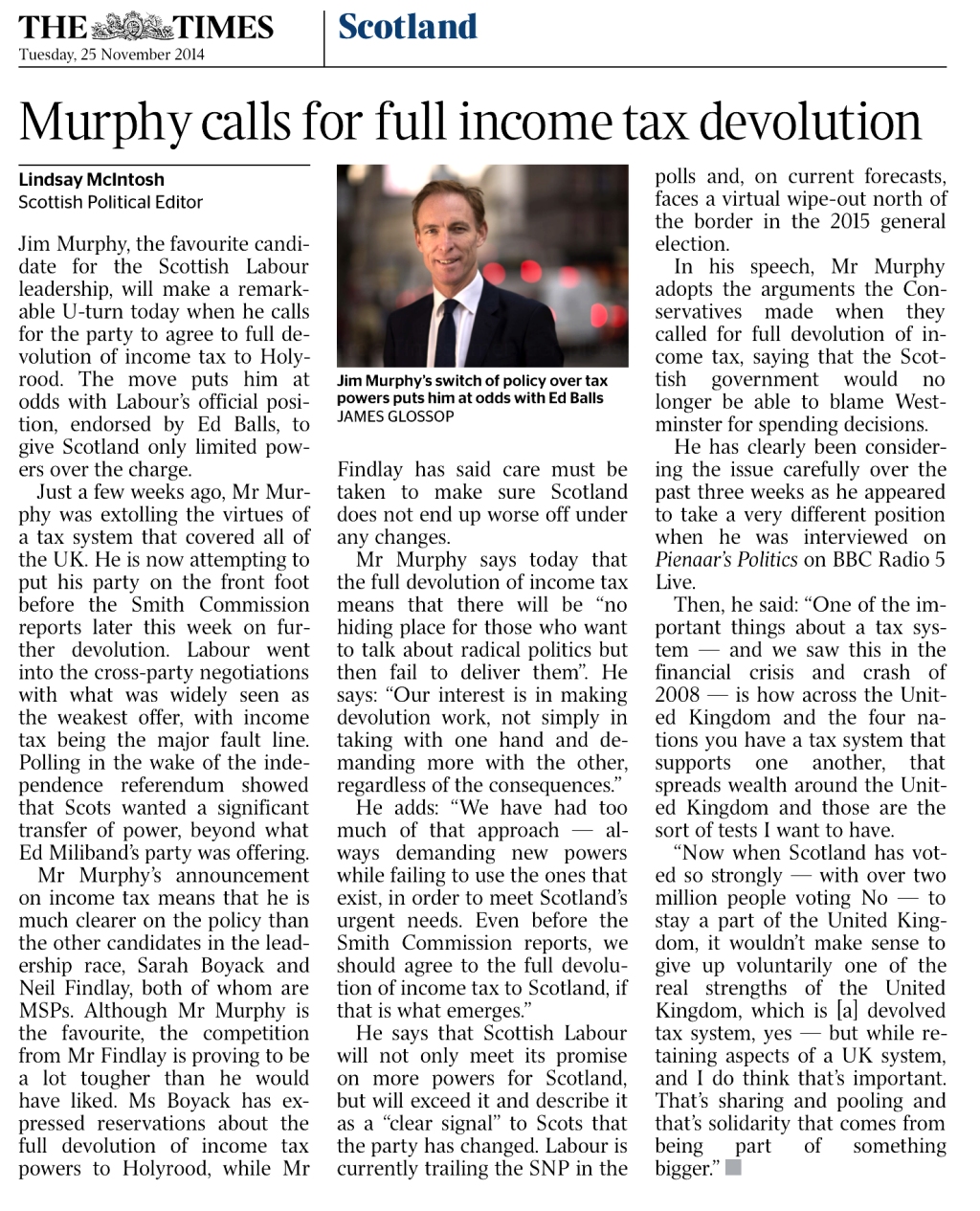
Following on from this morning’s post, we thought it was about time someone found a definitive quote from Jim Murphy outlining his position on the devolution of full income tax powers to the Scottish Parliament once and for all.

It turned out to be a surprisingly tricky job.
Read the rest of this entry →
Category
analysis, investigation, scottish politics
There was a very disturbing opinion poll published by YouGov earlier this year and recently highlighted by the pollster, which took 16 policy propositions across a variety of subjects and set them against each other in a sort of Politics World Cup to find out the British public’s priorities. The result was predictable but no less depressing for it.

By some chillingly large margins, the policy the people of the UK want implemented more than any other is the spiteful removal of the right to benefits for new immigrants. (We suspect that if the question had offered the option of withdrawing benefits from immigrants full stop it wouldn’t have changed the figures much.)
And we couldn’t help wondering how big a deal that really was.
Read the rest of this entry →
Category
analysis, investigation, uk politics
The talk of the steamie in this weekend’s Sunday papers is that Scottish Labour are set to backpedal on the devolution of 100% of income tax, a position previously described by Gordon Brown – the great architect of “The Vow” – as a “Tory trap” which was “not in Scotland’s interests”.
(Coincidentally, the papers also report that Brown, who said he would personally ensure the safe delivery of the new devolution settlement, will stand down at the 2015 election in order to devote more time to his “charity” work.)

It is, of course, a challenge to keep track of Labour’s position on the move from one day to the next. In 2013 it wanted to devolve all taxation, then in 2014 it decided as its final settled position that it wasn’t a good idea after all, and has flip-flopped on a more or less weekly basis ever since. Just this month the favourite for the Scottish branch office leadership, Jim Murphy, poured cold water on the notion, but now it seems yet another U-turn is on the cards.
We wouldn’t put a lot of money on it being the last one.
Read the rest of this entry →
Tags: Devo NanoThe Vow
Category
analysis, comment, scottish politics, uk politics
Last night’s bizarre edition of Scotland 2014, in which the three Scottish Labour “leadership” candidates were quizzed by the daughter of a former Labour leader in front of an audience of the candidates’ own supporters (comprising MSPs, councillors and activists), saw all three stick doggedly to what’s clearly going to be the party’s main pitch in the 2015 general election – “Vote SNP, get Tories”.
It’s a line the party has trotted out at every election for decades, and which has been getting pumped out almost daily since Johann Lamont’s resignation – former deputy “leader” Anas Sarwar (who oddly declined to stand for the actual job when it became available) penned a column for the Evening Times on Monday, for example, entitled “Every vote for an SNP candidate is a vote to help elect David Cameron”, and he said the same thing in the Commons this very afternoon.

As alert readers will know, we like to check the facts on these things.
Read the rest of this entry →
Tags: flat-out liesmisinformation
Category
analysis, history, investigation, reference, scottish politics, stats, uk politics
…is the phrase that was making us chuckle this morning.

It headed an article of disingenuous carping so feeble that we can’t even be bothered archive-linking to it, entitled “Ten SNP Fails Since 2007”, because Margaret is bare down with the kids, innit? But we couldn’t help noticing one of the examples.
Read the rest of this entry →
Tags: hypocrisy
Category
analysis, scottish politics, stats, uk politics