There was a very disturbing opinion poll published by YouGov earlier this year and recently highlighted by the pollster, which took 16 policy propositions across a variety of subjects and set them against each other in a sort of Politics World Cup to find out the British public’s priorities. The result was predictable but no less depressing for it.

By some chillingly large margins, the policy the people of the UK want implemented more than any other is the spiteful removal of the right to benefits for new immigrants. (We suspect that if the question had offered the option of withdrawing benefits from immigrants full stop it wouldn’t have changed the figures much.)
And we couldn’t help wondering how big a deal that really was.
Read the rest of this entry →
Category
analysis, investigation, uk politics
The talk of the steamie in this weekend’s Sunday papers is that Scottish Labour are set to backpedal on the devolution of 100% of income tax, a position previously described by Gordon Brown – the great architect of “The Vow” – as a “Tory trap” which was “not in Scotland’s interests”.
(Coincidentally, the papers also report that Brown, who said he would personally ensure the safe delivery of the new devolution settlement, will stand down at the 2015 election in order to devote more time to his “charity” work.)

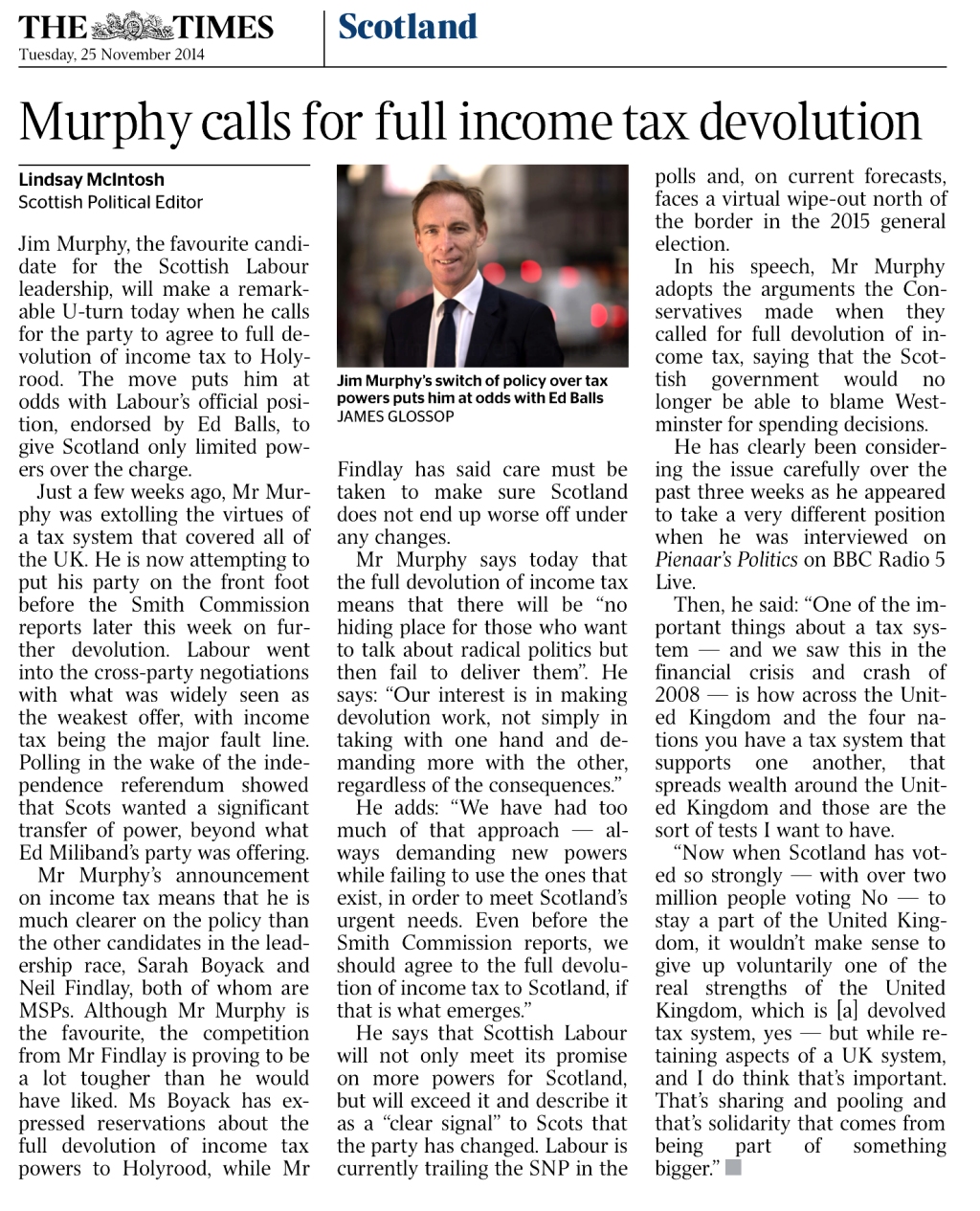
It is, of course, a challenge to keep track of Labour’s position on the move from one day to the next. In 2013 it wanted to devolve all taxation, then in 2014 it decided as its final settled position that it wasn’t a good idea after all, and has flip-flopped on a more or less weekly basis ever since. Just this month the favourite for the Scottish branch office leadership, Jim Murphy, poured cold water on the notion, but now it seems yet another U-turn is on the cards.
We wouldn’t put a lot of money on it being the last one.
Read the rest of this entry →
Tags: Devo NanoThe Vow
Category
analysis, comment, scottish politics, uk politics
Last night’s bizarre edition of Scotland 2014, in which the three Scottish Labour “leadership” candidates were quizzed by the daughter of a former Labour leader in front of an audience of the candidates’ own supporters (comprising MSPs, councillors and activists), saw all three stick doggedly to what’s clearly going to be the party’s main pitch in the 2015 general election – “Vote SNP, get Tories”.
It’s a line the party has trotted out at every election for decades, and which has been getting pumped out almost daily since Johann Lamont’s resignation – former deputy “leader” Anas Sarwar (who oddly declined to stand for the actual job when it became available) penned a column for the Evening Times on Monday, for example, entitled “Every vote for an SNP candidate is a vote to help elect David Cameron”, and he said the same thing in the Commons this very afternoon.

As alert readers will know, we like to check the facts on these things.
Read the rest of this entry →
Tags: flat-out liesmisinformation
Category
analysis, history, investigation, reference, scottish politics, stats, uk politics
…is the phrase that was making us chuckle this morning.

It headed an article of disingenuous carping so feeble that we can’t even be bothered archive-linking to it, entitled “Ten SNP Fails Since 2007”, because Margaret is bare down with the kids, innit? But we couldn’t help noticing one of the examples.
Read the rest of this entry →
Tags: hypocrisy
Category
analysis, scottish politics, stats, uk politics
Ever since Nicola Sturgeon announced on Saturday that the SNP would never put the Tories in government, various mainstream political pundits have shown an alarming level of inability to grasp the concept of someone who cannot possibly become Prime Minister declaring their preference out of those who can.

Perhaps we’re being a bit unkind, as this isn’t a regular feature of British politics – usually we only hear the leaders of the two main parties telling us why they’re the best for the job, with the Liberal Democrat candidate comically trying to pretend that they stand a chance of being Prime Minister – but it does highlight the extraordinarily parochial nature of political debate in the UK media.
Because anyone who cares to cast a glance across the continent will see that such scenarios are not just common, but often an integral part of politics across Europe.
Read the rest of this entry →
Tags: Doug Daniel
Category
analysis, europe, media, scottish politics
As the Smith Commission continues its fundamentally pointless and impossible deliberations, in which it’s expected to digest and consider many thousands of submissions (including hundreds of detailed ones from political organisations and “civic Scotland”) in around three weeks, the Scottish and UK press is still casually and inaccurately tossing around the term “devo-max”.

There seem to be essentially two competing interpretations of the term – the previously-understood meaning (also known as “Full Fiscal Autonomy”) in which all powers are devolved to Holyrood except foreign affairs and defence, and a new one which simply refers to whatever devolution Westminster is prepared to grant. (Justified semantically by the claim that it’s the maximum devolution Scotland’s going to get.)
So when we commissioned our latest Panelbase poll, we decided that rather than the usual checklist of “which powers should be devolved”, to which the answers have remained the same for years, we’d ask some slightly different questions about the relationship between Holyrood and Westminster, and the process of devolution itself, to see if we could determine what it is that the people of Scotland really want from their Parliament.
Read the rest of this entry →
Tags: poll
Category
analysis, psephology, scottish politics, stats
When we commissioned our latest poll, the candidates for the Scottish Labour sort-of leadership hadn’t yet been finalised. In fact, we’re not even sure whether the post of deputy “leader” was up for grabs at that point, with Anas Sarwar having said that he had no intention of stepping down, shortly before stepping down.

But in any event we thought it’d be much more interesting to see who people actually thought should be the leader, rather than just who they regarded as the least-worst option out of whoever put their head above the parapet and took on the least attractive job prospect in Scottish politics.
Read the rest of this entry →
Tags: poll
Category
analysis, psephology, scottish politics, stats
As part of our latest Panelbase poll, we wanted to explore the so-called “2017 Scenario” hinted at by new SNP leader and First Minister-elect Nicola Sturgeon, whereby the Tories control the UK parliament, the SNP have another majority at Holyrood, and the UK holds a referendum on the EU where England/the rUK votes to leave and Scotland votes to stay in.

To that end, we asked two key questions. Our findings are below.
Read the rest of this entry →
Tags: poll
Category
analysis, europe, psephology, scottish politics, stats
We try to deploy the money that generous readers send us during our fundraisers very carefully, so we were annoyed last week when we commissioned a new opinion poll from Panelbase with a few thousand quid left over from the Wee Blue Book campaign, only to have every other pollster and his dog release the results of their own surveys the very next day.
So sadly (for us) the following figures won’t have quite the dramatic impact that they might have commanded otherwise, but they’re still pretty interesting, particularly in the context of how they relate to the findings from Ipsos MORI, YouGov and others.
(Our poll also covered some ground that nobody else has done, but to add excitement and build a little suspense we’ll save that for a wee bit later on today.)

Let’s get to it, then.
Read the rest of this entry →
Tags: poll
Category
analysis, psephology, scottish politics, stats
We thought you might be interested to see some of the working of this post from yesterday. Of the 2.4m votes cast in Scotland in the 2010 UK general election, not far short of a million – if a recent YouGov poll is to be believed – are currently likely to be cast for different parties in 2015. And it’s intriguing to see where they’ll go.

Read the rest of this entry →
Category
analysis, comment, psephology, scottish politics, uk politics
Some SNP supporters have – rightly, in this site’s view – called for calm and caution over this week’s opinion polls, showing the Nats at stratospheric support levels and, supposedly, on course to win either 54 or 47 of Scotland’s 59 Westminster seats next May. Given the huge gaps that the SNP would have to close in order to take each individual seat, those numbers seem extremely optimistic to anyone familiar with First Past The Post, even given Scottish Labour’s ongoing implosion.

So rather than rely on dodgy uniform-swing predictors, we thought we’d try something a bit simpler but also more scientific and likely to come up with a believable result.
Read the rest of this entry →
Category
analysis, psephology, scottish politics