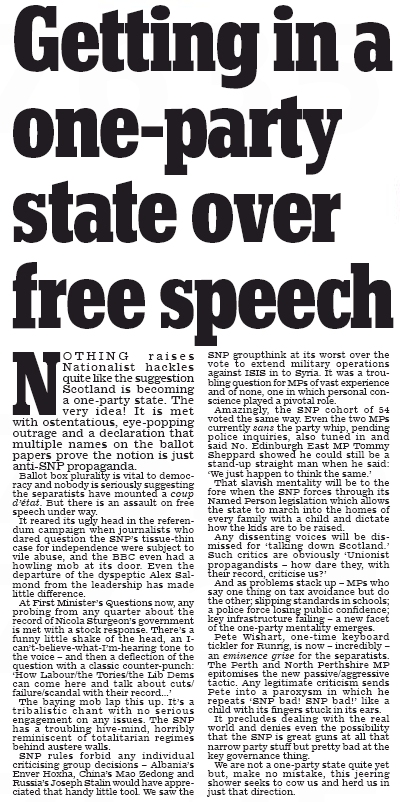
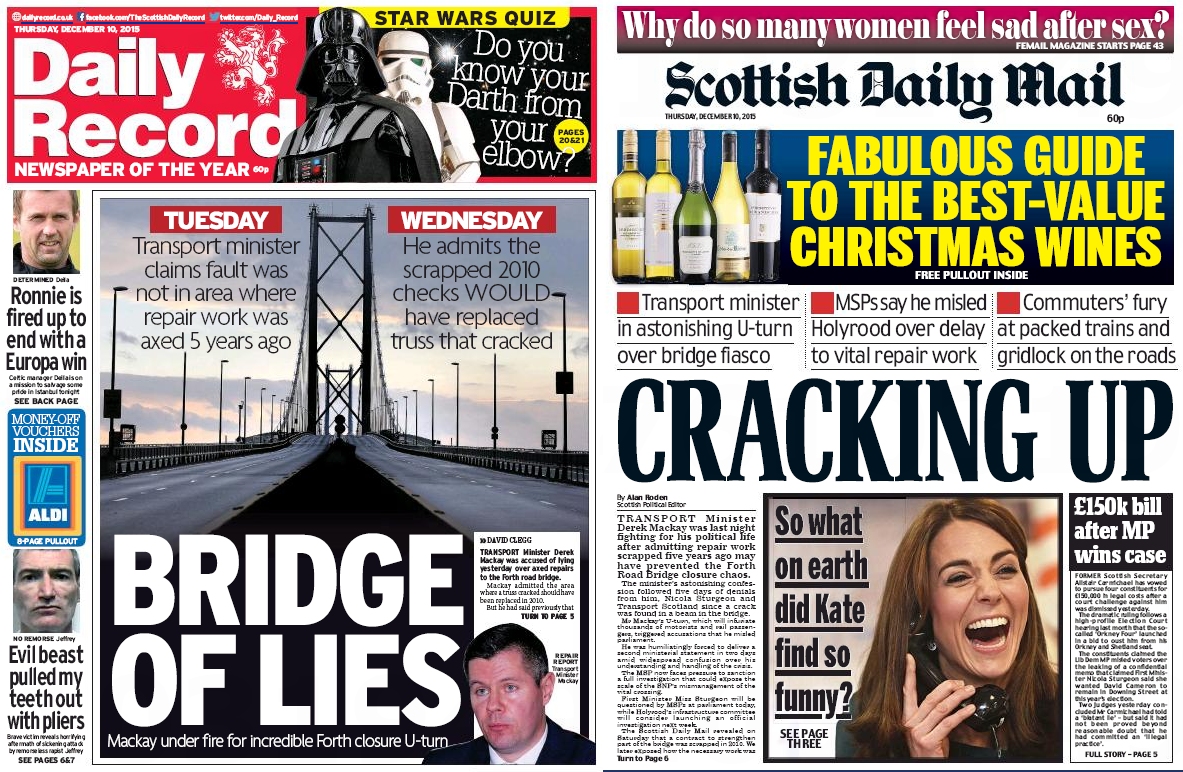
As politics wakes up from the holidays, any readers still bothering to gaze at the pages of the Scottish media could be forgiven for a crushing sense of deja vu.

In more senses than one.
Read the rest of this entry →
Tags: misinformationsmears
Category
analysis, debunks, media, scottish politics
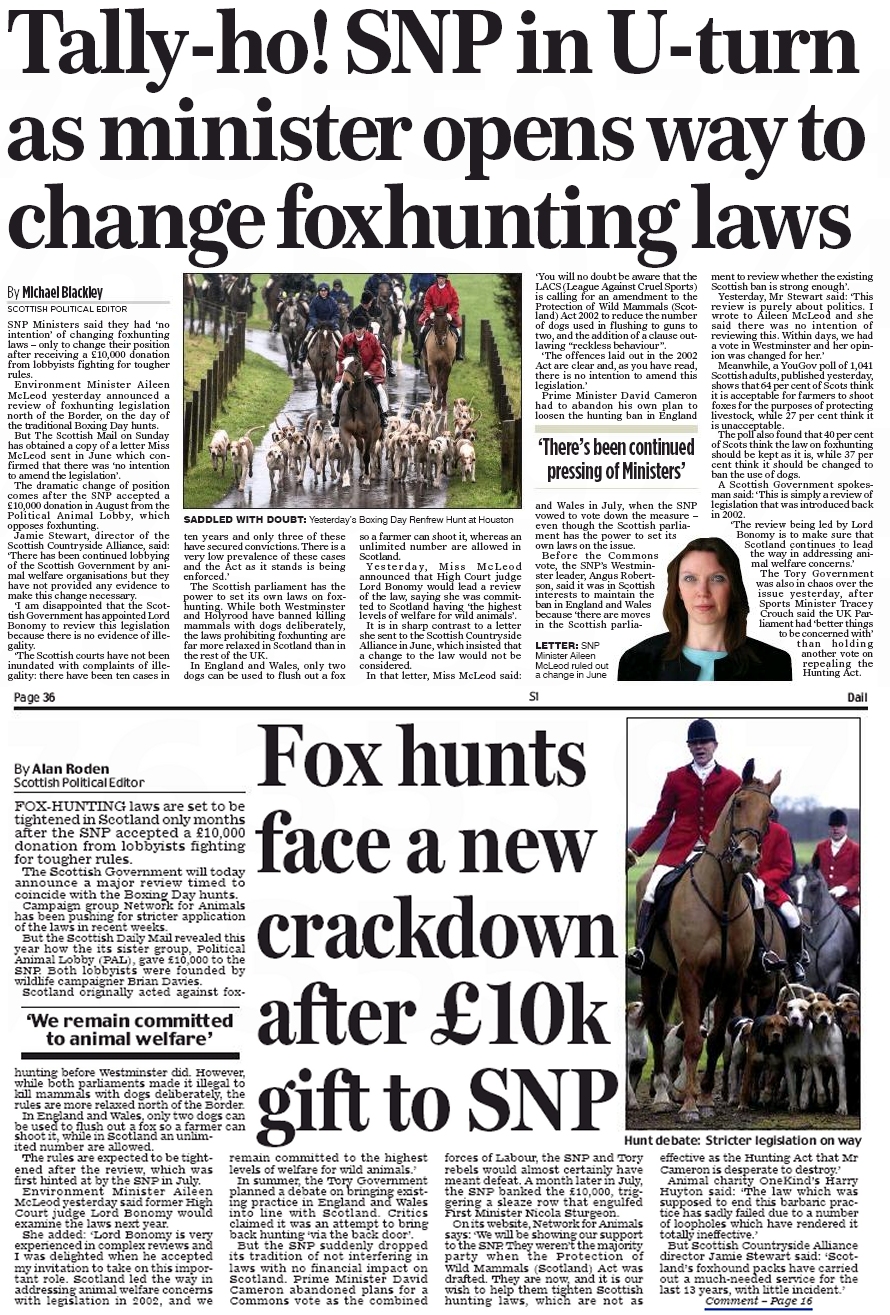
The Scottish Daily Mail, which alongside its Sunday sister paper is spending the festive period engaged in an “SNP BAD!” frenzy – attacking the party over everything from foxhunting to the brutal Stalinist suppression of free speech to using taxpayers’ money to send people Christmas cards – today runs the same story across a news page, a comment column and an editorial leader:

Let’s take a closer look.
Read the rest of this entry →
Category
analysis, comment, media, scottish politics
We’ve spoken a number of times before on this site about the “gish gallop” or “swarm of wasps” debating technique, in which a person attempts to bury their opponent under such an overwhelming tsunami of false, misleading or nonsensical claims in a short space of time that they can’t possibly debunk it all.
The Urban Dictionary gives an example of the form:

Faced with such a rushing torrent of drivel, it’s almost impossible for an opponent to know where to start in order to begin to even scratch the surface (if you can scratch a torrent). And that brings us directly to Severin Carrell’s article in today’s Guardian.
Read the rest of this entry →
Tags: black holeflat-out liesnumberwang
Category
analysis, comment, debunks, media, scottish politics
Over the last few days, as most of Scotland’s media has focused on hysterical smear stories and outright lies, we’ve been digging around trying to uncover the truth about events around and leading to the closure of the Forth Road Bridge.

Here’s what we’ve got so far.
Read the rest of this entry →
Tags: misinformation
Category
analysis, debunks, history, investigation, media, scottish politics
The Scottish Mail on Sunday’s shock-horror Forth Road Bridge story today is also accompanied by an editorial leader. And if the main article was a piece of bare-faced deception, it’s got nothing on the opinion piece.
Read the rest of this entry →
Tags: flat-out lies
Category
analysis, debunks, media, scottish politics
We’ve been struggling to get a good grip on what’s happening with the Forth Road Bridge this week. It’s a confusing tale full of contradictory financial and engineering detail, being flayed for all it’s worth by the Unionist media and opposition.

As usual, we’ll make this as simple as possible.
Read the rest of this entry →
Category
analysis, scottish politics
We’ve been having some trouble trying to explain the Alistair Carmichael verdict to some English chums who hadn’t been following the case previously and have now just heard about it on the news.
Lord Matthews and Lady Paton in their great wisdom concluded that Carmichael had lied about the “Frenchgate” memo, and that he had also lied to them in the courtroom, and that the first of those lies was intended to help Carmichael achieve re-election, but that somehow his own re-election was not a “personal” matter.

Our friends couldn’t follow the logic of that, and to be honest we weren’t able to help them much. Nevertheless, the judgement has been handed down and the case is closed. It seems unlikely the petitioners could fund an appeal even if one was to be allowed, particularly given that according to press reports Carmichael will be pursuing them for his £150,000 costs as well as their own.
However, in the process of wriggling out of his lie on an obscure legal and semantic technicality, Carmichael appears, so far as we can tell, to have explicitly implicated himself in a far more serious crime.
Read the rest of this entry →
Tags: flat-out liesmemogate
Category
analysis, investigation, scottish politics, uk politics
The National today has a story we’ve been sitting on for several days while we tried to get some verifiable evidence in the form of links or screenshots to back it up.

But Labour aren’t the only people having trouble scaring up a candidate roster.
Read the rest of this entry →
Category
analysis, comment, investigation, scottish politics
We were considering having a day off today, readers. There’s absolutely nothing of any note happening in Scottish politics, and the papers have been reduced to scraping up all manner of barely-reheated leftover dregs to fill their pages.
But then someone drew our attention to something in Scotland On Sunday about the ongoing Women For Independence fiasco, and we were too annoyed to let it lie.

Read the rest of this entry →
Tags: misinformation
Category
analysis, media, scottish politics
Yesterday George Osborne treated us to an Autumn Statement in which he performed one of the most remarkable political U-turns in living memory.
The apparent need to cut £12bn from the welfare budget has long been sign-posted by the Tories as a requirement to getting us “back in the black” and on the road to a “higher wage, lower welfare, lower tax” society as part of their oft-cited “long-term economic plan”. (Or what academic economists prefer to call a “risky experiment with the economy in order to score political points“.)
Alert readers will recall David Cameron saying before the general election that child tax credits wouldn’t be cut in pursuit of that goal. But after the election, Osborne decided that they would. The Institute for Fiscal Studies determined that these cuts would have the worst effects on some of the poorest families in Britain.

Despite widespread opposition to the cuts, Labour infamously abstained on the critical vote in the Commons. Then, when the welfare bill reached the Lords, Labour once again abstained on a Lib Dem motion that would have completely killed the bill, in favour of a Labour one which phased in the cuts over three years, but meant Osborne would have to find another £4.5bn in his budget.
The passing of the Labour motion enraged Cameron so much that he went on an extraordinary rant about a “constitutional crisis” and announced a “rapid review”.
So we were somewhat surprised to hear Osborne say yesterday that the best thing to do was “not to phase these changes in, but to avoid them altogether”.
Read the rest of this entry →
Category
analysis, comment, uk politics
We tweeted this yesterday:

Increasingly, the line between satire of the Scottish media and reality is non-existent.
Read the rest of this entry →
Category
analysis, media, scottish politics
For over two years now, this site has been warning that the UK government will take the earliest opportunity it thinks it can possibly get away with to abolish the Barnett Formula, the funding mechanism which the No campaign sold as the biggest benefit of Scotland remaining in the Union.

The Formula is hated almost everywhere else in the UK, by both politicians and the English (especially) public, who see it as an over-generous subsidy to the scrounging Jocks, and with the threat of independence theoretically removed after the referendum there’s very little protecting it.
Neither Labour nor the Tories – with just one Scottish MP each – would have much to lose politically from reducing Scottish funding by billions of pounds they could use to bribe swing voters in England instead. Barnett’s partial survival was the only solid commitment made in The Vow, but it’s set to be slashed by the Scotland Bill, and the smaller it gets the less resistance there will be to its total removal.
This week the House Of Lords made lots of headlines by highlighting the shambolic, half-baked state of the Bill, which hasn’t yet come up with a “fiscal framework” to replace the bulk of Barnett. But make no mistake – the Lords want it gone just as much as everyone else does.
Read the rest of this entry →
Category
analysis, comment, scottish politics, uk politics