Positive-case-for-the-Union update #14 14
Posted on
April 13, 2012 by
Rev. Stuart Campbell
Picture special!

Picture special!
The world of Scottish soccer is in a ferment this week, and we use the word "soccer" quite deliberately. The two-part compound word "football" sticks in our throat, because the Scottish game has plenty of the first part but absolutely none of the second.
The reason for the sudden outbreak of sound and fury, which will ultimately signify nothing, is the revelation by the SPL of what the blogosphere is already calling the "Cheat's Charter". In itself it's actually a fairly innocuous document, and indeed could be portrayed as a crackdown. It proposes a raft of new penalties for teams going into administration or liquidation, with sanctions both on and off the field – a 75% reduction in monies paid by the League to the offending team for three years, and a 10-point deduction for two additional years following administration.
Since none of these punishments are currently part of SPL rules, one could not entirely unreasonably depict the changes (should they be agreed by the clubs in the meeting at the end of April) as a tightening-up of procedures. But equally rationally, the supporters of 11 out of the 12 SPL clubs are seeing them as something else entirely. Because what the proposed new rules do is explicitly lay down the route to a possibility which until now was only implicit – the return of a post-liquidation Rangers Football Club directly into the top flight of the Scottish game.
We were going to write about something else today, but we have a touch of the flu and we're not quite up to a hefty post. As we bravely ploughed through some research, though, we stumbled across another example of something we've noted before on this blog – Labour's curious (some might say outright untruthful) habit of presenting the SNP's position on things as the precise opposite of what they actually are. The latest accidental misunderstanding came from Johann Lamont's speech to the Scottish Labour conference last month. Here's what Johann claims the SNP say:
Here, on the other hand, is what the SNP actually say, from two months earlier:
"Scotland is not oppressed and we have no need to be liberated."
How odd. In the interests of fair and honest political discourse, should we all perhaps club together and offer to buy the leader of Scotland's opposition some new batteries? We'll throw in 50p to get things started. Pledge the amount of your support in the comments below and let's see if we can make the world a better place.
RUNNING TOTAL: £0.50
Last week saw another deployment of Labour's secret weapon in the fight against the SNP and their dastardly independence plans. The device is a WMD (Weapon of MisDirection) which the party has unleashed several times. But the weapon has a persistent teething problem – it has a tendency to come straight back and hit the user in the rear when they least expect it, while rarely managing even a glancing blow off the intended target. (Which in this case is of course the SNP.)

We've seen the patented Attack Boomerang in action on many occasions (the most recent being the bizarrely ill-judged attack on the SNP's referendum consultation which rebounded particularly badly on the party's "deputy" Scottish leader Anas Sarwar, and forced even the BBC to reluctantly acknowledge Labour's embarrassment), but one of the strangest was Labour's bitter criticism of the SNP over the fact that it had persuaded Amazon, the internet retailing giant, to recently open a large centre in the Dunfermline area and provide thousands of new jobs.
We couldn't help but note the Bill Walker story floating back to the top of the media agenda again this weekend like – well, you can finish that metaphor for yourself.
After an embarrassing week in which Labour had scoured Twitter and Facebook with a fine tooth comb trying to find obscure SNP councillors/candidates saying anything mildly contentious that they could fake some pious outrage about (of which this surely represented the pitiful, embarrassing nadir, as a fully-grown man tried pathetically to manufacture some kind of offence at a handful of primary-school-playground jokes that wouldn't have upset even the primmest Victorian maiden aunt), the beleagured party and its increasingly-desperate activists went back to some safer ground.
*Wings over Scotland is very pleased to be able to bring its readers another terrific guest post from Andrew Page of A Scottish Liberal. We spoil you, really we do.
This past Friday, the 6th of April, saw the anniversary of one of the most significant events in Scottish history – the signing of the Declaration of Arbroath.
It was a truly inspirational and courageous statement on many levels, and it is unsurprising that almost eight hundred years later it continues to have an impact on our understanding of nationhood and Scottish identity. That it was an expression of Scottish nationalism cannot be doubted: indeed, it is one of the most articulate, eloquent and heartfelt expressions of Scottish nationhood ever written.
But it is so much more than that, and at its heart was more than mere nationalistic aspiration, but a passionate cry for freedom and liberty. It was also, at its most basic level, a challenge to religious authority centuries ahead of its time in addition to arguably being a stimulus for far-reaching changes in European constitutional thinking.
In appealing to the Pope the signatories to the declaration make clear their commitment not merely to Scotland’s independence but also to its nationhood. In a curiously selective recollection of Scottish history, they point to how the Scots “came, twelve hundred years after the people of Israel crossed the Red Sea, to their home in the west where they still live today”, thereafter “[holding] it free of all bondage ever since” while “in their kingdom there have reigned one hundred and thirteen kings of their own royal stock, the line unbroken [by] a single foreigner.”
While these “facts” are more the product of cultural sensitivities rather than historical understanding, there can be no escaping the sense of belonging to a proud nation – one of “freedom and peace” in which “our people harbour no malice or treachery and [are] unused to wars or invasions.” A fine vision, indeed.
In some respects, it is easy to detect a more than faint romanticism in these claims as is generally true with most nationalist thinking. Perhaps, while many today identify Scotland in terms of Celtic mysticism, the tartan and bagpipes culture of the White Heather Club, haggis and shortbread tin landscapes the signatories of the Arbroath declaration were equally in love with an artificial view of Scotland, based itself on false assumptions about the nation’s history, its potential and its individual nature.
Such assumptions perhaps contain a grain of truth, but are in fact quite dangerous and are themselves usually based on modern hostility to Scottish nationalism. Certainly, the myth of ethnic origin apparently expressed within the Declaration can be easily debunked, but it’s also clear that Scottish nationhood was not defined by such fiction. The explanation of Scotland’s establishment was designed to persuade the Pope of their cause rather than an exercise in writing accurate history.
What is immediately obvious is that the nature of nationhood itself, as expressed in the Declaration of Arbroath, is far different from that often associated with the romanticised view of Scotland that appeals far more to foreign visitors than it rings true to most contemporary Scots. At the root of the nationalists’ cause in 1320 were core values, not determined by lines on maps or even historic achievements but a right to self-determination, for recognition, for an end to oppression and the subservient status apropos England. Put in modern terms, it was a desire on the part of Scots to take control of their own political destiny.
Today's lesson: Welsh For Beginners, Module 1.

"Lift".
I've been watching the Labour Party's slow self-destruction for some years now with a mixture of regret and relief. Regret in what has become of a once great party, and relief that the Frankenstein’s monster it became may be slayed. This article will be rather critical of Labour, indeed it is more of a lament about Lamont and her ilk, but it is deserved. How did the party get to a point where its leadership has become so dysfunctional that they've turned former voters – myself included – away in droves?
I'm one of the lucky ones. As a supporter of independence I can envisage a future where the parties of old are reborn from the flames of destruction like a phoenix, without any Westminster baggage dragging them down. But that future is post-independence and until then the final death throes of the corruption eating away at the party are a danger to its prosperous future in an independent Scotland.
It is for this reason that I have been looking at most probably the greatest example of dysfunctional leadership in modern history, but one in which the participants learned and adapted to prosper later, a trick Labour could do with learning.
Wings over Scotland is extremely chuffed to be able to welcome aboard a new contributor today, in the form of Scott Minto. Scott may already be familiar to those of you who regularly inhabit the Guardian's comment pages, where his alter-ego "sneekyboy" regularly posts lengthy streams of exceptionally well-informed and accurately-sourced data in response to Unionist misinformation and anti-Scottish trolling from Daily Mail and Express readers.
(We were especially impressed by his submissions to the Guardian's interesting recent "Reality Check" series on Scottish independence, where his command of officially-verified facts put not only other commenters to shame, but frequently also the authors of the articles themselves, by their own admission.)
He'll be lending us his encyclopaedic statistical knowledge but also gracing the blog with other contributions, columns and essays, of which you'll be seeing the first later today. It's a meaty, chunky piece to get your teeth into for the weekend, so go and pour yourself a wee dram in readiness and prepare to be enlightened. We're delighted to have Scott join the team, and we think you will be too.
If you'd like to contribute to Wings over Scotland too, we welcome all quality submissions, including from those opposed to independence. Drop us a line via our contact form or message us on Twitter.
Attentive viewers will recall this blog’s investigative journalism of last month, when we went searching for Scotland’s most prominent missing person – Scottish Labour’s alleged leader Johann Lamont. We were so concerned about her sudden dramatic disappearance from the nation’s airwaves shortly after her election that we were prompted to start an ongoing daily log of all political appearances on the Scottish media, which a couple of you have even very kindly been helping us to maintain.
With the Scottish Parliament in recess for Easter and the first quarter of 2012 just over, it seemed a good time to take a look at the old scoreboard, and as for the results… well, you’ll have had bigger surprises, let’s put it like that.
Pretty much every newspaper and media source ran with a particular statistic as their headline from the published conclusions of the UK government's consultation on the independence referendum. More or less everywhere led with the 75% of respondents who wanted a single Yes/No question, which is mildly curious because it's not really news – the stated preference of every party and MSP in the Scottish Parliament, and the Scottish Government itself, is already for a single question.
The Secretary of State for Scotland loudly proclaimed that the consultation had therefore delivered a mandate to get on with the referendum on the UK government's terms, meaning a single question as quickly as possible and no votes for 16/17-year-olds. But the respondents to the consultation actually presented a much more significant demand: a similarly large majority of them – 72% – expressed the view that what they really wanted the UK government to do was butt the hell out altogether and give the Scottish Government the power to get on with it.
For some reason, Moore and the Scottish media weren't so keen to draw attention to that particular finding. But it would appear to mean that the electorate overwhelmingly want the Scottish Parliament – the only body which has an actual democratic mandate to hold a referendum on independence at all – to handle the entire matter without interference from Moore and his coalition colleagues.
We look forward, therefore, to the Scottish Secretary and his chums – having made their point and stated their views – keeping their noses out from now on, waiting for the Scottish Government to conclude its own (far more popular) consultation, and make its own decisions about the number and wording of the questions, the timing of the vote and the extent of the franchise. As democrats, we're sure they'll happily comply with the wishes of the people.
We invite the de facto leader of Scottish Labour to sue us if the title of this article is libellous. But the facts seem to us to be clear and incontrovertible. On BBC1’s weekend political programme Sunday Politics Scotland on the 1st of April 2012, Anas Sarwar was interviewed by Isabel Fraser, along with the SNP’s Stewart Hosie.

Below is a transcript of part of the discussion, on the subject of Labour’s allegations that the Scottish Government’s consultation on the independence referendum was “designed for abuse”. It begins 43m 36s into the show, just after Fraser has suggested to Sarwar that the consultation process is in fact, as stated by Hosie, identical to those previously conducted by Labour.
SARWAR: It isn’t the same as previous processes, because you don’t even have to submit an email address or any form of identity to put in an anonymous response, and you can put in multiple anonymous responses… on the second point that Stewart raised around the Labour Party’s own website, you have to put in an email address and a name to be able to respond, so it’s not an anonymous response that you could put in from our own site.
FRASER: But you could put in multiple responses from that address.
SARWAR: No, you have to put in your own name and an email address, which, which you can’t use multiple…
FRASER: So you’re monitoring it, and you will ensure that?
SARWAR: Absolutely, there’s no multiple responses, they can see exactly who has put in a response with their name and also their email address.
Sarwar then repeats the allegation that the process was“not only open to abuse, it’s designed for abuse” by the SNP. Fraser puts it to Hosie that that’s a very significant accusation and asks him if he accepts the charge.
HOSIE: What’s more disturbing is Anas Sarwar there saying that the responses through the Labour Party website are being monitored. That clearly is very worrying indeed, if the Labour Party are able to monitor responses through their website to a public consultation. That’s extremely concerning indeed that you said that.
SARWAR: That’s not what I said, Stewart. What I said was –
HOSIE: You said they were being monitored.
SARWAR: – there are individual, individual email addresses and names –
HOSIE: You said they were being monitored.
SARWAR: – individual email addresses and names that would go in from our responses. The point I’m making, and this is clear – I am making that accusation that the SNP are looking like they’re trying to rig this referendum.
(We’ll ignore the cowardly weasel-worded smear “I am making the accusation that the SNP are looking like they’re trying to rig this referendum” for now.)
We’ll be clear: Sarwar’s statements in the transcript above are lies. That’s not a matter of our interpretation or opinion, but empirical fact. You do NOT “have to put in your own name” on Labour’s form. Wings Over Scotland has already proved this by submitting a consultation response through the form using Anas Sarwar’s name, along with the email address “anas.sarwar@scottishlabour.org.uk”. We are not Anas Sarwar.
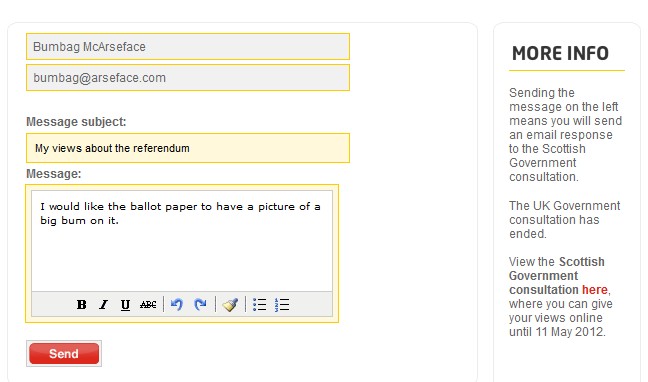
Sarwar’s repeated claim that “no multiple responses” are possible through the form is also a lie – there are no discernible safeguards against either fake names or multiple responses on the site, as we also verified by successfully submitting further multiple entries through the same form, including this one in which we used the name “anonymous” and the email address “anonymous@anonymous.com”.
Sarwar’s position on whether Labour are monitoring the responses in order to potentially catch these abuses is doubly untruthful. When Fraser asks him “So you’re monitoring [the responses via the form]?”, he answers “Absolutely” (although our experiments suggest this is not the case), yet mere seconds later when Hosie expresses concern about this admission, he replies “That’s not what I said”, even though it was, as an indisputable matter of record, precisely what he said.
The Scottish media, it probably goes without saying, has not challenged Sarwar on these easily-demonstrable lies. As Sarwar was nominated by Scottish Labour to be its spokesman for the issue on Sunday Politics Scotland, we believe it’s reasonable to assume, furthermore, that his responses were not made out of simple ignorance.
Should Mr Sarwar contact us to explain that in fact it was the case that he simply had no idea what he was talking about, we will gladly withdraw our allegations and issue an apology to that effect. But in the absence of any such statement, the evidence makes it impossible for us to reach any other conclusion than that he deliberately and knowingly lied to Isabel Fraser, Stewart Hosie and the Scottish people.
We do not believe such a person is fit for office in one of the nation’s biggest political parties, or indeed to be a Member of Parliament. We think most people would agree, and we call on Anas Sarwar to resign both positions immediately.
Wings Over Scotland is a thing that exists.