Today’s Daily Record covers the story we mentioned yesterday about a report from a Scottish Labour campaign group making the pretty factually-uncontestable point that the branch office’s dismal strategy in last month’s election held the UK party back.

And it made the Record really angry.
Read the rest of this entry →
Tags: arithmetic failmisinformation
Category
analysis, debunks, idiots, scottish politics, stats, uk politics
Broadly speaking, the psychological phenomenon known as the Pollyanna Principle is a tendency to neurotically see the most positive possible view of a situation. It’s not generally widely found in newspapers – for whom bad news as a rule sells much better than good news – but for some reason the Scottish press makes a uniform exception when it comes to military shipbuilding.
This, for example, is today’s Herald:

Now, in itself that headline is – unusually – true, so far as it goes. But it only takes until the first sentence of the article text before things start to fall apart.
Read the rest of this entry →
Tags: misinformation
Category
analysis, debunks, disturbing, media, scottish politics
Today the BBC finally officially revealed what everyone already knew.

So now Scottish viewers definitely know where we stand.
Read the rest of this entry →
Category
analysis, comment, football, media, scottish politics
Here’s Kezia Dugdale in the Daily Record today:

If only there was somewhere that Labour DID already run the NHS so that we could judge the truth of that claim, eh readers?
Read the rest of this entry →
Category
analysis, idiots, investigation, scottish politics
We’re always loath to criticise political journalists for feeble stories published during the summer season, when parliaments are in recess and there’s nothing much happening to fill space with. But the Sunday Post has started pretty early this year.

Let’s see if we can put a number on the degree of “dilution” here, shall we?
Read the rest of this entry →
Tags: misinformation
Category
analysis, debunks, media, scottish politics
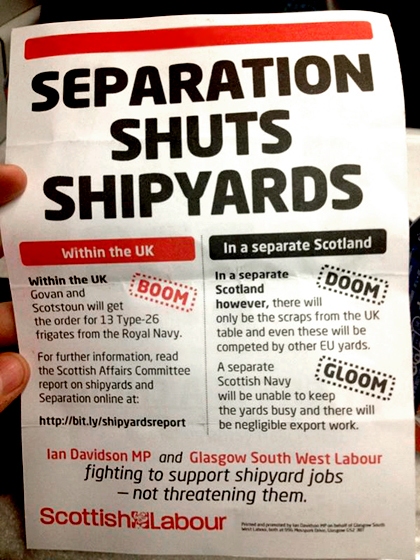
Of all the tropes of the 2014 independence referendum, few were fought over more repeatedly and bitterly, or more dishonestly by the No campaign, than the saga of the Type 26 frigates. The UK government promised Clyde shipbuilders hit hard by years of neglect and job losses that it would build 13 of the state-of-the-art vessels at BAE’s Scotstoun yard, but only if Scots voted No.
Once that vote was secured the number very swiftly dropped to eight, accompanied by a whirlwind of misinformation insisting that there had in fact been no reduction. (As keen social media users will know, this brazen lie was pushed particularly hard by the militarist website UK Defence Journal.)
So we were interested to see a story in today’s Scotland On Sunday which showed how desperate the Unionist side is to cling on to the ships as a future blackmail tool.

The paper has chosen to present the news with a super-positive spin, as you can see from the headline. But the text of the article tells a very different story.
Read the rest of this entry →
Category
analysis, media, scottish politics
Pictured below are Ruth Davidson and her 13-strong* cohort of Scottish Tory MPs.

When they were elected earlier this month, the group rushed to tell anyone who’d listen that they were ready and willing to “defy” the UK leadership and act (ironically) as an independent party, standing up bravely for the people of Scotland.
They would be able to do so, they said, from a position of “unprecedented influence”, because without the Scottish Tory group Theresa May cannot get a majority to pass any legislation, even with the support of the DUP. It could be reasonably argued, then, that for that reason Ruth Davidson’s 13 are at least in theory the most powerful group of Scottish MPs in Westminster history.
So what concessions have they extracted with all that power?
Read the rest of this entry →
Category
analysis, scottish politics
The Labour Party’s current state of euphoric hubris about losing another election is at least partly explicable. Jeremy Corbyn increased his party’s 2015 vote in England and Wales by a thumping 40%, took the highest vote share of any Labour leader since 2001 (beating Tony Blair’s 2005 victory by five points), the highest actual vote since Blair’s 1997 landslide, and deprived the Tories of their overall majority.

Those achievements are tempered by the fact that while Corbyn vastly overperformed expectations and certainly gave Theresa May a bloody nose (and might well end up depriving her of the Prime Ministership once her party gets a challenger together), the morning-after reality is that Tory rule has been extended to at least 2022 – by which time Corbyn will be 73 – with the nasty hangover of the empowerment of the DUP.
(With both Labour and Corbyn personally now leading in the polls it’s pretty much impossible to see the Tories losing a vote of confidence which would trigger another exemption to the Fixed-Term Parliaments Act. Any new election would very likely lead not only to a Labour government but to a Jeremy Corbyn Labour government, a prospect to chill even the most rebellious Tory into meek and sober compliance.)
But it would be churlish to dispute that Corbyn has put Labour in its best position for nearly 20 years. The same is emphatically NOT true of Scottish Labour, which hasn’t stopped the Scottish media from desperately trying to pretend otherwise.
Read the rest of this entry →
Tags: misinformation
Category
analysis, media, scottish politics
The media is aflame today with some rather woolly “news” to the effect that Theresa May might possibly, in some unspecified manner, have conceded a veto over Brexit to the Scottish Parliament.
We can see no evidence suggesting such a thing has happened or will happen, and would instead direct readers to a report published yesterday by Unlock Democracy. We strongly advise taking five minutes out of your day to read pages 26-33 of it, but if you’re really in a rush this paragraph will give you the basic conclusion:

Remember your place, lesser nations of the UK.
Category
analysis, comment, scottish politics, uk politics
There's nothing about Ramboat (Genera, free, iOS and Android) that isn't interesting. The game itself is a short, punchy and fun pure arcade shooter that most obviously channels Metal Slug and Irem's much-underrated In The Hunt. Indeed, it's basically a very clever adaptation of the latter game for one-thumb control, but presented with all the beautifully-detailed character of the former.

But this isn't the article I've been meaning to write for years about the fascinating and often incredibly elegant and even revolutionary ways that developers have rejigged every traditional game genre for touchscreen devices in order to avoid going down the horribly unsatisfactory route of the "virtual d-pad".
Because the other most intriguing aspect of modern gaming*, particularly on mobile formats, is the monetisation of it. And in the case of Ramboat, the opportunity for an experiment presented itself.
Read the rest of this entry →
Category
analysis, videogames
The SNP were there for the taking in last week’s general election. Across the country they typically lost something around 10,000 votes per seat compared to the 2015 tsunami, and the vast majority of those seats formerly belonged to Scottish Labour.

Yet while Labour did take back six seats of the 41 they lost two years ago (most of them by wafer-thin margins), they fell short in dozens of others despite the huge scale of the SNP’s losses.
And the reason is that, even riding the coat-tails of the Jeremy Corbyn bounce, Kezia Dugdale’s northern regional branch office delivered a showing that was at best barely any better than the 2015 catastrophe, and in many cases actually worse.
We’re still on a break, really, but it’s a rotten dreich day today and we’re waiting in for a parcel, and we completed all our domestic administrative tasks yesterday, so just to kill a bit of time we number-crunched all the seats where Labour came second.
The results, if you’re Kezia Dugdale, should be dismally sobering.
Read the rest of this entry →
Category
analysis, scottish politics
The Scottish Liberal Democrats have been a drastically reduced force in Westminster politics ever since they were all but wiped out (along with most of their UK colleagues) in the 2015 election. But there were still sizeable areas of the country where they retained a strong presence, even when they’d lost their seats.

That changed dramatically last Thursday.
Read the rest of this entry →
Category
analysis, scottish politics