Fewer than one in ten of our readers follow us on Twitter, which is a bit annoying as it’s a great way of passing on interesting stuff quickly without having to put together a whole post on it. (We don’t really understand people’s objections to using Twitter. Some say it’s full of daft trivia about what celebrities had for their tea and suchlike, but that’s only true if you choose to follow those people. There’s no law that says you have to follow 1000 folk, you can follow just one if you like.)
Anyway, the point is that while everyone on Twitter is talking about it, if you aren’t you might well not have come across this piece by baby-faced left-wing wunderkind Owen Jones for the Independent yet. Called “The Strange Death Of Labour Scotland” (in a nod to Gerry Hassan and Eric Shaw’s recent book of the same title), it doesn’t contain much we haven’t been saying here for the last year. But it’s always interesting to see the English left slowly starting to notice what’s going on in North Britain. Their assessment is rarely kind, and currently readers are approving of Jones’ analysis by a margin of around 15 to 1. It’s well worth a read.
Last week, unnoticed by the media, the “Better Together” website issued a rather disturbing “Activist Briefing”. It was based around what’s been a core facet of the anti-independence campaign for years – the notion that even with oil revenues, Scotland is too poor to go it alone. (Despite regular assurances to the contrary in more recent times, this is still a fundamental belief of the No camp.)
The alarming passage was this one:
“Even with a generous allocation of Scotland’s oil revenues (a geographical share) the best estimate is that in 2011-12 Scotland was running at a significant deficit. Assuming a geographical share of oil revenues – which would in no way be guaranteed – Scotland would have run at a significant deficit in each of the last ten years.”
The two troubling aspects of the quote above are pretty obvious. Firstly, the notion of Scotland receiving its clear rights under international law is described as “generous”, as if it was somehow in the gift of the UK to decide where Scotland’s maritime borders lay in the event of a Yes vote. But much more worrying is the second part, which reaffirms the assertion that such a share “would in no way be guaranteed”.
Any attempt by the rUK to annexe internationally-recognised Scottish resources after independence would be quite simply an act of war, and as such can be discounted as belonging to the realm of fantasy. But what such comments do point to is a mindset and possible strategy that’s barely any less discomforting.
Johann Lamont actually taught English, hard as that can be to believe sometimes. But for the sake of the children of Rothesay, Springburn and Castlemilk, we hope she was never asked to fill in on a Geography class, judging by this remarkable extract from her speech to the Scottish Labour conference in Dundee back in March:
You kinda do, Johann. How can you be Scottish if there’s no such thing as Scotland? And if there is, how do you know whether you’re in it or not, unless it’s got borders?
If there’s no border, how do we know whether a crime committed somewhere near Berwick comes under the jurisdiction of Scots law or English law? How do we know if the Scottish NHS or the English NHS is responsible for looking after the victim? And how do we know whether to charge the future lawyers who’ll fight the court case for their law degrees or not, if we don’t know which country their university’s in?
While we’re not planning to shut Wings Over Scotland down during the festive break, obviously political stories are likely to be a bit thin on the ground with Parliament on recess and everyone plonked in front of Doctor Who full of turkey and booze. So to fill the gaps we’ll be resorting to some traditional methods – scattered in among new articles will be some end-of-year awards, best-ofs and perhaps the odd reprint of stories from earlier in the year when we had only a fraction of the readership we do now, and which most people therefore won’t have seen.
So let’s start with our favourite piece of terrier-like interrogation from the nation’s broadcast journalists, reporters and presenters. These are the people ultimately charged with holding our politicians to account on our behalf – literally so in the case of the BBC – so it’s vital they keep on top of their game with a firm grasp of the issues and an ability to cut through the waffle and obfuscation of their interview subjects and get to the heart of the matter.
So for a gem that dates way back to almost the first political programme of the year but which nobody managed to better for the entire 11-and-a-bit months that followed it, our first-ever “Wingy” goes to… Raymond Buchanan of BBC Scotland!
When we wrote a story earlier today about another piece of embarrassing evidence falling off the Scottish Labour website, we thought it was nothing more than the latest in a long line of attempts by the party to clumsily cover its tracks over policy U-turns. But when we did a little digging, we found something altogether more interesting.
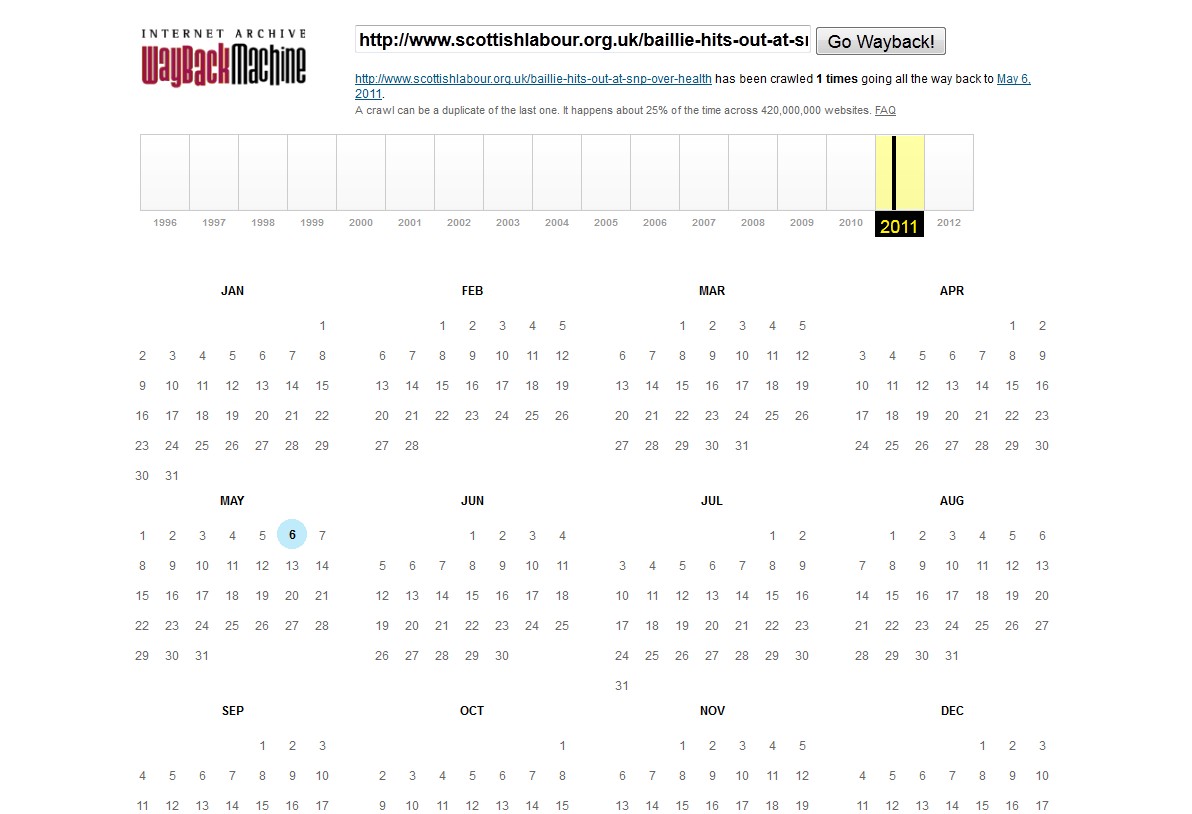
Because when we typed the page’s address into The Internet Wayback Machine for fun, we fully expected to find that the line about continuing free prescription charges had been deleted yesterday, or at least in the weeks since Johann Lamont made her infamous“something for nothing”speech.
Instead, however, TIWM listed only one previous version. While it’s not the sole factor, pages tend to show up on the archive site when they’ve been amended, and the only time the Wayback Machine had been called on to notice this particular page since its creation in November 2010 was on Friday the 6th of May 2011 – the day after the Scottish Parliament election delivered a historic landslide victory to the SNP, and an unprecedentedly humiliating defeat for Labour.
Results were still coming in on the 6th of May, but Scottish Labour had clearly already decided to eradicate mention of their promise to maintain free prescriptions. Now, it seems rather unlikely that the party convened a meeting of its executive committee, debated the policy, decided on a change and dutifully edited a page of its website while everyone was still digesting the scale of their defeat and/or catching up on some much-needed sleep after a long night of results.
(Indeed, it’s possible that the web page was changed even earlier than the 6th.)
The only reasonable conclusion it’s possible to draw, then, is that the policy was already internally a dead duck before election day. The party’s manifesto pledge (which can be found on page 41) that “with Scottish Labour, there will be no reintroduction of charges for prescriptions in Scotland” must therefore have been a deliberate and cynical lie, set to be abandoned even if the party won power.
It took almost 18 months from that day before Johann Lamont announced her “review” of policy to consider whether universal benefits like prescription charges would be retained under a future Labour government at Holyrood. The review isn’t due to publish its conclusions for almost two more years, and some prominent Labour MSPs have already suggested that free prescriptions will “probably need to stay”(despite the same member also describing them as a “right-wing policy”). But in the light of this evidence, we think it’s a reasonably safe bet what the final verdict will be.
Were readers to further conclude that it’s rather unwise – and perhaps even literally damaging to one’s health – to accept a word of anything Scottish Labour ever says at face value, we’d find it hard to disagree.
Yesterday we noted how Scottish Labour deleted evidence of an embarrassing policy U-turn from its website after it was highlighted by Alex Salmond at First Minister’s Questions. We suspected that it wouldn’t be the last example of the phenomenon, and sure enough we happened to stumble across this page earlier this morning.
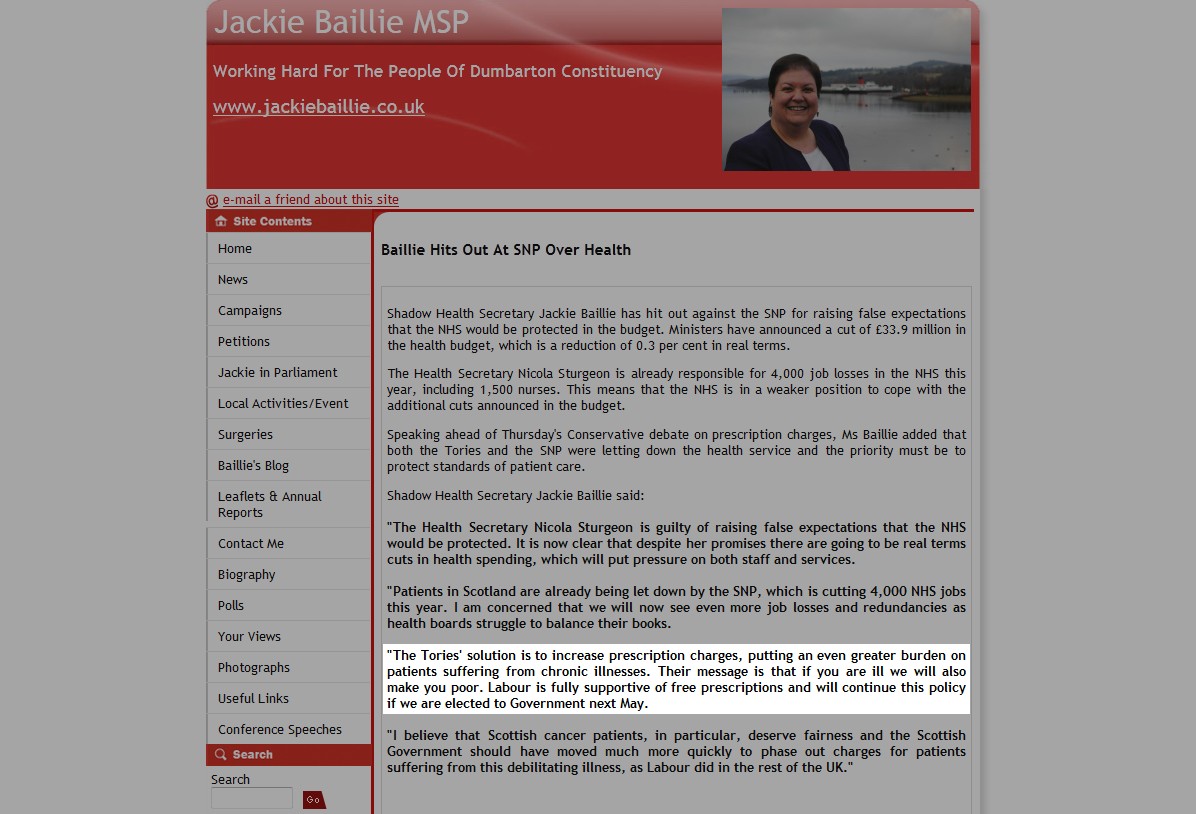
It’s a press release from before the 2011 Holyrood election, by Scottish Labour’s shadow health minister and serial fibber Jackie Baillie. But we noticed something seemed to be missing from it that we were sure we remembered. So we went and checked out the same press release on Jackie Baillie’s own website. In the quote below, the sentence in bold is a line still visible on Baillie’s homepage, but which is oddly missing from the Scottish Labour version.
The text of the two releases is otherwise identical down to the last word. Just that one solitary line has unaccountably fallen off the page in the journey between sites. We don’t mind telling you, readers, we’re completely baffled.
There’s been much hot air unleashed in Holyrood in recent weeks over various “wastes” of money by the Scottish Government. First the opposition accused the SNP of spending £100,000 (which turned out to be a wild piece of back-of-a-fag-packet guesswork vastly overestimating the actual £4,000 cost) in fighting a Freedom Of Information request over EU legal advice. Then there were complaints about £48,000 spent sending a team to the premiere of Brave, despite the obvious benefits to be had marketing Scotland’s tourism industry on the back of the movie.
And finally, Labour in particular screamed themselves hoarse (and were still doing so as recently as yesterday’s FMQs) about the £470,000 the Scottish Government delegation to the Ryder Cup cost, even though it was a contractual obligation, encompassed numerous other business engagements which generated Scottish jobs, and in fact represented a 30% saving on comparable trips by the last Labour-led Holyrood administration. (Which weren’t contractual obligations.)
But still. If just for the sake of argument you were to accept the Unionist parties’ line, that’s a whopping £522,000 the Scottish Government has cavalierly thrown away in recent months. Meanwhile, how has the UK government in Westminster been doing?
This was the “Education” page of the Scottish Labour website this morning:
After Alex Salmond referred to it at FMQs, the page has now been deftly amended to fall in line with the rest of party policy, as you can see in the image below:
Okay, so here’s a fun teaser you can try out around the table after your Christmas dinner. What do the following far-flung countries have in common: Canada, Togo, Uzbekistan, Sierra Leone, Guinea, Gabon, Panama, Zambia, Haiti, Libya and the Cape Verde Islands? Give up? Here’s a clue:
Yep – all of them, and 60 other nations too, are now officially better at football than Scotland. Entirely coincidentally, in the same week this dismaying fact was revealed, it was confirmed that former national coach Craig Levein was to sue the SFA for only offering to pay him £35,000 a month for the next year-and-a-half to sit around and scratch his arse in front of the Jeremy Kyle Show.
We don’t often get to see Johann Lamont on the telly, so when she made one of her rare appearances in a five-minute interview with STV’s excellent Bernard Ponsonby this week we couldn’t only do half a job. As we’re still stuck in the house fighting off this year’s unusually-horrible and persistent germs – and as Lamont repeated most of the speech at today’s FMQs – we steeled ourselves, sat down with a large medicinal hot toddy and transcribed the rest of the piece.
What with it being Christmas and everything, though, you’re probably busy, so if you’re in a rush we’ve condensed all of Johann’s umming and aahing and stumbling and waffling down to its essence, where there is such a thing. The parts highlighted in red below are all you really need to read.
We’ve spent the last 90 minutes watching an incredible video someone linked us to in a reader comment earlier today. It’s a public meeting of the Clydebank Trades Union Council on November 29th, headed by a panel comprising Gil Paterson (SNP MSP for Clydebank and Milngavie), Jackie Baillie (Labour MSP for Dumbarton), chairman Tom Paterson (secretary of Clydebank TUC), Stephen Boyd (assistant secretary of Scottish TUC) and Cathy Leach (Scottish Pensioners’ Forum).
Throughout the meeting the sense of anger and hurt coming from the traditionally-Labour audience and directed mostly at Baillie is overwhelming. Time and again the party’s betrayal of its core audience is bitterly attacked. But an hour and 25 seconds in, there’s a particularly remarkable exchange.
To be honest, we’re still trying to work out what happened here. The Secretary of State for Scotland was well and truly slapped up and down the room yesterday by a panel of peers in the House Of Lords Economic Affairs Committee, every one of whom was a Unionist. One after another lined up to lambast the hapless minister with stinging attacks and rebukes in a session that caught most observers used to the Lords’ normal cosy atmosphere of mutual Nat-bashing completely unawares.
It seems far too late in the day for Westminster’s second chamber to present itself as the heroic defender of the people of Scotland. It would be much too ironic for the unelected Barons and Earls and whatnot to be doing it in the name of democracy. And there seems little chance this one-day aberration will suddenly convince anyone to buy the implausible notion that the Committee is an impartial investigator into the issues surrounding Scottish independence.
So frankly, readers, your guess is as good as ours as to what the noble lords were up to. A momentary outbreak of conscience? One too many sherries at the office Christmas do? If you’ve got any suggestions, we’re all ears.
Hatey McHateface on Faces In Sand: “All the severed body parts are put into a big hat. Then the attendees draw lots to see who gets…” Oct 18, 09:22
Captain Caveman on Faces In Sand: “Is it “just” the SNP though? The Greens have (rightly) also been cited, but what about the moronic Lib Dumbs…” Oct 18, 09:17
Minceheid on Faces In Sand: “You’re not wrong, Red. Not wrong at all. Mind you, the idea of a Green Party orgy has put me…” Oct 18, 08:36
Aidan on The fight about to come: “I see stinking fat shit is back posting again.” Oct 18, 08:11
Willie on Faces In Sand: “Here are two photographs from journalist Cris Mullin’s X account. One shows an apparently bursting full SNP Conference. The other…” Oct 18, 06:47
Willie on Faces In Sand: “Absolutely incredible that the SNP are going to ban all government and government agencies from using the media platform Twitter…” Oct 18, 06:35
Angus on Faces In Sand: ““16th century Scots would have driven them all into the sea by now.” Scots had real spines in those days.” Oct 18, 02:24
Cynicus on Faces In Sand: “Quos Deus vult perdere, prius dementat. Or- to mark the end of the Mòd, in the tongue of those called…” Oct 18, 01:47
Lothianlad on Faces In Sand: “Just did something i rarely do an looked at whingy scot goes pop mealy mouth. Interesting he says nothing about…” Oct 17, 22:47
Lothianlad on Faces In Sand: “Proof if any were needed that the SNP is utterly owned by the british security sevices. They allow no prospect…” Oct 17, 22:37
Anthem on Faces In Sand: “Q Manivannan, did he ever get a visa extension? The illegality of that seems to have gone quiet.” Oct 17, 22:37
Andrew scott on Faces In Sand: “THIS IS BEYOND AWAFUL DOOMED AH TELL YE DOOMED” Oct 17, 22:14
Red on Faces In Sand: “Looking at the SNP conference now, they’re just human biotrash. The least intelligent, the least honest, the least courageous and…” Oct 17, 20:02
Jim Thomson on Faces In Sand: “In other news – “A Ministry of Defence analyst has been elected rector of the University of St Andrews. Dr…” Oct 17, 19:32
Jim Thomson on Faces In Sand: “They’ve obviously never heard of VPNs. “Choose Scotland”, our reframing group developed that slogan way back in 2013 and have…” Oct 17, 19:28
Hatey McHateface on Faces In Sand: “Hmmm. Listening to the BBC tonight, I got the impression that Swinney has just announced that Indy is as good…” Oct 17, 18:52
Hatey McHateface on The fight about to come: “Crivens, James. Is it usual for yer maw tae stay oot sae long? Hope she’s nae been lifted! Wha’s pitting…” Oct 17, 18:45
Tommo on Faces In Sand: “‘The truth is simple: the SNP exists for power’s sake alone. As long as it can keep funnelling fat salaries…” Oct 17, 17:53
Ian on Faces In Sand: “I suppose we should look on the bright side. 1. If everyone who still thinks independence is coming via the…” Oct 17, 17:17
Alison on Faces In Sand: “Nothing about this surprises me except that Facebook has a 70% reach.” Oct 17, 16:51
twathater on Faces In Sand: “The smugness emanating from that FAT BALDHEADED TWAT is almost bile inducing” Oct 17, 16:46
twathater on Faces In Sand: “We can only hope that the Alex Salmond trial and the EXPOSURE of the vile , despicable actions of Sturgeon…” Oct 17, 16:40
Captain Caveman on The fight about to come: “My word, some horrendous imagery coming out of France right now, the place seems to be on fire. Tsk, all…” Oct 17, 15:42
James on The fight about to come: ““….hurled at those whose ability to construct a coherent, cogent, written statement…” Site Prick. When’s that happening then, wee man?…” Oct 17, 14:54
Hatey McHateface on The fight about to come: ““The talent is there” Where? Serious question. Where are they hiding? Help me out here. Name 20 talented Scots capable…” Oct 17, 14:15
sarah on The fight about to come: “SSRG 2026 Saturday 17th October on youtube is working well today. Please watch. Sensible, principled people talking constructively. They are…” Oct 17, 13:49
Wally Jumblatt on The fight about to come: “Your perseverance with the moribund SNP is praiseworthy, but I’m sure we are all way past the point where we…” Oct 17, 13:36
Captain Caveman on The fight about to come: “” What glass house pray am i supposed to inhabit” Well, son, “if you have to ask” and all of…” Oct 17, 12:17
Hatey McHateface on The fight about to come: “@James says: 17 October, 2026 at 10:21 am “Prick”? Naw, James, that ane hasnae been devalued. Its meaning remains clear,…” Oct 17, 11:23
Hatey McHateface on Still Time To Save Her: ““Still read the rag though” Me too, the online version. Some good journalism occasionally, although hell will freeze over before…” Oct 17, 11:13