What you’re paying for 86
Posted on
March 25, 2013 by
Rev. Stuart Campbell

Running total (updated daily): £28,920 of £29,796 (97.1%).
Donations in last 24 hours: £886.
Running total (updated daily): £28,920 of £29,796 (97.1%).
Donations in last 24 hours: £886.
Apologies for the lack of posts today, readers – been working on a small practical project and getting into an argument with a No voter who might just be persuadable, among other things. But amid it all we stumbled across this on the BBC website.

It’s a 2011 interview with Noel Gallagher about the English riots. Gallagher was one of the cultural figureheads famously invited to Downing Street by Tony Blair during the short-lived “Cool Britannia” phase before the shine wore off the New Labour project.
“Running up to the last election I wasn’t going to vote, until my wife said ‘You’ve got to vote’, and I’ve got to say it’s the first time I’ve picked the most ludicrous thing on the list – some guy who was gonna dress as a pirate.
But the Labour Party have managed to prove themselves to be just as sleazy and horrible as we all know the Conservatives are. There’s nothing left to vote for any more.“
We empathise. But there’s still one part of Britain where that’s not true.
We suspect that for the vast majority of our readers, it’ll be quite hard to get to grips with the fact that the Scottish Daily Mail intends this headline as a criticism.

In 18 months’ time, Scots will have the chance to decide whether they’d rather spend their money on pay rises for public-sector workers or on tax cuts for the rich and bribes for them to buy second homes and inflate another housing bubble with. We must admit to being quite surprised that there’s a debate about it.
We already know that Labour, particularly in Scotland, have no policies on just about anything. But in the light of the past week’s glut of abstentions, we decided to see if we could find out if the party had any remaining principles either. The results were startling, by which we mean not startling in the slightest.

Below are just a few of the votes that Labour has abstained on, at both Westminster and Holyrood, in recent memory. What, we ponder rhetorically, is the point of having an Opposition that doesn’t ever actually oppose anything?
Well, what a curious day this is shaping up as. As we scoured our Twitter feed in vain after the bewildering media blackout on the workfare vote, we also discovered that “Better Together” has been running around half the internet trying to censor a satirical video. To cut a long story short, you can download a copy of the video by right-clicking on the image below and choosing “Save As…” or “Save Link As…”.
(NB: Don’t left-click, as it will attempt to stream it and fail.)
We invite the No campaign to see if they can have it pulled from this site.

But that wasn’t the end. As people started to read our story on the workfare motion, we began to get tweets and comments questioning the quote we’d used, as it didn’t seem to appear anywhere in the article on the website. Confused, we went and had a look, and sure enough the original version had vanished, replaced by something much shorter and far more innocuous.
Luckily this isn’t our first time with internet censorship. At the time of writing there’s still a cached version of the original, and when that disappears you can read it here.
We’re not quite sure what’s happening today, but we don’t like it.
This article* puts our feelings about the actions of the three London parties in the House Of Commons today better (or at the very least, more concisely and with considerably more restraint) than we could ourselves.
The SNP, Plaid Cymru, the sole Green and about 40 of 258 Labour MPs opposed the motion, which was only able to be rushed through because of Labour’s co-operation with the government. Everyone else either voted for it or abstained. The rule of law means nothing any more, and neither does democracy. Better together, right?
*The link now points to a saved version. The original has been mysteriously replaced.
The usage of Nazi terminology to refer to any actions of a democratically-elected UK government is nearly always an absurd and unhelpful exaggeration. Today, however, one such analogy is absolutely literally justified.

The words “Arbeit Macht Frei” were emblazoned, usually in iron, over the gates of numerous concentration and extermination camps in 1930s and 1940s Germany, most infamously Dachau and Auschwitz. The phrase is usually rendered in English as “work makes you free”, though a more precise translation of the first word is “labour”.
That the same exhortation is used in Britain in 2013 by The Salvation Army tells you all you need to know about the ideological climate of the modern United Kingdom.
Diligent readers will know that this site is engaged in a lonely and difficult quest to find out what Labour’s actual policy on the Bedroom Tax is. And in attempting to establish the facts of the matter, it’s important to differentiate a policy from an opinion.
The latter are in plentiful supply – Labour, we’re told repeatedly, is “against” the tax. Check out, for example, this intriguing exchange on Twitter. (Click for full version.)
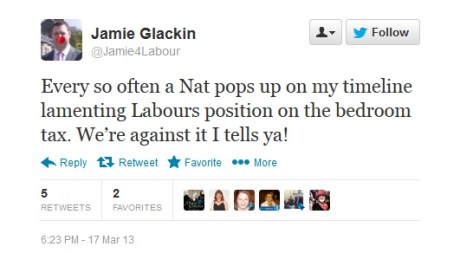
Jamie Glackin is a member of Labour’s Scottish Executive Committee, so you think he’d have a fairly firm grasp of the party’s policies, but he’s oddly evasive regarding the Bedroom Tax. Asked by SNP councillor Mhairi Hunter if Labour would scrap the tax, Glackin dodges by saying “Don’t think it will get that far. It’s a dead duck.”
But he’s far from alone in not wanting to answer that question.
Only the special ineptitude of the Scotsman could make the task of downloading a simple PDF into a near-impossible trial suitable for the Krypton Factor. We don’t advise you bother trying to get yourself a copy of “Scotland Decides” (the paper’s compilation of its eight-week series of pro- and anti-independence essays) from its own website unless you have a fetish for frustration, but thanks to the sterling efforts of Peter Bell we have a local copy here for you without all the dicking around.

The contents of the document, when all taken together, are revealing.
Brigadoon is the story of a Scottish village which only appears for one day every hundred years. GERSland, on the other hand, is a country – similar to Scotland in many ways – which has appeared, albeit fleetingly, every year since 1999.

GERSland too suffers from Caledonian Antisyzygy – it is simultaneously like Scotland and unlike it. It is not Scotland as we know it and it’s not a glimpse of an independent Scotland either, despite the dogged insistence of countless journalists, analysts and commentators less insightful than Wings Over Scotland’s on presenting it as such.
It is, as the lawyers say, sui generis, or a special case.
A couple of paragraphs in a Vince Cable story (to over-dignify the piece in question) from today’s Scotsman are quite amusing if you swap the order they come in.
“The first day I took up my job as the chief economist at Shell I was given a plaque which had an Arabic saying and when I pressed for a translation, they said ‘All those who claim to predict the future are lying, even if they are later proved right’.”
Righto.
“Business Secretary Vince Cable last night warned that an independent Scotland’s reliance on revenue from oil would result in savage public spending cuts or tax rises, as he addressed the Liberal Democrat Scottish conference.”
Oops!
Wings Over Scotland is a thing that exists.