Legal correspondence 149
Posted on
April 15, 2013 by
Rev. Stuart Campbell
We’ve received another letter from Ian Taylor’s lawyers. You can read it below.
We’ve received another letter from Ian Taylor’s lawyers. You can read it below.
Scotland on Sunday, 14th April 2013 (our emphasis):
“[A Labour] MP pointed out that any further devolution would need support from the Labour Party in England: ‘Johann can’t just say to Ed [Miliband, the Labour leader] this is what I want. These decisions and policies have consequences for the whole of the UK. There are Labour MPs in England now who are getting fed up with it, not just Tories.'”

We hate to harp on. But it may be that there are still some people stuck in a cave somewhere in the Hebrides who think Johann Lamont is the “leader” of a political party called “Scottish Labour” rather than a regional branch manager of one based in London, and who imagine that the findings of her commission on devolution – should there actually be any before the referendum – will become official Labour policy.
And for those people, we have four words.
We’ve been documenting of late how the No campaign has grown increasingly negative and smear-based since the turn of the year, as opinion polls show a trend of small but consistent movement towards independence. One of the core characteristics of negative political campaigning is to accuse your opponents of doing the thing you’re actually doing, and the last couple of days have thrown up some striking examples.

That’s our old pal Euan McColm of the Scotsman, of course. And he’s not alone.
The Labour Party’s clinging to the pretence of a commitment to multilateral nuclear disarmament is perhaps the most cynical of all the lies it still tells the electorate, on either side of the border. This weekend, as thousands of protesters congregate in Glasgow, Labour activists are mounting a frantic rearguard action pretending that independence and Trident are unconnected issues.

But the feeble smokescreen with which the party attempts to conceal the truth could be blown away by an asthmatic bee. It shouldn’t take too long to run through the logic.
Ian Taylor, chief executive and president of Vitol, is the donor who just keeps on giving:
(Our emphasis, as usual.) To be honest, we hope “Better Together” don’t hand back Mr Taylor’s £500,000 donation. We imagine Yes Scotland will rather enjoy hitting them with this particular oil- and blood-soaked stick all the way to September 2014.
Here’s Ken Macintosh MSP (Labour) on today’s Good Morning Scotland:
GARY ROBERTSON: Do you have concerns about where the funding for the Better Together campaign is coming from? There have been questions about a half-a-million donation from Ian Taylor and his background. Do you have concerns about that as someone who’s part of that campaign?
KEN MACINTOSH: I don’t… I have to say I’m not close enough to the campaign to know. I’ll go have a look at this story afterwards, but I…
GR: It’s been around for a couple of days now. Basically there are question marks about this man’s background and his business dealings in the past. Questions that have been raised at Westminster by Douglas Alexander for instance.
KM: Well, I certainly would want the Better Together campaign to make sure that the people donating to the campaign are abiding by all the laws and are properly scrutinized by it. But no inside knowledge. I’m not close enough to the campaign to be able to tell you that.
It’s a fair comment from the Labour finance spokesman.
We haven’t heard any more from Ian Taylor’s lawyers yet. But in a surprising development never previously observed on the internet, his attempt to silence various pro-independence voices appears to have resulted in people digging deeper into the affairs of Vitol, the oil-trading company of which he’s been Chief Executive since 1995.

One particularly interesting revelation that we don’t think was covered in any of the earlier articles relates to the company’s conduct in the Republic of the Congo, where they got up to shenanigans a little shadier than simply drinking all the Um Bongo.
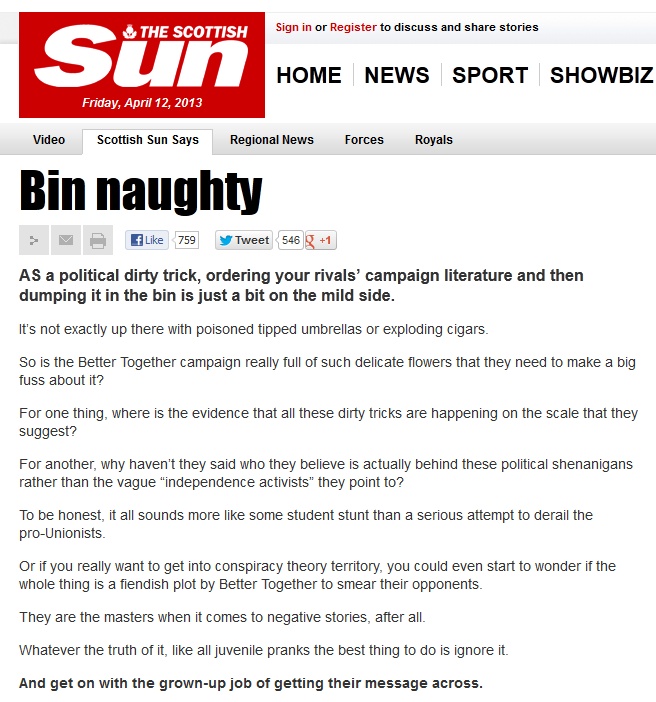
It seems odd to talk of the anti-independence campaign being “desperate” when most polls still give them a significant lead. But to any rational observer the tone of the debate has changed noticeably since the turn of 2013, culminating in the extraordinary and hysterical outburst on the “Better Together” website this week [local copy] when challenged on what we’ll call the “colourful past” of its chief donor Ian Taylor, lest we get any more badly-spelled letters from his lawyers.
(This humble wee website has seen a quite dramatic increase in malicious targeting of various kinds in recent weeks, from legal threats to disgusting personal smearing from No activists and various forms of “cyber warfare”.)

And when you see what the Scotsman’s been reduced to making one of its lead stories this morning, the weight of evidence for the growing state of panic in the No camp becomes hard to ignore.
There’s an old maxim that serves all writers well: “Perfection is when there’s nothing left to take away”. With that in mind, let’s see how few words we can render the complex issue of the future of welfare in the UK in.

But in case those aren’t enough, we’ll expand just a little.
We’ve noted a few times in the past that one of the challenges of highlighting media bias is that you rarely get a chance to directly compare like with like. If a Labour MP is caught up in some sort of scandal and the media soft-pedal it, say, it’s all very well claiming “It’d be different if this was someone in the SNP”, but unless the latter does the exact same thing it’s hard to make it stick.

So this week presents a rare opportunity to study the phenomenon in the flesh, as both the Yes and No campaigns release their lists of campaign contributions so far. Let’s see how it went.
The Daily Record, 5th May 2010:
“Before Margaret Thatcher, Scotland made steel, ships, cars and trucks and produced coal. By the time she had finished with our country, all those industries were devastated – and tens of thousands of proud men and their families were living in ravaged communities with no jobs and no hope.
Scotland could wake up tomorrow to the grim reality of a new Tory government, led by Thatcher disciple David Cameron. And for all his talk of “compassion”, few doubt that we will suffer again if he wins power. We spoke to five men who lost their livelihoods under the Tories, and they all had the same message for the voters: “Don’t let them loose on Scotland again.”“
Well, voting Labour didn’t work. What else could we try?
This is from last weekend’s Sunday Herald:
And then there’s this, from the Herald back in January:
(All emphases ours.) Mr Taylor lives in London – not located in Scotland the last time we checked – and is Chief Executive of an oil-trading company called Vitol, whose extremely colourful history includes the fact that “Last year, it was revealed that for a decade the company had been using Employee Benefit Trusts which avoided tax on incomes of its UK staff and was in discussion with HMRC about a deal to pay this off.”
(The next-biggest donator, author CJ Sansom, sent their £161,000 cheque from their home in Sussex, which we’re fairly sure also isn’t in Scotland.)
We’ve dropped Mr Sheridan a line asking if he finds non-Scottish-resident, tax-avoiding Ian Taylor’s huge donation to the No campaign “nauseating”. We’ll let you know his answer the minute it arrives, which surely won’t be long.
Wings Over Scotland is a thing that exists.