We had a brief and dispiriting Twitter exchange back in May with a prominent Scottish Green activist (if there can strictly be said to be such a thing), in the shape of the party’s former head of media James Mackenzie. The discussion was sparked by a piece in the Guardian reporting the Green quasi-leader Patrick Harvie’s dire warning to Alex Salmond against a “bland, middle-of-the-road”prospectus for independence, which he suggested would risk “alienating” the left-leaning section of the Scottish public (ie most of it) and thereby losing the referendum.
Wading in with all our trademark gentle, reasoned tact, we recited our well-worn observation that referenda are for deciding single precisely-defined issues – in this case, who gets to elect the future governments of Scotland – rather than the fine details of multiple policies, and that starting the Yes campaign off by emphasising our differences perhaps wasn’t the smartest move.
To this Mr Mackenzie accused us of having “confused policy with constitution”, and while we won’t bore you with the full he-said-we-said (you can go and track it for yourself if you really want to), the conversation culminated in this rather huffy tweet:
Now, independence and the SNP are of course not interchangeable terms. Something like a third of SNP voters don’t back the policy, and the Greens and SSP are also in favour, as are various percentages of those who vote for the three London parties. And one of the loudest calls from the non-SNP sections of the independence movement has been that those in favour should formulate a constitution for the prospective nation in advance of the referendum, which could then form the basis of what people voted on, avoiding the danger of the referendum being seen as a party-political issue.
(Which is what the Unionist side desperately wants to make it, hence their strategy of trying to personally discredit the SNP leadership in recent months.)
The whole point of independence is indeed to give us the chance to debate every aspect of Scotland’s future. But demanding to have all these fights now is wrong in principle as well as pragmatically. We’ll come to the pragmatic part in a moment, but let’s take the moral high ground and examine the principle first.
Disappointingly, since we examined the state of censorship in Scottish political blogs back in April, the situation has only got worse. Even those sites which previously sat atop the table for freedom of debate have gone backwards – Bella Caledonia now snootily demands a WordPress login before it’ll deign to allow you to comment without days in the moderation queue, and Lallands Peat Worrier has tragically fallen foul of the dreaded Curse Of Captcha – while many of the others have tightened their grip even further over the year, allowing only the most anodyne of opinions to be aired.
Our award for Moderator Of The Year, though, goes not to obvious suspects like Better Nation or Labour Hame (RIP). While both still reject wholly inoffensive comments by the bucketload lest they cause their delicate readers to faint at the prospect of civil disagreement (and the former now closes comments on stories as soon as three or four days after publishing them), at least within a few days the “offending” item tends to be deleted altogether so that the would-be commenter knows where they stand.
Merry Christmas, readers. We hope you have one filled with peace and love. There are still at least two-and-a-half years of Tory-led Westminster government to come.
Fewer than one in ten of our readers follow us on Twitter, which is a bit annoying as it’s a great way of passing on interesting stuff quickly without having to put together a whole post on it. (We don’t really understand people’s objections to using Twitter. Some say it’s full of daft trivia about what celebrities had for their tea and suchlike, but that’s only true if you choose to follow those people. There’s no law that says you have to follow 1000 folk, you can follow just one if you like.)
Anyway, the point is that while everyone on Twitter is talking about it, if you aren’t you might well not have come across this piece by baby-faced left-wing wunderkind Owen Jones for the Independent yet. Called “The Strange Death Of Labour Scotland” (in a nod to Gerry Hassan and Eric Shaw’s recent book of the same title), it doesn’t contain much we haven’t been saying here for the last year. But it’s always interesting to see the English left slowly starting to notice what’s going on in North Britain. Their assessment is rarely kind, and currently readers are approving of Jones’ analysis by a margin of around 15 to 1. It’s well worth a read.
Last week, unnoticed by the media, the “Better Together” website issued a rather disturbing “Activist Briefing”. It was based around what’s been a core facet of the anti-independence campaign for years – the notion that even with oil revenues, Scotland is too poor to go it alone. (Despite regular assurances to the contrary in more recent times, this is still a fundamental belief of the No camp.)
The alarming passage was this one:
“Even with a generous allocation of Scotland’s oil revenues (a geographical share) the best estimate is that in 2011-12 Scotland was running at a significant deficit. Assuming a geographical share of oil revenues – which would in no way be guaranteed – Scotland would have run at a significant deficit in each of the last ten years.”
The two troubling aspects of the quote above are pretty obvious. Firstly, the notion of Scotland receiving its clear rights under international law is described as “generous”, as if it was somehow in the gift of the UK to decide where Scotland’s maritime borders lay in the event of a Yes vote. But much more worrying is the second part, which reaffirms the assertion that such a share “would in no way be guaranteed”.
Any attempt by the rUK to annexe internationally-recognised Scottish resources after independence would be quite simply an act of war, and as such can be discounted as belonging to the realm of fantasy. But what such comments do point to is a mindset and possible strategy that’s barely any less discomforting.
Johann Lamont actually taught English, hard as that can be to believe sometimes. But for the sake of the children of Rothesay, Springburn and Castlemilk, we hope she was never asked to fill in on a Geography class, judging by this remarkable extract from her speech to the Scottish Labour conference in Dundee back in March:
You kinda do, Johann. How can you be Scottish if there’s no such thing as Scotland? And if there is, how do you know whether you’re in it or not, unless it’s got borders?
If there’s no border, how do we know whether a crime committed somewhere near Berwick comes under the jurisdiction of Scots law or English law? How do we know if the Scottish NHS or the English NHS is responsible for looking after the victim? And how do we know whether to charge the future lawyers who’ll fight the court case for their law degrees or not, if we don’t know which country their university’s in?
While we’re not planning to shut Wings Over Scotland down during the festive break, obviously political stories are likely to be a bit thin on the ground with Parliament on recess and everyone plonked in front of Doctor Who full of turkey and booze. So to fill the gaps we’ll be resorting to some traditional methods – scattered in among new articles will be some end-of-year awards, best-ofs and perhaps the odd reprint of stories from earlier in the year when we had only a fraction of the readership we do now, and which most people therefore won’t have seen.
So let’s start with our favourite piece of terrier-like interrogation from the nation’s broadcast journalists, reporters and presenters. These are the people ultimately charged with holding our politicians to account on our behalf – literally so in the case of the BBC – so it’s vital they keep on top of their game with a firm grasp of the issues and an ability to cut through the waffle and obfuscation of their interview subjects and get to the heart of the matter.
So for a gem that dates way back to almost the first political programme of the year but which nobody managed to better for the entire 11-and-a-bit months that followed it, our first-ever “Wingy” goes to… Raymond Buchanan of BBC Scotland!
The core claim of the No campaign, or “Better Together” as it prefers to be called, is that Scotland is economically, politically and socially stronger as a partner within the United Kingdom. This status is defined, according to the campaign’s website, by three key factors: Prosperity, Security and Interdependence.
Each deserves scrutiny, but for now let’s focus on the first one, with reference to Alistair Darling’s recent speech at the John P. Mackintosh lecture. This was the claim that Darling made on trade and business:
“Scotland is far better represented abroad as part of the UK than we could ever hope to be as a separate state. The nationalists tell you that the UK embassies and consulates do not represent Scots. Try telling that to Scots who find themselves in trouble in a far-flung part of the world and can rely on the UK embassy to help them out. To the businesses seeking trade. They open doors for our people and businesses across the globe.
Farmers, fishermen and women, businesses big and small all reap the benefits of the UK’s global reach and global influence. Losing this influence would be a massive loss. It would be impossible to replicate it on a smaller scale.”
I’ve worked in 27 countries around the world in all six inhabited continents, so I think it’s fair to call myself a global businessman. I’m operating in a medium-sized company, but in 11 years of travel I cannot bring to mind a single case where association with Britain has differentiated our business.
When we wrote a story earlier today about another piece of embarrassing evidence falling off the Scottish Labour website, we thought it was nothing more than the latest in a long line of attempts by the party to clumsily cover its tracks over policy U-turns. But when we did a little digging, we found something altogether more interesting.
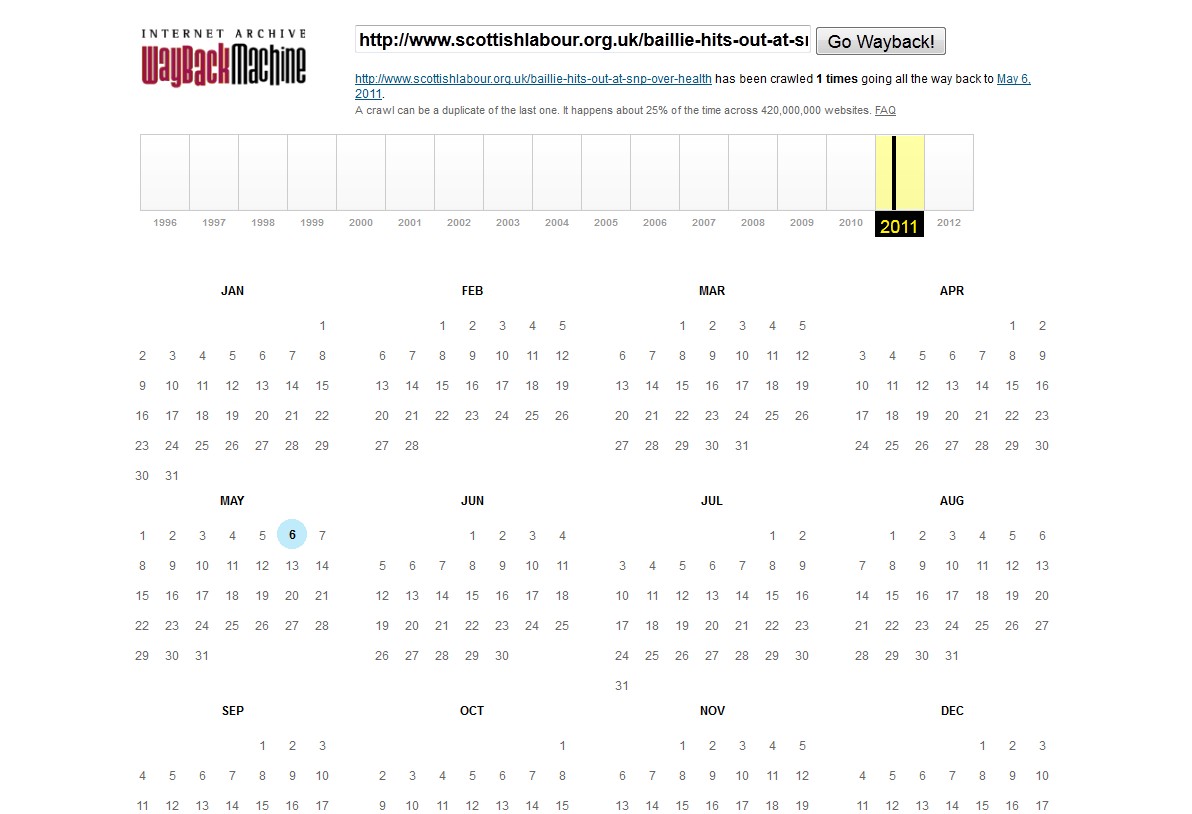
Because when we typed the page’s address into The Internet Wayback Machine for fun, we fully expected to find that the line about continuing free prescription charges had been deleted yesterday, or at least in the weeks since Johann Lamont made her infamous“something for nothing”speech.
Instead, however, TIWM listed only one previous version. While it’s not the sole factor, pages tend to show up on the archive site when they’ve been amended, and the only time the Wayback Machine had been called on to notice this particular page since its creation in November 2010 was on Friday the 6th of May 2011 – the day after the Scottish Parliament election delivered a historic landslide victory to the SNP, and an unprecedentedly humiliating defeat for Labour.
Results were still coming in on the 6th of May, but Scottish Labour had clearly already decided to eradicate mention of their promise to maintain free prescriptions. Now, it seems rather unlikely that the party convened a meeting of its executive committee, debated the policy, decided on a change and dutifully edited a page of its website while everyone was still digesting the scale of their defeat and/or catching up on some much-needed sleep after a long night of results.
(Indeed, it’s possible that the web page was changed even earlier than the 6th.)
The only reasonable conclusion it’s possible to draw, then, is that the policy was already internally a dead duck before election day. The party’s manifesto pledge (which can be found on page 41) that “with Scottish Labour, there will be no reintroduction of charges for prescriptions in Scotland” must therefore have been a deliberate and cynical lie, set to be abandoned even if the party won power.
It took almost 18 months from that day before Johann Lamont announced her “review” of policy to consider whether universal benefits like prescription charges would be retained under a future Labour government at Holyrood. The review isn’t due to publish its conclusions for almost two more years, and some prominent Labour MSPs have already suggested that free prescriptions will “probably need to stay”(despite the same member also describing them as a “right-wing policy”). But in the light of this evidence, we think it’s a reasonably safe bet what the final verdict will be.
Were readers to further conclude that it’s rather unwise – and perhaps even literally damaging to one’s health – to accept a word of anything Scottish Labour ever says at face value, we’d find it hard to disagree.
Yesterday we noted how Scottish Labour deleted evidence of an embarrassing policy U-turn from its website after it was highlighted by Alex Salmond at First Minister’s Questions. We suspected that it wouldn’t be the last example of the phenomenon, and sure enough we happened to stumble across this page earlier this morning.
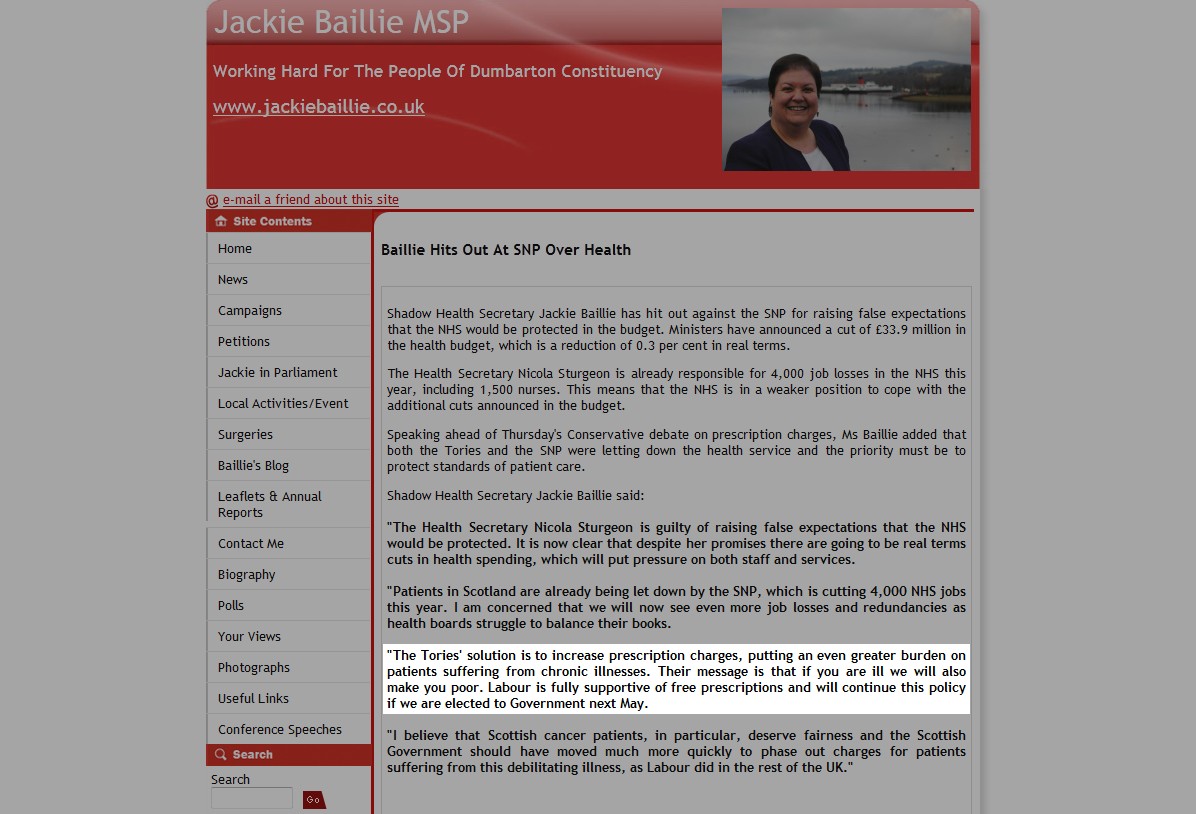
It’s a press release from before the 2011 Holyrood election, by Scottish Labour’s shadow health minister and serial fibber Jackie Baillie. But we noticed something seemed to be missing from it that we were sure we remembered. So we went and checked out the same press release on Jackie Baillie’s own website. In the quote below, the sentence in bold is a line still visible on Baillie’s homepage, but which is oddly missing from the Scottish Labour version.
The text of the two releases is otherwise identical down to the last word. Just that one solitary line has unaccountably fallen off the page in the journey between sites. We don’t mind telling you, readers, we’re completely baffled.
There’s been much hot air unleashed in Holyrood in recent weeks over various “wastes” of money by the Scottish Government. First the opposition accused the SNP of spending £100,000 (which turned out to be a wild piece of back-of-a-fag-packet guesswork vastly overestimating the actual £4,000 cost) in fighting a Freedom Of Information request over EU legal advice. Then there were complaints about £48,000 spent sending a team to the premiere of Brave, despite the obvious benefits to be had marketing Scotland’s tourism industry on the back of the movie.
And finally, Labour in particular screamed themselves hoarse (and were still doing so as recently as yesterday’s FMQs) about the £470,000 the Scottish Government delegation to the Ryder Cup cost, even though it was a contractual obligation, encompassed numerous other business engagements which generated Scottish jobs, and in fact represented a 30% saving on comparable trips by the last Labour-led Holyrood administration. (Which weren’t contractual obligations.)
But still. If just for the sake of argument you were to accept the Unionist parties’ line, that’s a whopping £522,000 the Scottish Government has cavalierly thrown away in recent months. Meanwhile, how has the UK government in Westminster been doing?
Young Lochinvar on The quality of mercy: “Beggars Quoting Hitler (one on from the derivative Main Kampf here).. You’ve graduated from Moseley it seems.. Not a good…” Apr 7, 00:21
Sven on The quality of mercy: “I’m just betting it wasn’t either of Ms Sturgeon’s “Clyde Built” Ferry boats with painted on windows, Mark. You’d be…” Apr 6, 20:57
George Ferguson on The quality of mercy: “@Fearghas Agreed people don’t understand the Constitutional implications of King Charles not fulfilling the Union treaty to the Church of…” Apr 6, 19:43
Mark Beggan on The quality of mercy: “Why Aye Man. ‘We had no way of staying afloat We had to leave on the ferry boat Economic refugees…” Apr 6, 19:40
Geri on The quality of mercy: “It’s more than ten years & I hate to break it to you but it’s GLOBAL. England has perpetual grudges.…” Apr 6, 19:38
Geri on The quality of mercy: “Agreed! I’m also so over the eejits who constantly think we need to fix this & that before Indy. England…” Apr 6, 19:24
Mark Beggan on The quality of mercy: ““It is thus necessary that the individual should finally realise that his own ego is of no importance in comparison…” Apr 6, 19:24
Alf Baird on The quality of mercy: ““Hate by its very nature is destructive. To hate an entire nation over a period of ten years rips the…” Apr 6, 18:55
Young Lochinvar on Clocks And Calendars: “What in tarnashun boyy! Aint not no none of yer good ol’ boyys talkin’ likee that in tham there Scahtland..…” Apr 6, 18:31
TURABDIN on The quality of mercy: “From WIKI: «The earliest use of the term appears in 1507, when King James IV of Scotland was granted the…” Apr 6, 16:56
Andy Ellis on Clocks And Calendars: “@YL Given that “gotten” is – as I stated – probably more common amongst Scots than English users of the…” Apr 6, 16:47
Young Lochinvar on Clocks And Calendars: “Yee Haw Pardner! You for forget to say FACT after your “construction” (?!?) statement.. Do you also call trousers “pants”,…” Apr 6, 16:27
Young Lochinvar on The quality of mercy: “Beggars Then stop dissing all things Scotland “old boy”! By your own acknowledgement ye’ll feel so much better for it…” Apr 6, 16:20
Andy Ellis on Clocks And Calendars: “The construction “might have gotten” is perfectly acceptable English usage: it’s probably more common in US, Canadian and indeed Scots…” Apr 6, 16:05
James on The quality of mercy: “Purpose here? Distract, divide, dereail. Rinse, Repeat. And he/she/it thinks everyone is his/her/it’s “mate”. When in reality I don’t expect…” Apr 6, 15:57
Mark Beggan on The quality of mercy: “To hate someone takes a lot of energy. Energy that could be better spent and used more constructively. Hate by…” Apr 6, 15:46
crisiscult on Clocks And Calendars: ““might have gotten”? Who writes the blog these days? 8-/” Apr 6, 15:17
Fearghas MacFhionnlaigh on The quality of mercy: “CONSTITUTIONAL STATUS of CHURCH OF ENGLAND and CHURCH OF SCOTLAND. When Elizabeth was Queen the royal website carried the following:…” Apr 6, 14:35
James Barr Gardner on The quality of mercy: “I totally agree word for word, more and more people agree with it but the process needs speeding up for…” Apr 6, 14:06
James on The quality of mercy: “Wilma; “Hello, pot? Kettle here…..”” Apr 6, 12:51
Captain Caveman on The quality of mercy: “Heh. If there’s one thing I couldn’t been accused of, mate, it’s “poor self esteem”… much to the annoyance of…” Apr 6, 12:45
Jay on The quality of mercy: “Thank you for the ‘good luck’ comment, Young Lochinvar. Regrettably, I lack your knowledge of M. Beggan and what I…” Apr 6, 12:19
Confused on The quality of mercy: “an independent Scotland with the worst government imaginable is still preferrable to being in the UK with a government of…” Apr 6, 11:51
Confused on The quality of mercy: “I’m not here to talk / debate / discuss with the hotpot-eaters, but merely to piss on them, from a…” Apr 6, 11:47
Northcode on The quality of mercy: “I asked the internet this question: Do colonised elites appease their oppressor? And the internet said this: “In summary, while…” Apr 6, 11:22
Northcode on The quality of mercy: “A hae writ doun a new vers fir thon rideeculous, agin-the-Scots, hatesome Inglis naconal anthem pish tae pit in the…” Apr 6, 10:36
Alf Baird on The quality of mercy: ““Let us celebrate humiliation” Deid richt, Willie, the assimilated colonized aye celebrate their oppressor, e’en raise statues tae thaim, name…” Apr 6, 09:47
Captain Caveman on The quality of mercy: “If you don’t understand the meaning of the terms “left” and/or “right” in a political sense, maybe pick up a…” Apr 6, 09:41
Willie on The quality of mercy: ““Lord grant that Marshal Wade, May by thy mighty aid, Victory bring. May he sedition hush, And like a torrent…” Apr 6, 07:03
Aidan on The quality of mercy: “And yet here you are Alf, indulging in the oppressive language of the coloniser and therefore condemning your fellow Scot…” Apr 6, 05:00