My first ever real experience of politics was playing Dictator.
Originally written by Don Priestley for the Sinclair ZX81 in 1982, it was a simple text-based game which subsequently came to other formats including the Commodore 64, BBC Micro, Elan Enterprise and the ZX Spectrum, which is where I encountered it.
As readers may already be aware, my main hobby to distract myself from my day job in the profoundly depressing world of politics is to delve into retro videogaming via my Retropie. It’s an endlessly rewarding fount of discovery and entertainment for many reasons, but sometimes the two spheres collide in extremely unexpected ways.
So let’s talk about GORF.
Midway’s 1981 arcade hit was a pioneering and innovative game. It was the first game to be comprised of multiple highly distinct sub-games, boldly including direct lifts of other people’s coin-ops in the form of Space Invaders and Galaxian. And while it wasn’t the first arcade game to feature synthesised speech – it was beaten to that punch by the likes of Berzerk and Wizard Of Wor the previous year – it was famous for the extensive and iconic vocabulary with which it taunted and goaded the player.
It got numerous conversions of variable quality to various home systems, whether as contemporary licences or later homebrew ports, and that’s where we come in.
If you consult the ZXDB Spectrum database, in the 43 years of the classic Sinclair computer’s history it identifies 64 clones of Konami’s 1981 arcade hit Frogger.
Until yesterday, remarkably, this was still the best one.
Earlier today I happened to pop into to a ZX Spectrum forum I used to frequent to look for a bit of info about an obscure old game, and my eye was caught by a post there.
It regarded an article called “20 Indie Games That You Could Beat in the Time It Would Take You to Watch That Hbomberguy Video”, which is about an almost four-hour-long YouTube video that gamer types are currently talking about on social media, relating to plagiarism by someone or other, but which I’m not going to bother watching or linking to because (a) it’s by a monstrous arsehole, (b) it sounds really really boring and (c) it’s almost four hours long.
Like the forum poster I was disappointed that the headline didn’t mean you could beat ALL of those 20 games in less than the video’s 3h 51m 09s running time, but merely that you could beat any ONE of them, which didn’t seem much of a fun fact.
But it did seem like a bit of a challenge, so to liven up my afternoon while I listened to some lawyers also droning on tediously for hours I thought I’d try to find out how many old Speccy games you could complete, one after the other, in the same timespan.
Obviously stuff has continued to happen on the Speccy scene since then, so it’s now, in some senses, not quite so definitive. Or at least it wasn’t, until I updated it, which I’ve just done, so now it is again. Of it. Or something.
(I appear to have a debilitating compulsion to write top 100s for no very good reason. There’s also this one, and I’m currently working on yet another as a distraction from the wretched state of politics, so fans of subjectively-numbered lists of extremely old videogames should definitely stay tuned.)
I also wanted to have it all in one post rather than five, so now if you want to see the videos of the original arcade games you’ll have to click the titles of each entry – only the Speccy videos are embedded within the article, so the page SHOULD now actually load up without falling over.
There are loads of new entries, a few position adjustments – don’t get TOO excited, Bomb Jack fans – and a bit of general tidying, but I haven’t rewritten the entire thing because it’s 33,000 words and I’m not a lunatic, although those two facts are mostly unrelated. So if you haven’t seen it before, go and get a cup of tea and some biscuits, because this might take a while.
The Spectrum community is arguably more on top of the machine’s history than any other in the world of gaming, so it’s always quite noteworthy when something and/or someone escapes its notice entirely. And so it is with Lukasz Kur.
The screenshot above is of a game called a_e Adventure, or sometimes a_e in King Chrum’s Gold Mines. (According to Kur the character’s name represents “a portion of a forum member’s user name which inadvertantly looked like an emoticon of sorts – a little face with asymetrical eyes.”)
The 16K ZX Spectrum was definitely the ginger stepchild of the family of micros that defined home computing in the UK in the 1980s. With far less memory available to coders (just 9K) than a 16K ZX81, the £125 cost of the entry-level model – shockingly the equivalent of £416 now – didn’t get you all that much bang for your buck when it launched, even by the standards of April 1982.
The vast majority of purchasers wisely chose to save up the extra £50 for the 48K version (£175, or a hefty £582 in 2023 money, although still peanuts compared to the Commodore 64’s launch price of £1,327 equivalent), and the 16K Speccy very quickly fell out of favour. In fact it was withdrawn from sale after barely over a year on the shelves, with old stocks cleared at £99.
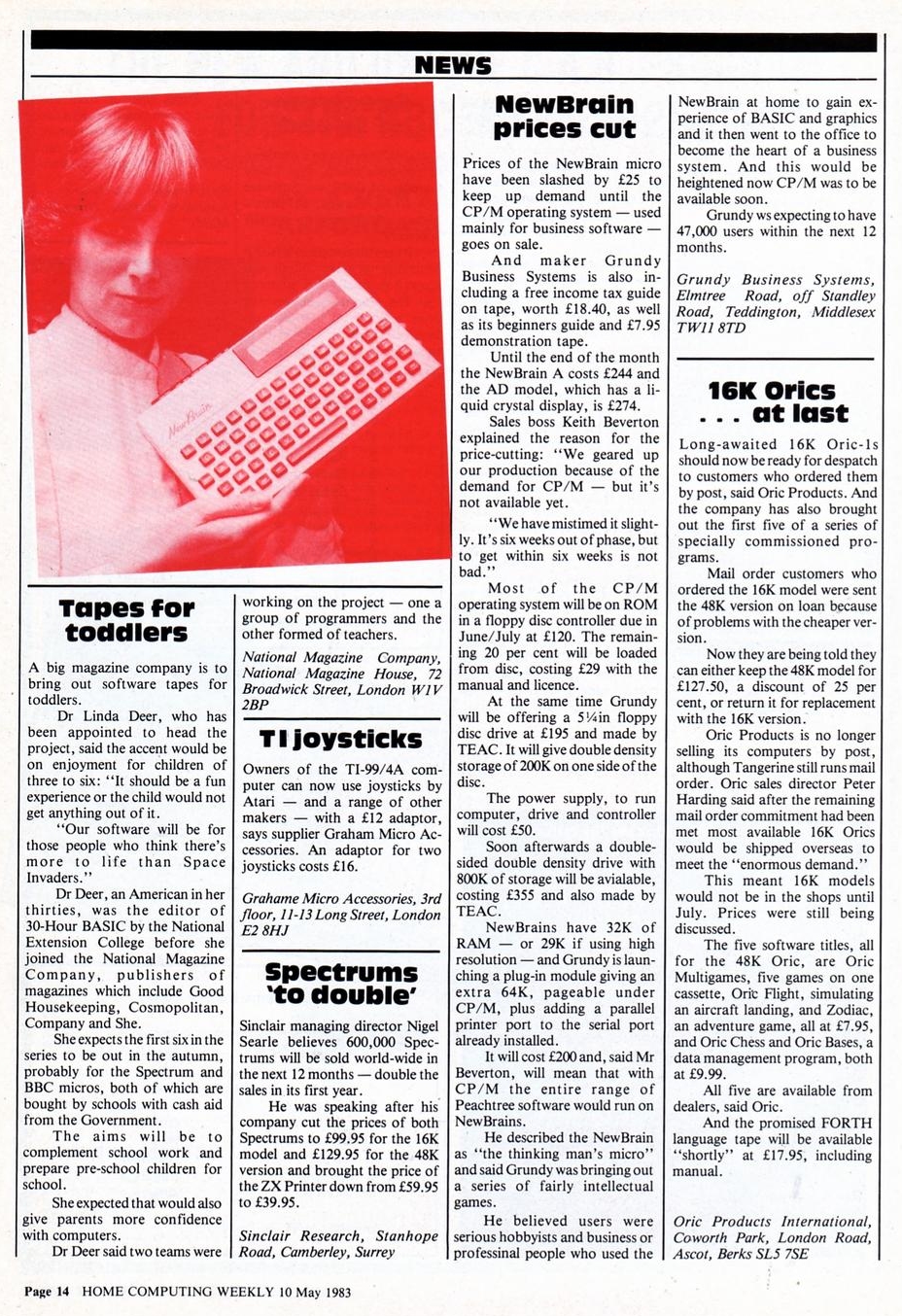
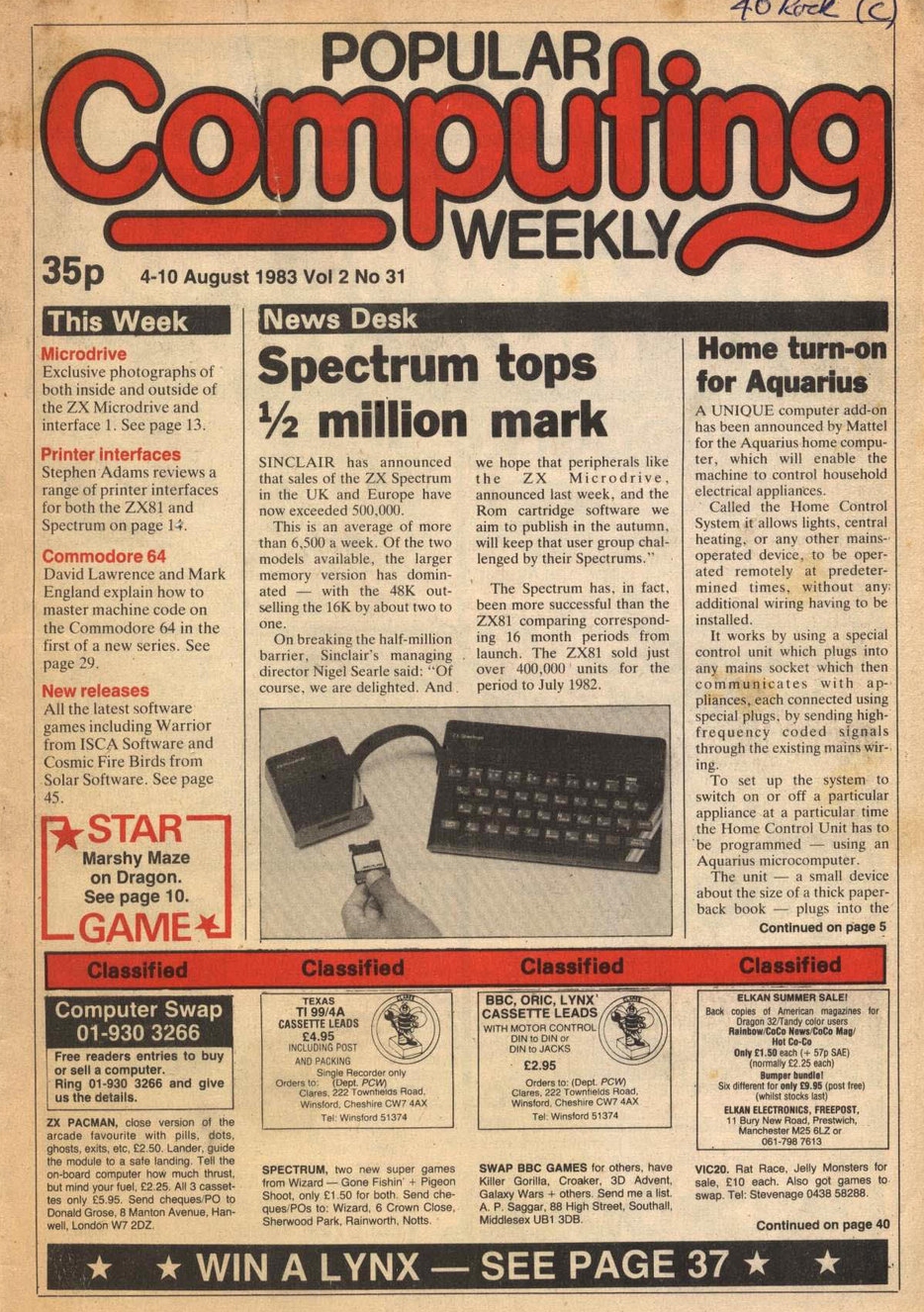
(There are no official figures for how many of the 5 million Spectrums sold were 16Ks, but Home Computing Weekly reported in May 1983 that 300,000 machines in total were sold in the first year, and in August 1983 Popular Computing Weekly reported that the 48K had outsold the 16K by two to one, so we can make a reasonable guess at somewhere between 120,000 and 150,000 units of the 16K in the year and a bit it was on sale, or roughly 3% of all Spectrums.)
But even in its very brief life (the vast bulk of these titles were released in 1983), the 16K machine amassed a library of fun games that left the catalogues of many better-specced computers in the dust. And for no particular reason other than that 40 years have passed since it abruptly met its fate, we’re here to celebrate them.
So sit yourself down with one of the last cans of Lilt (or don’t, because it’s full of poisonous artificial-sweetener chemicals now), get ready to fondly remember a few old favourites, and hopefully also discover some lost gems for the first time.
In the modern world, presentation and packaging is absolutely central to how we experience (and sell) everything. When videogame arcades tried to break that rule, it almost led them to disaster.
If you went to a shop to buy the latest blockbuster videogame, handed over your £50 and were given in return a blank unboxed disc with the name scrawled on it in marker pen, you’d be really unhappy about it – even though the disc would contain the exact same game code and play exactly the way it does when it comes in a pretty case.
It’d be like ordering a cup of tea in a cafe and have them bring you a cup of cold water, a teabag and a kettle – you’ve technically got everything that you need, but it’s not the experience you were hoping for.
And yet, for many years – and to some extent even today – that’s exactly the way we treated arcade games.
Super-veteran readers may recall the story of Scorpion Software, the amateur games development collective I formed with a pal in the early 1980s to create largely rubbish games mostly written in BASIC for the ZX Spectrum and the Dragon 32.
If you read the 2008 retrospective linked in that paragraph, you’ll note that it offers a bit of constructive self-critique on some of the games we produced, and the other day I accidentally stumbled into following my own advice.
My Retropie setup is my favourite physical thing I’ve ever owned. For a total cost of under £200 (the Retropie box itself, plus a monitor and a double arcade joystick), I have instant access to just about the entire history of videogaming up to and including the original Playstation (plus some later stuff too, like the Nintendo DS).
But the physicality of it makes a huge difference. It’s hard to overstate what a complete revelation switching the Pi from a little box under my living-room TV controlled with Playstation joypads to a stand-up machine with proper joysticks was. It changed from something that was nice to have a little play on once in a while to something I use for pleasure every single day.
Phil on Not So Octopus: “My solution is to abolish Holyrood. It is the only way forward for Scotland, whether you are a Unionist or…” Apr 9, 15:18
GM on Not So Octopus: “If he is in the Greens he is a cunt.” Apr 9, 15:05
Northcode on Not So Octopus: “Squid Game and the Scottish Parliamentary elections have at least one thing in common – they are both works of…” Apr 9, 14:57
agentx on The quality of mercy: “Time to cheer – from midnight last night Sturgeon is no longer an MSP.” Apr 9, 14:56
Heather McLean on Not So Octopus: “Heaven help us all! Scotland is well and truly screwed! Just when you think things couldn’t get any worse they…” Apr 9, 14:42
100%Yes on Not So Octopus: “Who ever get elected in may to Holyrood, doesn’t need any IQ test the job doesn’t require you to even…” Apr 9, 14:41
Alf Baird on Not So Octopus: “The obvious solution is to vote for the Alliance to Liberate Scotland Party on the Regional list: https://www.barrheadboy.com/alliance-to-liberate-scotland-the-power-is-in-your-hands/” Apr 9, 14:31
Sven on Not So Octopus: “Duncanio @ 14.04. With a few “Has Beens” and “Never Was” clingons still trousering the copious public funds on offer.” Apr 9, 14:25
Socrates MacSporran on Not So Octopus: “CAMPBELL I have been a keen reader of your excellent site and a firm supporter of you since before the…” Apr 9, 14:22
Geri on The quality of mercy: “If that happened Independence would be a certainty. Scotland shouldn’t be forced into a coalition of fucking dregs & rejects.” Apr 9, 14:21
Liza Laine on Not So Octopus: ““the same old faces” – same old faeces surely? As for the low profile of Claire Williams on social media,…” Apr 9, 14:17
Geri on The quality of mercy: “& what Western propaganda story teller told you they were dictators? Both are democracies. With elections. I think they may…” Apr 9, 14:14
duncanio on Not So Octopus: “A Parliament of the Never-Will-Bes awaits us on 8th May.” Apr 9, 14:04
Geri on The quality of mercy: “It’s all pantomime. He’s just a puppet to distract the plebs until the organ grinders rearm & think of their…” Apr 9, 14:00
Captain Caveman on The quality of mercy: “Reform could conceivably combine forces with the Tories (the only other right wing party) but none of the others -…” Apr 9, 13:27
Cynicus on The quality of mercy: “My thanks, Fearghas, for bringing Robert Carver to our notice. Pace James MacMillan et al. , Robert Carver remains our…” Apr 9, 13:06
Sven on The quality of mercy: “Stevie @ 11.46. If only. Meantime, ” Both votes SNP”, the anthem echoes on from Mr Swiney and others.” Apr 9, 12:39
Stevie on The quality of mercy: “I’m moving slowly to the conclusion that the SNP will be in opposition as Labour, Libs, Greens and Reform band…” Apr 9, 11:46
auld highlander on The quality of mercy: “www.youtube.com/watch?v=x-7faZAW20k” Apr 9, 11:36
Northcode on The quality of mercy: “Trump is the bloated, unpleasant face of US neocolonialism… a face that often adopts expressions not unlike those of Winston…” Apr 9, 11:17
Aidan on The quality of mercy: “Oh so it’s complete deflection and distraction, got you. Anyway I thought you liked dictators?” Apr 9, 10:57
Cynicus on The quality of mercy: “When informed that the notoriously uncommunicative president, Calvin Coolidge had died, Dorothy Parker famously remarked, “How could they tell? Would…” Apr 9, 10:34
Geri on The quality of mercy: “Let me help you… I think the jist of it is that Tory thieving barstewards have taken campaigning donations from…” Apr 9, 10:01
diabloandco on The quality of mercy: “If any of you know how to link the song Scotland the Free , sung by Eden Power to this…” Apr 9, 08:08
Aidan on The quality of mercy: “You addressed the comment to me but I’ve no idea what it’s trying to say sorry.” Apr 9, 06:12
Mark Beggan on The quality of mercy: “If no-one else is going to say it then I will. Thankyou Police Scotland for protecting the Scottish people from…” Apr 9, 00:33
Fearghas MacFhionnlaigh on The quality of mercy: “A lovely poignant 16th Century Scottish song — REMEMBER ME MY DEIR (Amarcord – Harmonia Mundi) https://gobha-uisge.blogspot.com/2021/05/remember-me-my-deir-scottish-16th.html” Apr 8, 21:09
Geri on The quality of mercy: ““Best to await the outcome of their performance before making assumptions.” Best to just have a referendum eh? Y’know, what…” Apr 8, 20:52
Geri on The quality of mercy: “Cave dweller “The usual disingenuous, ill informed drivel from you.” Google AI – dickhead. Why don’t you go get a…” Apr 8, 20:39