…about the full extent of the modern Labour Party’s complete and utter betrayal of the poor and vulnerable and its wholesale capitulation to Tory ideology, read this.
The media (and some of the more gullible elements of the blogosphere) recently got itself into a lather about Douglas Alexander’s latest contribution to the independence debate – excellently rebutted by novellist and playwright Alan Bissett – which presented his vision of a post-referendum Scotland that voted No to independence.
Here’s an alternative picture. But unlike the typical “Better Together” scare story, these are not fabricated fantasies. Many are happening right now, while others are merely under discussion and in preparation.
“…a constitutional convention should consider how to further embed equality and human rights within the constitution and the extent to which the people of Scotland should have constitutional rights in relation to issues such as welfare, pensions, health care and education.”
“…and we need to stop human rights legislation interfering with our ability to fight crime and control immigration. That’s why, as our last manifesto promised, the next Conservative government will scrap the Human Rights Act, and it’s why we should also consider very carefully our relationship with the European Court of Human Rights and the Convention it enforces.”
I can’t decide for you, but I know which one seems more appealing to me.
“Millions of Scots will lose out on an RBS share bonanza worth up to £800 if they choose independence, Business Secretary Vince Cable has warned.
The Treasury is considering giving every taxpayer in the UK shares in RBS as part of a give-away ahead of the next general election. Coalition sources calculate the windfall could be worth £400 to £800 per person.
Coalition Cabinet minister Mr Cable said his Liberal Democrat party backed the payout to ensure taxpayers benefit from 2008’s billion-pound bailout of the Edinburgh institution, although he cautioned the Coalition not to “rush” the process.
Asked if Scots would get a chance to benefit in an independent Scotland, he said: “No. It is at the moment vested in the British Government.”
Even leaving aside the astonishingly crude bribery/blackmail aspect, we’re still a bit confused. Unionists constantly tell us that RBS is “Scottish”, and that therefore an independent Scotland should take on all of its debt. But apparently the people of the rUK will still own the whole bank, so they’ll get all the shares and the profits.
Sometimes, readers, it really does seem like the No camp is devoting most of its anti-independence efforts to putting us out of a job.
A lot of independence supporters are getting excited today about this clip of Labour shadow-cabinet MP Helen Goodman telling the BBC that Labour would keep the bedroom tax. They’re right to highlight it, but most are doing so for the wrong reasons.
Goodman’s position is that Labour WOULD still implement the hated tax, but would only penalise people for over-occupying their housing if they’d been offered smaller accommodation and refused to move. Opponents of Labour are observing the hypocrisy of the party raging against the tax in public while admitting they’d retain it, which is fair enough, but also misses the real point.
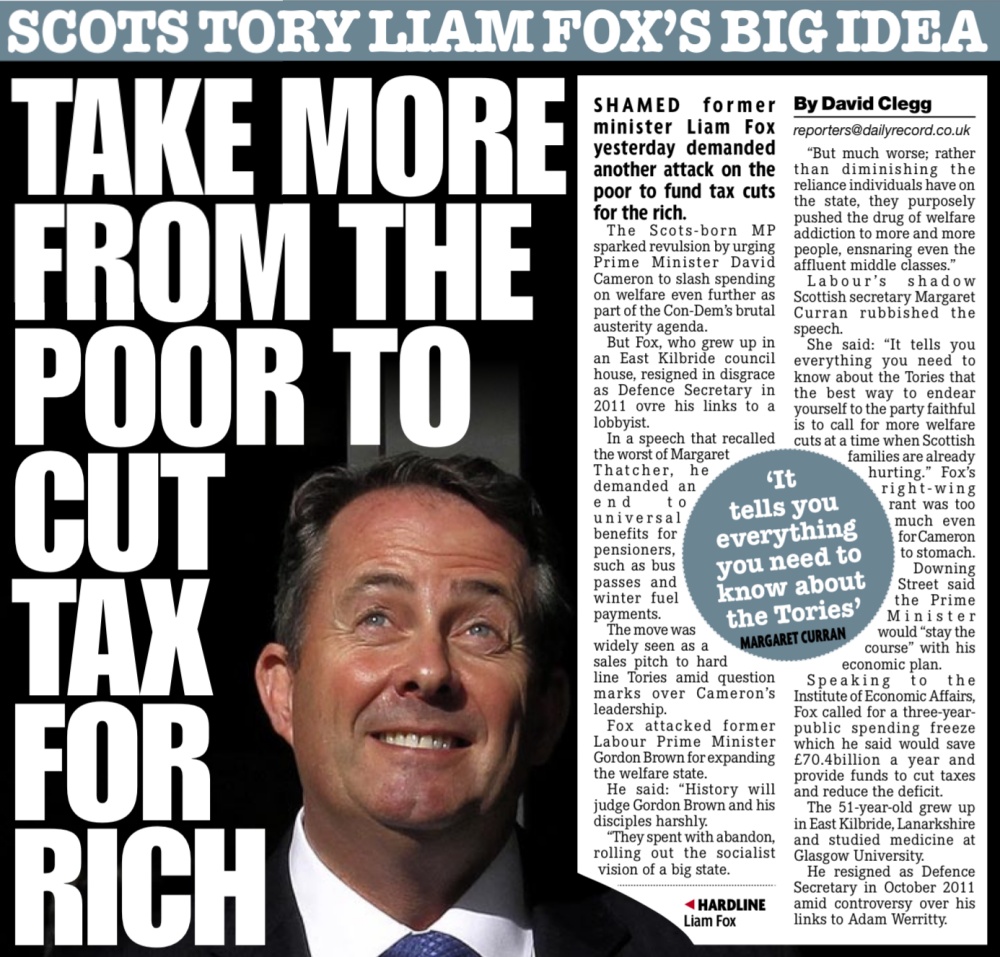
As we’ve mentioned before, it really has been a revelation to discover that the Daily Record’s iPad app – which gives you the entire printed paper, not just the selection of stories that reach the Record website – is free on weekdays. Today, for example, it brought us a large not-online Page 2 piece on former Tory cabinet minister Liam Fox’s idiotic hardline policy suggestions for the party, which were expertly ridiculed by Conservative commentator Alex Massie yesterday.
Thanks to Mr Massie’s splendid work, there’s no need for us to bother with Fox’s comments. What we noticed instead was the Record’s analysis of them.
Power Of Scotland is a newspaper about the power industry, given away as a business supplement with The Times. An alert contributor pointed us to an intriguing article in the latest edition from regular Scotsman columnist Peter Jones, offering a more nuanced account of the industry’s view of independence than you might expect.
If you’re pressed for time we’ve pulled out a couple of the more interesting passages.
Poe’s Law, which we only discovered on Wikipedia this morning, says that “without a clear indication of the author’s intent, it is difficult or impossible to tell the difference between sincere extremism and an exaggerated parody of extremism”. Or in other words, there’s a name for when people are so batshit crazy you can’t satirise them, because you simply couldn’t invent anything madder than what they say for real.
Last week (Feb 28th, to be precise) marked the anniversary of the founding of arguably the most successful mass anti-nuclear protest movement the world has ever seen. We’re talking, of course, of the Nevada-Semipalatinsk Anti-Nuclear Movement, which was active between 1989 and 1991.
If – for some unaccountable reason – you haven’t heard of it, then read on, for it’s a tale of how the ordinary people of a provincial part of the former Soviet Union found that a mass protest movement, well-organised and with right on its side, forced an intransigent, distant government to concede its demands. Are there lessons for the people of Scotland in their story? Let’s find out.
We’ve just noticed a report published by Scottish CND on the 26th of February, detailing the likely results of the UK actually using the submarine-based Trident nuclear weapons system in the event of some sort of unimaginable global conflict.
While we share SCND’s revulsion at the very notion of such weapons of mass destruction, the report makes a compelling anti-Trident argument that we’re absolutely certain wasn’t the one it meant to, and which SCND will doubtless find highly distasteful. We have no such compunction, though.
James on Irony you can’t buy: “It is not a derogatory racist term as ‘scot free’ has zero to do with Scots or Scotland, see posts…” Mar 22, 16:09
sam on Irony you can’t buy: “Yes, Andy. The majority of people in Ireland (south of border), around 66% favour reunification. Their wishes are likely to…” Mar 22, 14:48
James Barr Gardner on Irony you can’t buy: ““Scotland is entirely FREE to leave only if its granted by the PM @ Westminster”. That being the case London…” Mar 22, 14:40
Geri on Irony you can’t buy: “What we need is a revolution & a spot of regime change. Forget Ayatollahs – we’ve got the fckn parasitic…” Mar 22, 14:24
Confused on Irony you can’t buy: “why? https://www.telegraph.co.uk/news/2026/03/21/drilling-north-sea-answer-energy-crisis/ – surely the city, being the engine of wealth creation, can solve all problems via the free market…” Mar 22, 13:05
Sven on Irony you can’t buy: “Mark Beggan @ 09.49. Twinkle, Twinkle, little star. I don’t wonder what you are. I surmised your spot in space…” Mar 22, 12:14
Northcode on Irony you can’t buy: “Could Sturgeon be a plagiarist? The quote “If everything is a scandal, nothing is.” is attributed to Mary Anne MacLeod…” Mar 22, 12:04
Andy Ellis on Irony you can’t buy: “even if NI wanted a border poll it down to the PM granting it even though its state they can…” Mar 22, 11:57
Northcode on Irony you can’t buy: “Professor Aileen Mcharg is English and a unionist (colonist if preferred… same thing)… so not much point in listening to…” Mar 22, 11:38
100%Yes on Irony you can’t buy: “George Galloway, maybe the only person to show the Labour supporters who want Independence that voting for the SNP is…” Mar 22, 11:34
100%Yes on Irony you can’t buy: “Aidan, I couldn’t post to you above as there was no reply option. Reading between the lines the SNP leadership/SG…” Mar 22, 11:20
Mark Beggan on Irony you can’t buy: “And when the Lefty’s were thrown down into hell. They cried! ” Lord forgive us we didny Ken” And the…” Mar 22, 10:56
agentx on Irony you can’t buy: ““William George Walker (SNP politician) A case was brought against Walker and was heard at Edinburgh Sheriff Court on nine…” Mar 22, 10:56
Northcode on Irony you can’t buy: ““So Scotland Independence hopes within the UK system is dead…” Such hopes were never alive, such hopes were never real,…” Mar 22, 10:48
Geri on Irony you can’t buy: “That is wrong. Scotland is a sovereign nation & there were preconditions before the Act of Union ever took place.…” Mar 22, 10:35
agentx on Irony you can’t buy: “Scottish Oath Taken: King Charles III took the statutory oath to uphold the Presbyterian Church of Scotland at the inaugural…” Mar 22, 10:29
Geri on Irony you can’t buy: “Instead of watching baby Trump maybe you should educate yourself. Iraq had emptied its war chest being a proxy for…” Mar 22, 10:24
Northcode on Irony you can’t buy: “An alien spacecraft from another world did not crash land in America’s Area 51. The Illuminati is not a sinister…” Mar 22, 10:08
Mark Beggan on Irony you can’t buy: “Blue blue windows behind the stars. Yellow moon on the rise. Big Missiles flying across the sky. Throwing shadows on…” Mar 22, 09:49
Aidan on Irony you can’t buy: “You’re right 100% Yes – the only route to Scottish independence within the UK’s legal system is for an act…” Mar 22, 09:36
Cynicus on Irony you can’t buy: “sam says: 22 March, 2026 at 7:46 am “Ye cannae spell. Loser” ========== How do you know that?” Mar 22, 08:43
100%Yes on Irony you can’t buy: “What surprised me was the audience actually clapping Professor Aileen Mcharg, when she was stating clearly that Scotland had no…” Mar 22, 08:40
twathater on Irony you can’t buy: “Geri, Joanna is another one who sat on her arse and said fuck all about what was going on under…” Mar 22, 03:30
twathater on Irony you can’t buy: ““Thatcher was a necessary evil, presumably you didnt live in pre-Thatcher times” There speaks a good old tory with his…” Mar 22, 03:18
Mark Beggan on Irony you can’t buy: “That comment. Or was it a rant. No one knows. I never read it but it proves that AI is…” Mar 21, 23:16
robertkknight on Irony you can’t buy: “Truth is to Sturgeon what intelligence is to Trump.” Mar 21, 22:55
William G Walker on Irony you can’t buy: “Does Nicola Sturgeon Tell “Frankly” Fibs About Three Political “Casualties”? I have now read Nicola Sturgeon’s Memoir, “Frankly”, and am…” Mar 21, 22:45
willie on Irony you can’t buy: “Bad management got bad unions. Two cheeks of the same arse. A bit like saying free enterprise good, state ownership…” Mar 21, 21:56