For weeks now, if not months, the independence community has been bombarded with claims from Unionists that it’s not independence if you have a shared currency, cooperate on defence, keep the monarchy, share embassies or empower others to act on your behalf. There’s been a continuing drone to the effect that if you don’t do everything personally then you’re not independent.

This view, as any student of English will tell you, is flawed – doing everything for yourself is not independence, but rather self-reliance.
Self-reliance – Not requiring help or support from others while acting autonomously. Self-reliance is relative freedom from needing to rely on others for help with instrumental or task-oriented activities and is distinguished from independence as the latter is a pre-requisite to self-reliance and not predicated on its existence.
In other words, you need independence to act autonomously and to choose to be self-reliant, if you so wish. Yet it would seem, having watched various Unionist politicians and commentators struggle with the concept of independence, that it is necessary to provide a definition that can be easily understood. So I’ll have a go.
Read the rest of this entry →
Tags: essaysScott Minto
Category
comment, scottish politics
Can you spot what’s strange about this statement, viewers?
“We believe that the process of setting a single question should be taken out of the hands of elected politicians and given to relevant experts the public can have faith in.”
It comes from the mouth of Scottish Labour “leader” Johann Lamont, and forms part of her latest demand – along with her two partners in the Unionist coalition – that the Scottish Government should allow the defeated opposition parties to dictate the terms and conditions of the implementation of the flagship policy behind which it was so resoundingly and unprecedentedly elected a little over a year ago.
(Note in particular the sneaky way the overt demand also slips in a covert demand.)
We’re pretty sure that a general election is already, pretty much by definition, the primary means by which the public expresses who it does and doesn’t “have faith in”. We have, on the other hand, absolutely no way of knowing how much faith that same public does or doesn’t have in the ironically-unelected Electoral Commission, which is appointed by – who’d have guessed it? – the UK Parliament. And just by the by, below are a couple of other relevant snippets from the Commission’s Wikipedia entry:
“The Electoral Commission has a number of responsibilities in relation to referendums. These include:
- commenting on the wording of the referendum question (the government is responsible for proposing the wording)
The Commission has no legal position in the legislation concerning referendums proposed by the devolved Scottish and Welsh administrations.”
Our emphasis, there. So, and we admit this is just a crazy madcap idea we’re putting out there, maybe the business of government should properly be conducted by the people the electorate have democratically chosen to do the job, no?
Tags: Federalists Unionists and Devolutionists
Category
comment, scottish politics, uk politics
And so the phoney war rumbles on and gathers pace. The ‘No’ campaign – or whatever it decides to refer to itself as – will be unveiled shortly and we’ve heard (with a certain sense of deja vu) that the SNP has been debating the relative merits of the words “independenT” and “independenCE”. We have independence and Unionist groups galore appearing on Facebook and the web, we’ve got Cybernats and Britnats, republicans and monarchists, hawks and pacifists and goodness knows what else.

In the meantime, I still have the bills to pay, the washing to dry in the incessant rain, the mundane monotony of the “what’s for dinner?” conversations. Today a friend’s daughter is having a baby, while another lady I know has lost her best friend. The neverending cycle of joy and tears, grief and laughter rolls on.
Politicians would do well to stop and think about this – that away from Parliaments ordinary people are still living their everyday lives, and when we occasionally get to lift our noses from the grindstone we might appreciate a little passion from our politicians, a little honesty, some better research, and an end to the sniping and spin that threatens to suffocate the independence debate.
Read the rest of this entry →
Tags: Sue Lyons
Category
comment, scottish politics
The current issue of Private Eye (which also features a fascinating full-page piece on Craig Whyte) relates news of another Labour dividend for the people of Glasgow – the decades-long neglect and imminent destruction of a much-loved green space. We’ve attached the story below for your convenience.

On the upside, though, we’re pretty sure we know where another large green space, which already comes with goalposts, is about to become available.
Category
comment, football, media, scottish politics
To be honest, on the evidence we’ve seen on the rare occasions when Labour lets its Scottish “leader” speak to the public, we’ve been left with the impression that it doesn’t take all that much to confuse her. At the weekly joust of First Minister’s Questions, Johann Lamont is frequently exposed as unable to adapt her script to Alex Salmond’s replies, often leaving her haplessly repeating the question that’s just been answered.
Even in that context, though, the quote attributed to her in today’s Daily Record in regard of the latest referendum poll is a dismaying one for anyone concerned about the standard of Scottish political debate. With the stage set by an earlier quote from a “source” in the No campaign flatly asserting that the reason for the drop in support for independence was “There is just too much uncertainty – over jobs, defence, even the currency – everything, basically”, Lamont gallumphed in with her 2p’s-worth:
“This shows that the more people hear the arguments, the more they see through the absurdities of Alex Salmond’s case for separation”
Hang on. Is it because people ARE hearing the arguments and being convinced against independence by them, or is it because there’s “too much uncertainty” and people just don’t know where they stand, so they’re erring on the side of caution? We’re reasonably sure it can’t be both, and look forward to “Better Together” getting its story straight. We have a sinking feeling that might not be any time soon, though.
Category
comment, idiots, scottish politics
An Ipsos-MORI poll in this morning’s Times has shown a small decrease in support for independence, with figures among those certain to vote running at 35% Yes (down 4%) to 55% No (up 5%). The poll was the first full-sample one conducted in several months, and asked respondents the Scottish Government’s favoured question, so it’s a sound enough survey, and the headline figures clearly aren’t great for nationalists.
What’s odd, though, is that most commentators seem to be treating it as evidence of a fundamental shift in the direction of opinion. The reality is that at this moment in time, these numbers are something close to miraculously good for the Yes camp.
Read the rest of this entry →
Category
analysis, apocalypse, comment, scottish politics
We think our brains may have been completely fused by a story in today’s Daily Record, which is based around comments by Rutherglen Labour MSP James Kelly, pictured below in a scene from the particularly bad acid headache he’s just given us.

Here’s the bit that’s been making our minds spin round and round and round in circles this morning until we’re dizzy trying to make sense of it:
“ALEX Salmond was accused of “double standards” yesterday over his efforts to woo Rupert Murdoch. Labour raised further questions about the First Minister’s links with Murdoch following claims the media mogul lobbied Tony Blair to wage war in Iraq.
Former spin doctor Alastair Campbell said in the latest volume of his memoirs that Blair “took a call from Murdoch who was pressing on timings, saying how News International would support us, etc”.
Salmond won plaudits across Scotland for his outspoken opposition to the war which he described as “the most disastrous foreign policy decision of recent times”. But it did not stop him from trying to get closer to Murdoch to win The Sun newspaper’s backing for the SNP.
Labour MSP and chief whip James Kelly said: “This could make the conversation a little uncomfortable the next time Alex Salmond has Rupert Murdoch round to Bute House for tea and biscuits. Alex Salmond was against the Iraq war but that didn’t stop him cosying up to Rupert Murdoch. This is classic double standards from Alex Salmond who is prepared to put his party’s interests ahead of any issue.””
Let’s try to talk our way through this slowly: LABOUR is attacking the SNP for not being sufficiently critical of RUPERT MURDOCH when he backed LABOUR Prime Minister TONY BLAIR over going to war in IRAQ in 2003? What, seriously?
That can’t really be it, can it? Labour, who instigated the illegal war that left hundreds of thousands dead, attacking an opposition party who voted against that war (and which actually tried to impeach Blair for it) for not being critical enough of a newspaper proprietor whose papers enthusiastically backed Labour at the time and who made Tony Blair godfather to one of his children, because when subsequently in government it had a couple of meetings with that newspaper proprietor (also one of Scotland’s largest private-sector employers) the best part of a decade later?
Are we dreaming this stuff? Please tell us we’re dreaming it.
Tags: confusedhypocrisy
Category
analysis, comment, idiots, media, scottish politics, snp accused, stupidity
When you’re a journalist, it’s not uncommon to see your work hacked to bits in the time between being emailed to the commissioning editor and appearing in print. We long ago lost count of the number of times we’ve had vital explanatory passages chopped out leaving subsequent sections orphaned and incomprehensible, or the number of abominable, remedial-level grammatical errors and typos we’ve had inserted into our immaculately-proofed copy by a hapless young sub-editor from the generation when schools gave up teaching kids how to spell.
One of the most annoying things, though, is seeing your stuff go out with a headline that bears no relation to what the piece was supposed to be saying. It happens to the great and the good as much as to cub reporters and journeyman hacks – star Guardian columnist Charlie Brooker and the Independent’s high-profile political/feminist writer Laurie Penny have both suffered in recent weeks – and it drives writers crazy.
So we were only mildly startled to be browsing this morning’s Scotsman and see this:

The article itself features the words “independent” or “independence” six times, and mentions the concept of “separation” only once, in the sentence “This isn’t exactly the separatist fanaticism painted by some opponents”. That sentence is fairly obviously a critical reference to the Unionist camp’s dogged use of the word “separation” as a pejorative, intended to imply isolation, parochialism and xenophobia.
Hassan’s piece isn’t a partisan call to arms for either side, nor even one about the language of the referendum debate, but a calm, considered plea for a much wider, non-political, mature discussion of the sort of Scotland we want to see in the future (ie the same article Gerry’s been writing over and over again for the last year or more).
We can’t say with absolute 100% certainty that the article’s headline – which takes a sledgehammer and pneumatic drill to that happy notion and smashes it to a pile of ironic rubble – is indeed the work of the Scotsman (we’ve asked Gerry and await reply) but at this point we’d be happy to have a tenner on it.
Read the rest of this entry →
Category
comment, media
Much as Scots have grown accustomed to trying to pretend otherwise, you’ll probably have noticed that there’s currently another international football tournament going on without us. This evening sees the first appearance in the European Championship of the England team, the only side competing in the entire competition who don’t have a national anthem to call their own.

Two decades of living in England hasn’t changed this blog’s feelings towards the country’s international team much. Generally speaking we still want them to lose – not because we hate the English people, but precisely because we like them (see below). In the case of Euro 2012, though, we’re going to make an exception.
Read the rest of this entry →
Category
comment, football, scottish politics
Thursday night’s Question Time from Inverness saw Johann Lamont once again trot out the line that the independence referendum doesn’t offer Scotland its only realistic chance of escaping Tory government for the forseeable future. Once again, the Labour quasi-leader insisted (56m 50s) that the choice between independence and the Tories was a false one, and that her party provided a genuine ideological alternative to the right-wing neoliberal philosophy which has dominated UK politics since 1979.

Unfortunately, that’s a lie. And the really troubling thing about it is that it means NOBODY is speaking for the majority of the British population, which almost certainly means that no mainstream political party is interested in representing your views. Which, you might think, is a pretty odd way to be running a supposed democracy.
Read the rest of this entry →
Tags: essaysflat-out lieslizards
Category
analysis, comment, scottish politics, uk politics
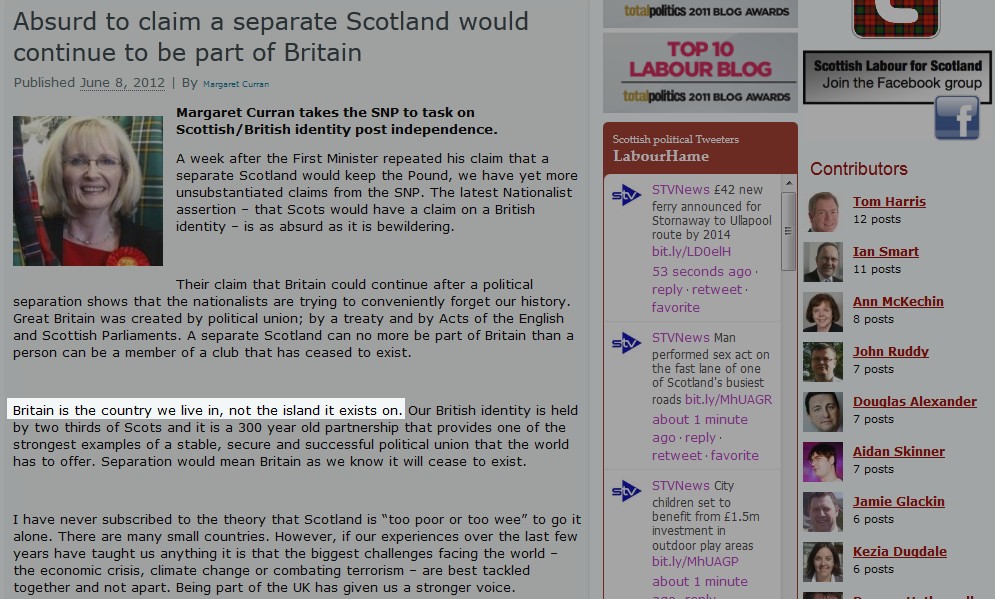
A surprise development today, as the moribund and long-neglected LabourHame website sprang suddenly back to life with its fourth post in as many months. And what a stirring comeback it was, as the party’s Shadow Secretary Of State for Scotland Margaret Curran launched into a vitriolic diatribe awkwardly entitled “Absurd to claim a separate Scotland would continue to be part of Britain“.
(There was plenty of room left in the headline to turn the car-crash grammar into English, for example by prefixing it with the words “Why it’s”.)
The centrepiece of the article’s argument was Curran’s unequivocal assertion that “Britain is the country we live in, not the island it exists on”, which is a claim only slightly spoiled by being completely factually wrong in every respect. Rather than waste all afternoon explaining why, we’ll just quote the Wikipedia entry and let you get on with your day. If you’re really pressed for time, you can stop after the first sentence.
“Great Britain or Britain (Welsh: Prydain Fawr, Scottish Gaelic: Breatainn Mhòr, Cornish: Breten Veur) is an island situated to the northwest of Continental Europe. It is the ninth largest island in the world, the largest European island, and the largest of the British Isles. With a population of about 60.0 million people in mid-2009, it is the third most populous island in the world, after Java and Honshu. Great Britain is surrounded by over 1,000 smaller islands and islets. The island of Ireland lies to its west. Politically, Great Britain may also refer to the island itself together with a number of surrounding islands which comprise the territory of England, Scotland and Wales.
All of the island is territory of the sovereign state of the United Kingdom of Great Britain and Northern Ireland, and most of the United Kingdom’s territory is in Great Britain. Most of England, Scotland, and Wales are on the island of Great Britain, as are their respective capital cities: London, Edinburgh, and Cardiff.
The Kingdom of Great Britain resulted from the political union of the kingdoms of England and Scotland with the Acts of Union 1707 on 1 May 1707 under Queen Anne.”
You’d hope someone aiming to be the Secretary of State for a part of somewhere would at least have a grasp of the most rudimentary geopolitical facts about it, but nobody ever went broke underestimating the intelligence of Scottish Labour.
Category
analysis, comment, idiots, uk politics