The way I feel today 57
Posted on
March 21, 2013 by
Rev. Stuart Campbell
Well, what a curious day this is shaping up as. As we scoured our Twitter feed in vain after the bewildering media blackout on the workfare vote, we also discovered that “Better Together” has been running around half the internet trying to censor a satirical video. To cut a long story short, you can download a copy of the video by right-clicking on the image below and choosing “Save As…” or “Save Link As…”.
(NB: Don’t left-click, as it will attempt to stream it and fail.)
We invite the No campaign to see if they can have it pulled from this site.

But that wasn’t the end. As people started to read our story on the workfare motion, we began to get tweets and comments questioning the quote we’d used, as it didn’t seem to appear anywhere in the article on the website. Confused, we went and had a look, and sure enough the original version had vanished, replaced by something much shorter and far more innocuous.
Luckily this isn’t our first time with internet censorship. At the time of writing there’s still a cached version of the original, and when that disappears you can read it here.
We’re not quite sure what’s happening today, but we don’t like it.
This article* puts our feelings about the actions of the three London parties in the House Of Commons today better (or at the very least, more concisely and with considerably more restraint) than we could ourselves.
The SNP, Plaid Cymru, the sole Green and about 40 of 258 Labour MPs opposed the motion, which was only able to be rushed through because of Labour’s co-operation with the government. Everyone else either voted for it or abstained. The rule of law means nothing any more, and neither does democracy. Better together, right?
*The link now points to a saved version. The original has been mysteriously replaced.
Over time, and particularly since the turn of 2013, this site’s attitude to the Unionist media in Scotland (which is to say, ALL of the media in Scotland) has undergone something of a shift. Previously we held its partisan spin and naked dishonesty in professional contempt, but more recently it’s become increasingly hard not to simply feel sorry for the poor beleaguered hacks on dying publications as they wrestle uncomprehendingly with their bleak future.

To exercise something as poisonous and destructive as hatred or even anger over today’s lead in Scotland on Sunday by Tom Peterkin (cache link), for example, would be about as productive as entering into a debate on a Saturday night with a drunk who was urinating into a skip and simultaneously ranting about immigrants round the back of a Lidl car park. All we can really do is sigh, call social services and walk sadly on.
We haven’t studied the McCluskey report in detail, and we’re awfully tempted – after 16 months of scrutinising the many abysmal failings of Scotland’s media – to cynically assume that if it’s got them so uniformly up in arms it must be a good thing. But we’ll try to resist the kneejerk reaction.
For now we’ll merely pass comment on a very odd piece against the proposals by Iain Macwhirter in the Herald, ostensibly listing reasons “Why Scotland should be afraid”.
“George Galloway called Tony Blair a murderer – but he won’t be able to say that in print or online. Some of the descriptions of Brian Souter, during the ‘Keep the Clause’ campaign against the promotion of homosexuality in schools, would be actionable, as would many of the remarks made by his supporters. Feminists who say silly things like ‘all men are rapists’ could be in the dock , as would loud-mouths like Ray Winstone who said he was ‘raped by taxes’.”
Um, and these are supposed to be BAD things, are they? If those are really the potential consequences of the report’s implementation, if such counter-productive and divisive and idiotic debasement of intelligent discourse would suddenly become a punishable act, then sign us up right now. Because given that we currently live in a country where this can happen, we’re not sure we’ve got anything to lose.
A couple of paragraphs in a Vince Cable story (to over-dignify the piece in question) from today’s Scotsman are quite amusing if you swap the order they come in.
“The first day I took up my job as the chief economist at Shell I was given a plaque which had an Arabic saying and when I pressed for a translation, they said ‘All those who claim to predict the future are lying, even if they are later proved right’.”
Righto.
“Business Secretary Vince Cable last night warned that an independent Scotland’s reliance on revenue from oil would result in savage public spending cuts or tax rises, as he addressed the Liberal Democrat Scottish conference.”
Oops!
The media (and some of the more gullible elements of the blogosphere) recently got itself into a lather about Douglas Alexander’s latest contribution to the independence debate – excellently rebutted by novellist and playwright Alan Bissett – which presented his vision of a post-referendum Scotland that voted No to independence.

Here’s an alternative picture. But unlike the typical “Better Together” scare story, these are not fabricated fantasies. Many are happening right now, while others are merely under discussion and in preparation.
This is what you’re voting for if you vote No.
A little compare-and-contrast to contemplate.
This is from the Scottish Government document about setting up a new constitution in an inclusive process after a Yes vote in a referendum:
“…a constitutional convention should consider how to further embed equality and human rights within the constitution and the extent to which the people of Scotland should have constitutional rights in relation to issues such as welfare, pensions, health care and education.”
This is from a recent speech by Theresa May:
“…and we need to stop human rights legislation interfering with our ability to fight crime and control immigration. That’s why, as our last manifesto promised, the next Conservative government will scrap the Human Rights Act, and it’s why we should also consider very carefully our relationship with the European Court of Human Rights and the Convention it enforces.”
I can’t decide for you, but I know which one seems more appealing to me.
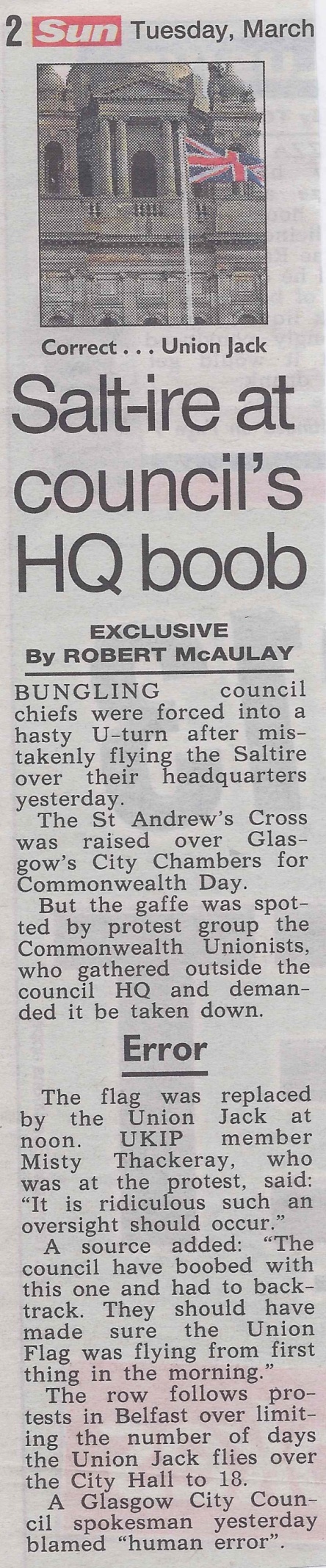
Alert contributor Scott Minto came across a weird little story in The Sun this week. We had a look into it and found the “Loyalist” nutcases responsible, whose Facebook page helpfully also provided us with a much more beautiful and uplifting sight.

Flying proudly over Glasgow City Chambers, just as it should. Not long now.
For the seasoned political analyst (and also for idiots like us), it can be hard to offer a rational explanation for why any thinking human being would ever believe a word the Labour Party says about anything any more.

It came to power 16 years ago promising to introduce electoral reform, then ditched it. (But still hilariously claims to be committed to the principle despite 100 years of failing to deliver it.) It also pledged not to introduce university tuition fees, then introduced them. It campaigned for re-election on a promise not to increase them, then increased them. It – well, we could go on all day, just about tuition fees alone.
But let’s cut to the chase and move up to the present day.
Vince Cable in today’s Herald:
“Millions of Scots will lose out on an RBS share bonanza worth up to £800 if they choose independence, Business Secretary Vince Cable has warned.
The Treasury is considering giving every taxpayer in the UK shares in RBS as part of a give-away ahead of the next general election. Coalition sources calculate the windfall could be worth £400 to £800 per person.
Coalition Cabinet minister Mr Cable said his Liberal Democrat party backed the payout to ensure taxpayers benefit from 2008’s billion-pound bailout of the Edinburgh institution, although he cautioned the Coalition not to “rush” the process.
Asked if Scots would get a chance to benefit in an independent Scotland, he said: “No. It is at the moment vested in the British Government.”
Even leaving aside the astonishingly crude bribery/blackmail aspect, we’re still a bit confused. Unionists constantly tell us that RBS is “Scottish”, and that therefore an independent Scotland should take on all of its debt. But apparently the people of the rUK will still own the whole bank, so they’ll get all the shares and the profits.
Sometimes, readers, it really does seem like the No camp is devoting most of its anti-independence efforts to putting us out of a job.
Wings Over Scotland is a thing that exists.